Appliances · Buying Guide

Best Bake Sourdough Bread Temperature Controls for Perfect Loaves

Mastering the environment for your homemade loaves is essential for predictable fermentation and reliable crumb structure. When ambient kitchen conditions fluctuate, maintaining exact warmth helps yeast and beneficial bacteria thrive during long fermentation cycles. Without a controlled environment, dough can rise too slowly or stall entirely, frustrating home bakers aiming for bakery-quality results.

Specialized equipment designed to regulate warmth removes the guesswork from your kitchen routine. Whether you need a compact mat for your starter jar or a spacious collapsible box for multiple loaves, precise thermal regulation ensures consistent outcomes. Explore these options to find the ideal thermal setup for your baking style and kitchen space.

As an Amazon Associate, StacyLaughs earns from qualifying purchases.

Yacumx Foldable Bread Proofing Box, 28 Liters
#1 Best Overall

Yacumx Foldable Bread Proofing Box, 28 Liters

This foldable bread proofing box provides a 28-liter capacity with precise PID temperature control ranging from 70°F to 122°F. It features an adjustable 1 to 24-hour smart timer, a food-grade waterproof interior, and an extra-long power cord. The unit collapses down to 45mm thick for compact storage and includes a stainless steel bowl for maintaining humidity during long fermentation cycles.

Best for Full-size batch bread proofing

Precision PID temperature controlAdjustable 1-24 hour timerFoldable 45mm thick designIncludes stainless steel bowlOverheat protection safety design
View on Amazon →

What stands out

  • Adjustable temperatures from 70°F to 122°F with PID precision up to plus or minus one degree.
  • Folds down to a slim 45mm thickness for efficient storage in kitchens with limited space.
  • Includes a 1 to 24-hour smart timer and an extra-long power cord for flexible placement.

What to consider

  • The 28-liter capacity and larger footprint require dedicated counter or table space during active baking sessions compared to compact jar warmers.
  • Maintenance requires wiping clean with a damp cloth after cooling rather than immersing components or rinsing under water.
Key specifications
Capacity
28 liters
Wattage
235 watts
Item Dimensions D x W x H
12"D x 15.7"W x 12"H
Material
Polyethylene Terephthalate (PET)
Product Care Instructions
Wipe clean with a damp cloth after cooling; do not rinse or use alcohol or bleach.
Voltage
120 volts

The practical verdict

This foldable proofing box is best for bakers who handle regular full-size dough batches and need a dedicated, temperature-controlled environment with ample capacity. Avoid it if you only require a small footprint for a single starter jar on a crowded counter. The primary trade-off is its larger operating footprint balanced against its collapsible storage design and precise PID thermal control.

#2
Pakusane SourKeeper Sourdough Starter Warmer with Probe
Starter Core Probe Warmer

Pakusane SourKeeper Sourdough Starter Warmer with Probe

Best for Direct sourdough starter monitoring

Designed specifically for starter maintenance, this warming base features degree-by-degree temperature settings from 70°F to 110°F. It incorporates a stainless-steel dough probe that measures core temperature directly inside the jar, along with an auto-warming switch and a 24-hour timer. The walnut finish adds a decorative touch to kitchen counters while accommodating various glass container shapes and sizes.

What stands out

  • Measures core temperature directly inside the dough using an integrated stainless-steel probe.
  • Offers degree-by-degree temperature settings from 70°F to 110°F with a built-in sensor display.
  • Features a sleek walnut finish and compatibility with various mason jars and glass containers.

What to consider

  • The 70 to 110°F temperature range focuses specifically on starter jars and smaller vessels rather than full-sized bulk dough batches.
  • The physical probe requires careful placement and cleaning inside your starter container between uses.
Key specifications
Item Dimensions L x W x H
6.5"L x 6.5"W x 0.98"H
Maximum Temperature
110 °F
Upper Temperature Rating
110 °F
Lower Temperature Rating
70 °F
Color
Walnut
Material Type
Plastic

The practical verdict

This device is best for bakers who want to eliminate starter guesswork by monitoring core jar temperatures directly. Avoid it if you need to proof entire loaves or large pizza dough batches simultaneously. The main trade-off is its specialized focus on individual jars rather than bulk fermentation capacity, paired with precise internal temperature tracking.

#3
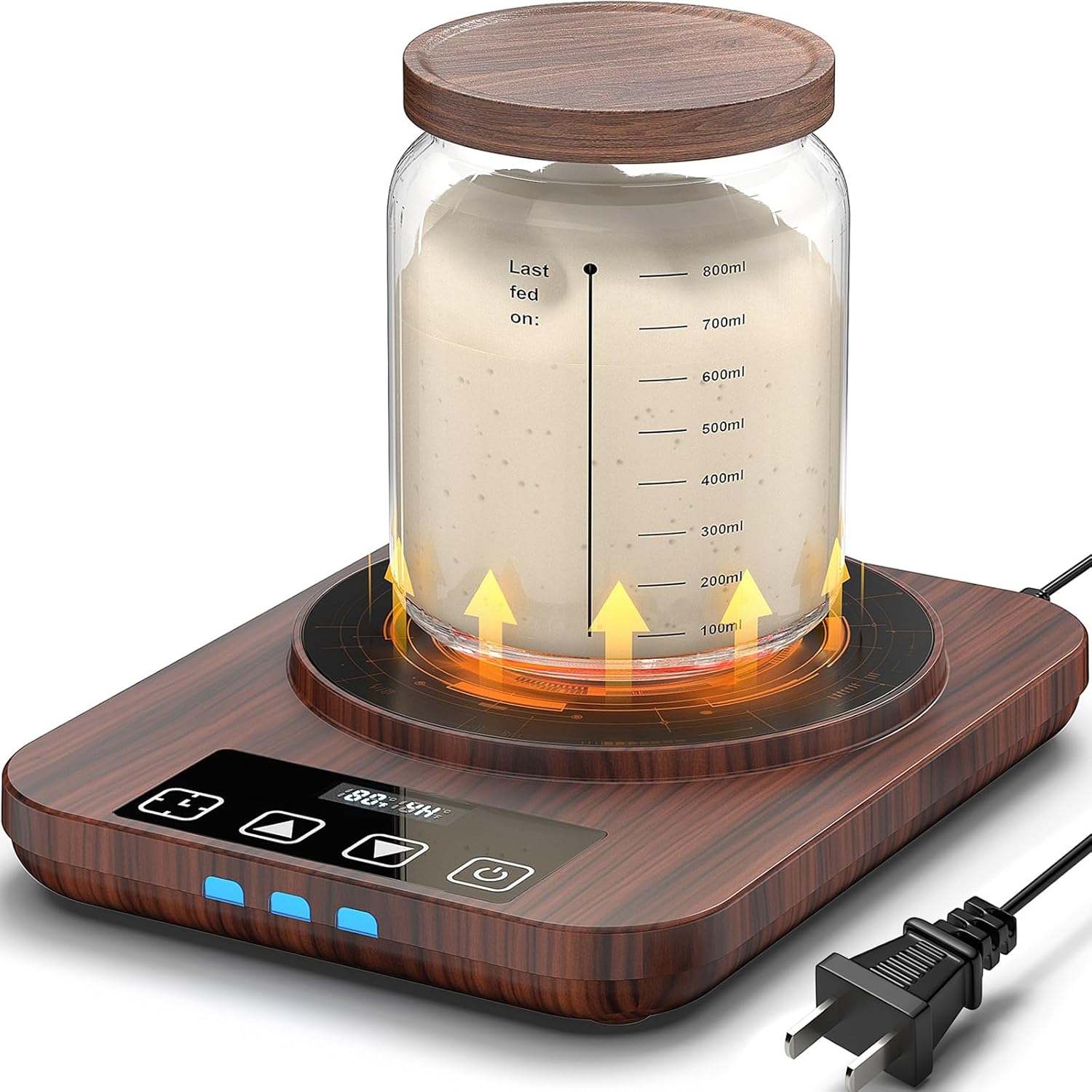
MENGBEI Sourdough Starter Warmer Mat, 40 Fluid Ounces
Compact Starter Mat

MENGBEI Sourdough Starter Warmer Mat, 40 Fluid Ounces

Best for Targeted jar heating pad

This compact warming mat features 1-degree precision from 70°F to 110°F and a 24-hour smart timer with auto shut-off. Utilizing graphene and aluminum heating film, it achieves rapid directional heating in ten seconds while consuming only 12 watts of power. A built-in memory function saves your last settings, and the slim US-plug design accommodates 24oz to 40oz fermentation jars.

What stands out

  • Provides fine-tuned temperature control from 70°F to 110°F with a memory function for saved settings.
  • Utilizes graphene and aluminum film for rapid, uniform heating in just ten seconds.
  • Consumes only 12 watts of power while accommodating fermentation jars from 24oz to 40oz.

What to consider

  • The heating zone is sized for individual jars between 24oz and 40oz, making it unsuitable for large bread baskets or sheet pans.
  • Requires an external towel or cover for enhanced heat retention around taller jars in cold rooms.
Key specifications
Capacity
40 fluid ounces
Wattage
12 watts
Maximum Temperature
100 °F
Upper Temperature Rating
110 °F
Lower Temperature Rating
70 °F
Material Type
Acrylonitrile Butadiene Styrene (ABS)

The practical verdict

This warming mat is best for bakers seeking an energy-efficient way to keep starter jars active during chilly months. Avoid it if you are looking to proof large bulk dough quantities inside an enclosed box. The main trade-off is its ultra-low power consumption and compact footprint versus a lack of enclosed chamber insulation.

#4
GIYUDOT Folding Bread Proofing Box, 36 Liters
Insulated Viewing Proofer

GIYUDOT Folding Bread Proofing Box, 36 Liters

Best for Enclosed multi-batch proofing

This 36-liter bread proofing box features a 5-layer insulating construction and three heating zones for balanced temperature distribution from 50°F to 113°F. It includes a 48-hour timer, a transparent acrylic viewing window, a stainless steel shelf, and a humidor. The foldable design secures a generous interior while protecting against cold kitchen environments.

What stands out

  • Utilizes three heating zones and five insulation layers to resist cold kitchen environments effectively.
  • Features a transparent acrylic viewing window to monitor progress without disturbing the internal environment.
  • Offers an extended 48-hour timer and versatile temperature range from 50°F to 113°F.

What to consider

  • The multi-layer insulated structure requires designated storage space even though the unit can fold flat when not in active use.
  • The 50 to 113°F temperature span tops out slightly lower than some high-heat proofing boxes.
Key specifications
Wattage
65 watts
Control Type
Smart Controller
Temperature Range
50-113 °F
Item Dimensions D x W x H
11.8"D x 15.7"W x 11.8"H
Capacity
36 liters
Material
Polyester, Oxford Fabric, Acrylic, Polypropylene, Insulation Cotton

The practical verdict

This proofing box is best for bakers working in drafty kitchens who want to monitor fermentation visually through a window. Avoid it if you only need a basic heating pad for a single starter jar. The primary trade-off is its comprehensive multi-layer insulation and window design against a larger countertop storage footprint.

#5
KOMBELLA XL Foldable Bread Proofing Box
Extra Large Bulk Proofer

KOMBELLA XL Foldable Bread Proofing Box

Best for High-volume family baking

Built for bulk baking, this extra-large folding proofer expands to accommodate multiple starter jars alongside a half sheet pan or two large proofing baskets. It features a 6-layer insulated honeycomb structure, a 3-sided balanced heating system, and a temperature range of 68°F to 122°F paired with a 48-hour timer. The sturdy frame collapses flat for convenient storage.

What stands out

  • Expands to an extra-large interior that fits multiple starter jars, half sheet pans, or two proofing baskets.
  • Employs a 3-sided balanced heating system and 6-layer honeycomb insulation for consistent warmth.
  • Features a 0 to 48-hour timer and a temperature range spanning from 68°F to 122°F.

What to consider

  • The expanded 23.6-inch width takes up significant counter space during bulk baking sessions.
  • The rigid honeycomb structure is bulkier to collapse and store than slim warming mats.
Key specifications
Wattage
151 watts
Voltage
110 volts
Item Dimensions D x W x H
15.35"D x 23.62"W x 12.2"H
Material
Oxford Fabric
Special Features
Foldable
Specific Uses For Product
Bread

The practical verdict

This extra-large proofer is best for experienced bakers managing high-volume family baking and large sourdough loaves simultaneously. Avoid it if you bake infrequently or work in a compact kitchen with limited counter space. The main trade-off is its massive internal capacity for bulk proofing versus a larger physical footprint during operation.

Buying guide

Evaluating Temperature Range and Precision

Selecting the right thermal tool begins with understanding your specific fermentation requirements. Most sourdough starters and doughs thrive when maintained between 75°F and 82°F. Devices offering degree-by-degree adjustments allow you to fine-tune warmth precisely.

Look for units with digital sensors that prevent overheating. Precise control eliminates seasonal variables, ensuring predictable rise times regardless of how cold your kitchen gets during winter months.

Capacity and Kitchen Space Requirements

Consider whether you are maintaining a single starter jar or proofing multiple full-sized loaves at once. Compact warming mats occupy minimal counter space and tuck away easily in drawers.

Enclosed proofing boxes provide generous interior volumes for multiple baskets and sheet pans. Balance your typical batch size against available kitchen storage to choose a suitable physical footprint.

Timer Functions and Automation Features

Built-in timers remove the need for constant monitoring during long fermentation schedules. Many proofing devices include auto shut-off mechanisms that activate once your set duration elapses.

Memory functions on digital controllers save your preferred settings between baking sessions. These automated capabilities streamline your routine, making it easier to replicate successful loaves consistently.

Insulation and Heating Distribution

Consistent warmth depends heavily on how well a device distributes thermal energy. Multi-zone heating systems help eliminate hot and cold spots across the interior floor or walls.

Insulated walls and multi-layer fabric structures retain warmth efficiently in drafty rooms. Good insulation prevents ambient temperature drops from interrupting your sourdough fermentation cycle.

Material Quality and Maintenance Needs

Food-grade interiors and waterproof surfaces simplify cleanup after messy baking sessions. Removable stainless steel racks or bowls add convenience when managing humidity levels inside enclosed proofers.

Always follow manufacturer guidelines, such as wiping surfaces with a damp cloth after cooling. Avoiding harsh immersion protects internal electrical components and extends equipment lifespan.

Versatility Across Different Fermentation Tasks

Many temperature-controlled baking tools double as fermentation stations for pizza dough, yogurt, and kombucha. Selecting a flexible device expands your culinary repertoire beyond standard artisan bread.

Verify the maximum temperature limits and interior dimensions if you plan to use the equipment for diverse kitchen projects requiring steady, low-level heat.

Frequently asked questions

What is the ideal temperature range for baking sourdough bread dough?

Most sourdough bread doughs ferment best when kept between 75°F and 82°F. Maintaining this specific thermal window encourages wild yeast and beneficial bacteria to work efficiently, resulting in a balanced flavor profile and proper oven spring. Using a dedicated proofer or warmer helps you sustain this exact range even if your kitchen environment cools down significantly.

How does a dough proofer improve consistency compared to a regular countertop?

A dough proofer removes environmental variables like drafty windows, sudden weather shifts, and fluctuating home thermostats. By delivering controlled, steady heat from heating zones or mats, these devices ensure your sourdough starter and shaped loaves rise at predictable rates every single time you bake.

Can I use a sourdough starter warmer for other kitchen fermentation projects?

Yes, many temperature-controlled mats and proofing boxes are versatile enough to handle pizza dough, yogurt incubation, kombucha brewing, and butter softening. Checking the device temperature range and interior space will help you determine what additional fermentation tasks fit your specific model.

How should I clean and maintain my bread proofing box or warming mat?

Manufacturer maintenance guidelines typically recommend unplugging the device and allowing it to cool completely before cleaning. You should wipe waterproof interiors and surfaces clean with a damp cloth. Never submerge heating units in water or use harsh chemical agents to preserve internal electrical components.

Why is my sourdough starter taking longer to rise even with a warmer?

If your starter is slow despite external warmth, factors such as feeding ratios, flour composition, starter maturity, or sluggish wild yeast activity might be involved. A warmer regulates ambient or core jar temperature, but your starter also requires fresh flour nutrients and proper hydration to achieve an active, vigorous rise.

Final thoughts

Investing in a dedicated thermal tool transforms your baking routine by removing the guesswork associated with ambient kitchen temperatures. Whether you choose a compact warming mat for your starter jar or a collapsible multi-layer box for bulk loaves, maintaining steady warmth guarantees more predictable fermentation outcomes.

Evaluate your available counter space, batch sizes, and kitchen climate to select the right equipment for your needs. With precise temperature regulation, you can achieve reliable crumb structures and bakery-quality sourdough loaves throughout every season of the year.