Appliances · Buying Guide

Best Electric Dough Makers for Roti and Bread Preparation

Preparing traditional flatbreads like roti, naan, or pizza crust requires consistent kneading to develop proper gluten structure without tiring your arms. Electric dough makers automate this demanding process by simulating natural hand-kneading rhythms, efficiently transforming simple ingredients of flour and water into smooth, elastic dough for everyday family meals and festive gatherings alike. These appliances remove the guesswork from manual preparation.

Modern countertop appliances integrate dual mixing and temperature-controlled fermentation features to streamline baking tasks from start to finish. Selecting the right machine depends heavily on bowl capacity, motor wattage, and control styles that match your specific household batch sizes and kitchen counter layout. Understanding these features helps secure reliable results.

As an Amazon Associate, StacyLaughs earns from qualifying purchases.

AIZIYO 7.4QT Electric Dough Maker with Ferment Function
#1 Best Overall

AIZIYO 7.4QT Electric Dough Maker with Ferment Function

This 7.4-quart electric dough maker features a 304 stainless steel bowl and a 250-watt motor built for home bakers. It utilizes a mix-pause-mix program with an S-shaped blade to simulate hand kneading, helping gluten develop naturally. A constant-temperature ferment function maintains 77 to 100 degrees Fahrenheit, while the removable lid allows ingredient additions during operation. Dishwasher-safe removable parts simplify cleanup after large baking sessions.

Best for Large family baking tasks

7.4QT stainless steel bowlConstant temperature ferment modeHand-kneading simulation bladeRemovable top lidTouch panel control
View on Amazon →

What stands out

  • Maintains a stable 77 to 100 degree temperature range to support even yeast proofing during fermentation cycles.
  • Removable lid design lets you add water or flour easily while the machine is actively mixing ingredients.
  • Food-grade 304 stainless steel mixing bowl accommodates family-size batches and cleans quickly after use.

What to consider

  • Operating at 250 watts may require longer cycle times when handling extremely dense, heavy bread doughs compared to higher-wattage commercial motors.
  • The 7.4-quart physical capacity and wider footprint demand substantial counter space, which can restrict placement in smaller kitchen setups.
Key specifications
Capacity
7.4 quarts
Item Dimensions D x W x H
11.42"D x 12.2"W x 9.6"H
Wattage
250 watts
Material
304 Stainless Steel
Special Features
Digital Display, Fermentation Function, Lightweight, Low Noise, Time Setting Function
Controls Type
Touch

The practical verdict

Best for families needing large 7.4-quart mixing capacities and automated temperature-controlled fermentation for daily bread or pizza preparation. Avoid if your kitchen counter space is strictly limited and you only require compact, small-batch appliances. The primary trade-off involves balancing a spacious stainless steel bowl against the larger physical footprint required to house the 250-watt motor base comfortably on standard countertops.

#2
SAMSAIMO 6.5QT Electric Stand Dough Maker with Stainless Steel Bowl
High-Wattage Kneading Machine

SAMSAIMO 6.5QT Electric Stand Dough Maker with Stainless Steel Bowl

Best for Heavy-duty dough processing

Equipped with a 600-watt motor and a 6.5-quart 304 stainless steel bowl, this machine handles 300 to 1400 grams of dough per batch. It features a mechanical knob control interface, a suction-cup base for stability, and an intelligent constant-temperature fermentation mode ranging from 77 to 95 degrees Fahrenheit. The S-shaped blade mimics professional hand kneading to build uniform gluten structures efficiently within fifteen minutes.

What stands out

  • Powerful 600-watt motor delivers robust kneading performance for handling dense batches up to 1400 grams smoothly.
  • Suction-cup base and double safety buckles keep the machine stable and secure during high-speed operation.
  • Mechanical rotary knob controls allow precise adjustments even when your hands are wet or covered in flour.

What to consider

  • Manufacturer guidelines recommend avoiding the dishwasher for the main stainless steel mixing bowl, requiring manual washing routines to maintain equipment properly.
  • Rotary knob controls provide mechanical operation but lack the advanced programmable digital timing precision found on standard touch-panel alternative appliance models.
Key specifications
Capacity
6.5 quarts
Item Dimensions D x W x H
11.3"D x 10.7"W x 10.82"H
Wattage
600 watts
Material
304 Stainless Steel
Controls Type
Rotary Knob
Special Features
304 Stainless Steel, 6.5QT Large Capacity

The practical verdict

Best for bakers seeking high-wattage motor power and robust mechanical knob controls to handle dense dough batches. Avoid if you strictly prefer dishwasher-safe bowls and advanced digital touch panel programming. The main trade-off centers on utilizing a powerful 600-watt motor that requires manual bowl washing rather than dishwasher cleanup, paired with physical rotary dial settings instead of digital display panels.

#3
Sunvivi 5.2QT Electric Dough Maker with Weighing Function
Integrated Weighing Mixer

Sunvivi 5.2QT Electric Dough Maker with Weighing Function

Best for Precise ingredient measuring

This 5.2-quart electric dough maker combines a built-in weighing function supporting 2.2 to 11 pounds with automated kneading capabilities. Driven by a quality DC motor, it operates with reduced noise compared to standard copper motors. The unit features a stainless steel inner liner, glass panel, and removable top cover and kneading blade to facilitate quick ingredient additions and effortless post-baking cleanup in home kitchens.

What stands out

  • Built-in weighing function measures ingredients directly from 2.2 to 11 pounds to streamline preparation routines.
  • Quality DC motor design operates with significantly reduced noise to maintain a peaceful kitchen environment.
  • Removable top cover and kneading blade allow fast access for adding ingredients and thorough cleanup.

What to consider

  • The 5.2-quart maximum bowl capacity restricts the volume of dough you can process in a single batch.
  • Lower 200-watt power rating means the internal DC motor may require extended processing time when handling very stiff or heavy bread formulations.
Key specifications
Capacity
5.2 quarts
Item Dimensions D x W x H
12.2"D x 9.5"W x 10.8"H
Wattage
200 watts
Material
Stainless Steel
Special Features
Fermentation, Low Noise, Removable Bowl, Weighing Function
Controls Type
Stainless Steel

The practical verdict

Best for users wanting an integrated weighing scale and quiet DC motor operation for moderate-sized baking batches. Avoid if you regularly prepare extra-large family portions exceeding the 5.2-quart limit. The trade-off involves receiving convenient built-in measuring tools and quiet operation while accepting a smaller bowl volume and lower motor wattage than industrial-sized alternatives.

#4
YUCHANLUCK 7.4QT Electric Dough Mixer with Ferment Function
Convenient Top-Window Mixer

YUCHANLUCK 7.4QT Electric Dough Mixer with Ferment Function

Best for Large batch monitoring

Featuring a spacious 7-liter capacity bowl, this dough mixer accommodates multiple batches of pastry or bread ingredients simultaneously. A built-in constant temperature fermentation feature establishes optimal yeast conditions, while a convenient top small window lets you add water or seasonings without pausing operations. The unit works intermittently to prevent premature rising, supported by a durable motor built for consistent, long-lasting kitchen performance.

What stands out

  • Spacious 7-liter stainless steel bowl easily manages generous ingredient amounts for large family meal preparations.
  • Convenient top small window enables you to add water or seasonings without pausing the mixing cycle.
  • Intermittent operation design prevents dough from overheating and rising prematurely during the active kneading stage.

What to consider

  • Spacious 7-liter capacity creates a bulky physical profile that demands dedicated storage space on standard kitchen countertops.
  • Constant temperature fermentation relies strictly on the inclusion of external yeast or baking powder additions to activate the proofing process properly every time.
Key specifications
Capacity
7.4 quarts
Item Dimensions D x W x H
12.2"D x 9.25"W x 11.42"H
Wattage
250 watts
Material
Stainless Steel
Special Features
Auto Shut Off, Digital Display, Fermentation Function, Rust Resistant, Time Setting Function
Controls Type
Touch

The practical verdict

Best for bakers who appreciate a top-loading window for adding ingredients without interrupting the mixing process. Avoid if you require a compact appliance for tight kitchen spaces. The trade-off requires accommodating a bulky 7-liter machine body to gain the convenience of uninterrupted top-window ingredient feeding and automated temperature regulation.

#5
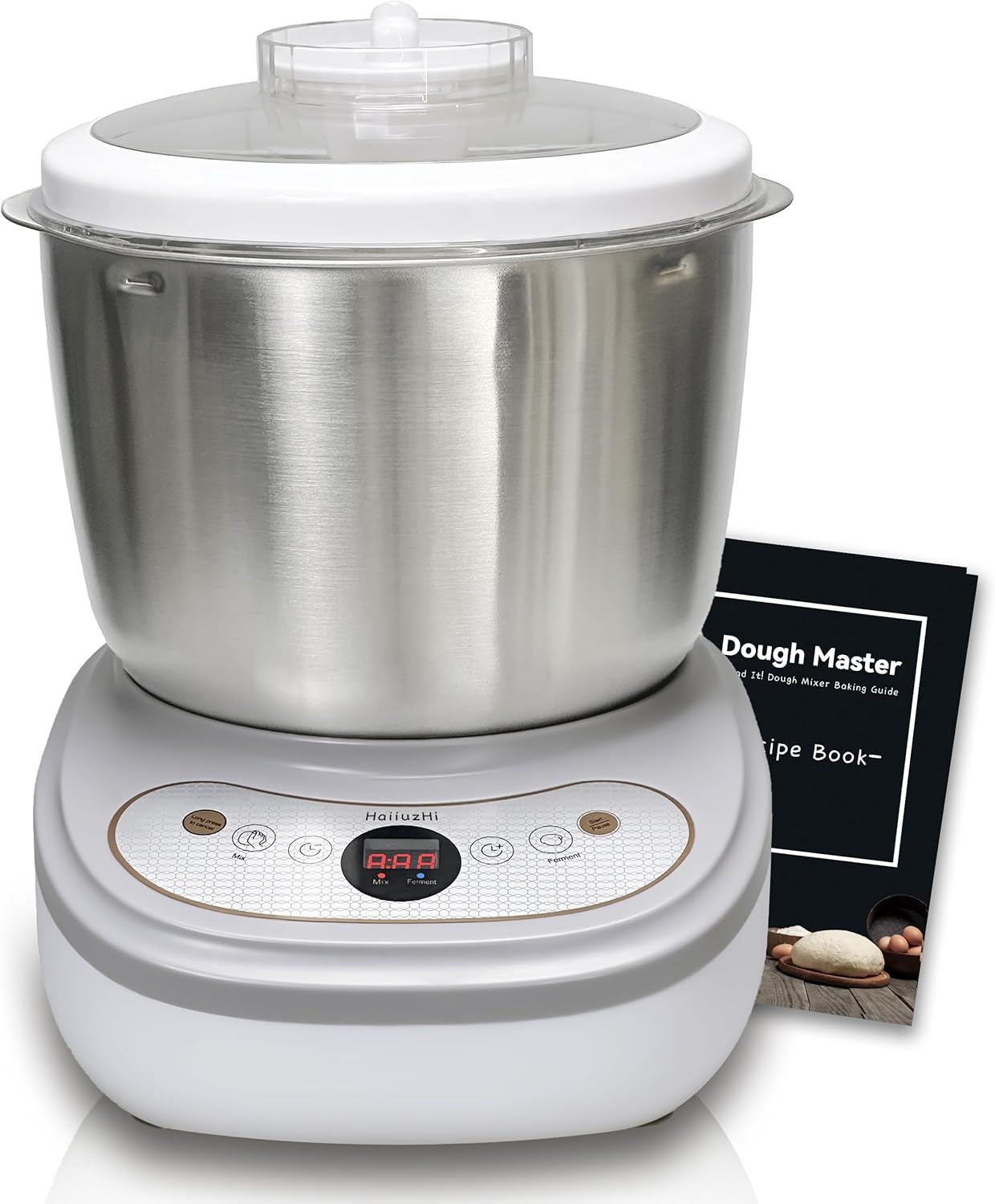
HaiiuzHi 7.4Qt Large Capacity Commercial and Household Dough Maker
Quiet Large-Capacity Maker

HaiiuzHi 7.4Qt Large Capacity Commercial and Household Dough Maker

Best for High-capacity quiet mixing

Powered by a 250-watt motor, this 7.4-quart dough maker handles 300 to 2100 grams of flour per batch. It incorporates an automatic fermentation feature operating between 77 and 100 degrees Fahrenheit. A silicone noise-reduction pad at the base dampens sound during operation, while the transparent lid and top feeding window provide clear visibility and easy access for adding extra ingredients while mixing.

What stands out

  • Accommodates broad batch sizes ranging from 300 grams up to 2100 grams of flour in single cycles.
  • Silicone noise-reduction pad at the base successfully lowers operational sound for a quieter kitchen environment.
  • Transparent lid and feeding window offer clear visibility and convenient access for adding ingredients mid-cycle.

What to consider

  • The 250-watt motor power specification may require extended rest intervals when continuously processing extremely dense, low-hydration dough mixtures.
  • Large 7.4-quart bowl dimensions take up considerable countertop space, making the appliance less suitable for compact or cramped kitchen room layouts.
Key specifications
Capacity
7.4 quarts
Wattage
250 watts
Material
Stainless Steel
Special Features
Auto Shut Off, Digital Display, Fermentation Function, Time Setting Function
Controls Type
Touch
Noise Level
50 db

The practical verdict

Best for high-volume baking needs requiring a transparent viewing lid and a noise-reducing silicone base pad. Avoid if your workspace is restricted to minimal countertop footage. The central trade-off balances a massive 2100-gram flour capacity and acoustic dampening against a powerful yet modest 250-watt motor and large physical countertop footprint.

Buying guide

Evaluating Bowl Capacity and Batch Sizes

Choosing the correct bowl capacity is essential for matching your baking frequency and household size requirements. Smaller 5.2-quart models suit moderate baking tasks, while 6.5 to 7.4-quart units handle large family demands effortlessly without requiring multiple batches. Reviewing specific flour weight ranges ensures the appliance processes your preferred volumes smoothly every single time.

Evaluating how much dough a machine can knead at once prevents overloading the motor during heavy mixing sessions. Larger capacities accommodate expansive batches for gatherings, whereas compact units save space for everyday single-batch cooking. Matching the bowl volume to your typical baking habits guarantees efficient performance and prevents unnecessary kitchen workflow interruptions while preparing meals.

Understanding Motor Wattage and Power

Motor wattage dictates how effectively an electric dough maker handles dense, heavy bread or pizza mixtures. Units ranging from 200 to 250 watts operate efficiently for standard home baking needs, relying on smart intermittent cycles to prevent premature motor wear and overheating. These motors balance energy efficiency with reliable daily performance for typical household cooking routines across various recipes.

Higher-wattage options, such as 600-watt motors, provide extra torque for processing massive quantities of stiff dough without slowing down during extended mixing intervals. Assessing your preferred recipes helps determine whether a standard low-wattage DC motor or a high-torque rotary system fits your specific culinary workflow and baking intensity expectations.

Assessing Temperature-Controlled Fermentation Features

Built-in fermentation functions eliminate guesswork by maintaining a stable environment ranging from 77 to 100 degrees Fahrenheit directly inside the sealed mixing chamber. This constant temperature control supports proper yeast activation, ensuring your dough rises evenly and develops rich honeycomb pores for superior bread and flatbread texture every single time.

When utilizing this feature, remember that activating the proofing cycle requires standard ingredients like active yeast or baking powder to function correctly. Evaluating whether a machine automates the direct transition from mixing to fermenting adds significant convenience to your daily baking schedule and reduces active supervision time for busy modern households.

Comparing Control Interfaces and Displays

Control interfaces dictate how easily you can program and monitor your electric dough maker during active operation. Digital touch panels offer sleek displays and precise programmable time settings for modern kitchens, whereas mechanical rotary knobs provide dependable tactile feedback even when your hands are wet or heavily flour-covered.

Selecting between touch panels and physical knobs depends heavily on personal preference and environmental conditions in your cooking workspace. Reviewing how easily you can adjust speed and timer settings during active cycles helps ensure a smooth, frustration-free baking experience that seamlessly matches your preferred operational style and household habits every day.

Reviewing Material Durability and Cleaning

Material durability ensures your electric dough maker thoroughly withstands years of regular kneading and proofing cycles without degrading. Food-grade 304 stainless steel bowls and removable S-shaped blades resist corrosion, unwanted odors, and physical scratches while providing completely hygienic surfaces for safe food preparation and daily mixing routines in busy homes.

Cleaning convenience varies significantly depending on whether specific removable parts are dishwasher safe or require manual hand washing routines. Following manufacturer maintenance guidelines carefully helps preserve the structural integrity of both the stainless steel mixing bowl and the internal motor base over extended periods of active kitchen use and storage.

Managing Kitchen Space and Footprint

Kitchen space and overall countertop footprint are critical practical factors when selecting a large-capacity appliance like an electric dough maker for your home. Units with spacious bowls require dedicated countertop room, making physical dimensions an important consideration for smaller or more compact kitchens where workspace is severely limited.

Evaluating stability features like suction-cup bases or silicone noise-reduction pads also helps determine how securely and quietly the appliance operates within your cooking space every day. Balancing large bowl capacity with available storage ensures your countertop remains functional, highly organized, and completely uncluttered during everyday meal preparation and extensive baking sessions.

Frequently asked questions

Do electric dough makers require yeast or baking powder for the fermentation function?

Yes, the built-in constant-temperature fermentation function found on these electric dough makers requires you to include yeast or baking powder in your mixture. The appliance is designed to maintain a stable, warm environment typically ranging between 77 and 100 degrees Fahrenheit, which supports yeast activity and allows the dough to rise evenly. However, the machine itself does not generate chemical rising agents; it only supplies the optimal thermal conditions necessary for proper proofing and gluten expansion.

Can I add water or flour while the dough maker is running?

Many models include a removable upper lid design or a convenient top small window specifically engineered for adding water, flour, or seasonings without pausing the mixing cycle. This feature lets you make quick, on-the-go adjustments to hydration levels as the S-shaped blade kneads the ingredients. Being able to feed ingredients through the top opening keeps the process clean, smooth, and efficient while preventing dough from spilling over the sides of the mixing bowl.

How long does the kneading process typically take?

Most electric dough makers complete a standard kneading cycle within approximately fifteen minutes. The internal programming typically utilizes an intermittent mix-pause-mix rhythm designed to simulate professional hand-kneading techniques. This scientific interval design allows gluten to develop naturally while preventing the dough from overheating or rising prematurely during friction-heavy mixing stages. For tougher or higher-volume batches, you may need to run consecutive cycles or allow rest periods according to your specific recipe requirements.

Are the mixing bowls safe to put in the dishwasher?

Cleaning compatibility varies depending on the specific model and manufacturer guidelines. While many removable S-shaped kneading blades and top lids are dishwasher safe, certain stainless steel mixing bowls have specific care recommendations. For instance, some manufacturers advise washing the main mixing bowl by hand to maintain its finish and structural integrity over time. Always review the specific product instructions and manual guidelines before placing any components into your dishwasher.

What is the benefit of the mix-pause-mix kneading rhythm?

The mix-pause-mix rhythm simulates real hand-kneading actions, which allows gluten to develop naturally and creates dough that is softer, chewier, and more elastic. Continuous-mix machines can sometimes overwork or overheat dense doughs, whereas intermittent operation gives the ingredients time to rest between kneading phases. This scientific intermittent design prevents the dough from building up excess heat prematurely, ensuring consistent gluten formation for bread, pizza crust, and flatbread preparations.

Final thoughts

Selecting an electric dough maker for your kitchen simplifies traditional baking tasks by automating the demanding physical labor of kneading bread, pizza, and flatbread doughs. By evaluating crucial specifications like bowl capacity, motor wattage, and control interfaces, you can find a countertop appliance that matches your household baking volume and everyday routine.

Whether you prioritize a spacious 7.4-quart bowl for large family gatherings or integrated weighing scales for precise measurements, these machines deliver consistent gluten development and reliable temperature-controlled fermentation. Reviewing your available counter space and cleaning preferences ensures long-term satisfaction with your baking equipment investment.