Appliances · Buying Guide
Best Extra Large Deep Baking Pan for Holiday Roasts and Lasagna
Baking and roasting for large family gatherings requires cookware that offers generous depth and broad surface areas. An extra large deep baking pan easily handles massive turkeys, tall layered lasagnas, and large sheet-pan dinners without overcrowding your ingredients. Choosing the right material ensures reliable heat distribution whether you prefer uncoated stainless steel or reinforced carbon steel options.
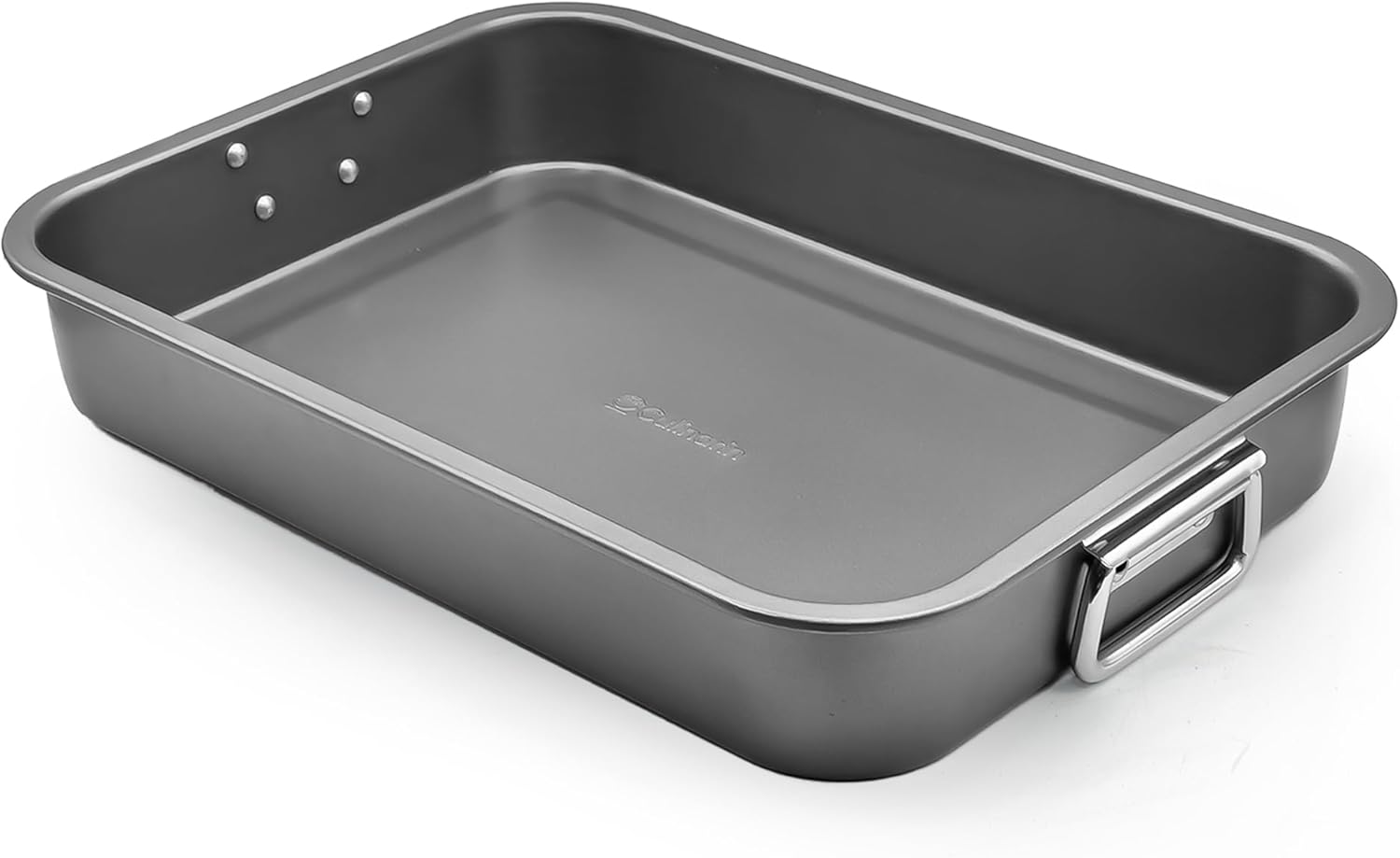
Different designs offer specific practical advantages, ranging from foldable handles for compact cabinet storage to elevated wire racks that keep meats above accumulated pan juices. Understanding your oven interior dimensions and typical meal sizes helps narrow down the ideal option for your specific kitchen needs. Reviewing physical dimensions, handle placements, and cleaning guidelines ensures your bakeware supports your favorite homemade recipes reliably over time.
As an Amazon Associate, StacyLaughs earns from qualifying purchases.
Buying guide
Material Selection for Baking Pans
Choosing the correct metal material for your baking pan affects heat conduction, durability, and maintenance routines. Stainless steel offers rust resistance and a non-reactive surface for acidic foods, while carbon steel provides rapid, even heat distribution across thick batters and roasted meats. Aluminum models often feature lightweight builds combined with applied nonstick coatings.
Consider how each material interacts with your typical cooking habits. Uncoated metals withstand high broiler temperatures without degrading surface coatings, whereas nonstick options simplify food release for delicate layered casseroles. Evaluating your recipe types helps determine which metal composition delivers the best cooking results.
Understanding Size and Oven Clearance
Extra large baking pans require careful measurement of your oven interior before purchase. Manufacturers list exterior dimensions including handles, which can determine whether a pan slides smoothly onto standard oven racks. Checking depth specifications ensures tall casseroles or turkeys will not spill over the edges.
Cabinet storage space also depends heavily on external pan dimensions. Models featuring foldable handles or stackable designs save valuable cupboard room compared to fixed-handle commercial roasters. Always measure your oven cavity and storage areas to avoid fit issues.
Nonstick Coatings Versus Uncoated Metal
Nonstick coatings prevent sticky ingredients like cheese and melted sugar from bonding to the pan surface. Multi-layer chemical-free coatings provide safe release properties that simplify cleaning routines. However, these surfaces often require non-abrasive sponges and gentle hand-washing to preserve their protective qualities.
Uncoated metal pans eliminate concerns about coating degradation under high heat or metal utensils. They allow for aggressive scrubbing and high-temperature searing, including broiler use up to five hundred degrees. Selecting between these two styles depends entirely on your cleanup preferences and cooking temperatures.
Handle Design and Safe Transport
Secure handles are essential when moving heavy pans loaded with turkeys, roasts, or dense lasagnas. Riveted stainless steel handles offer permanent structural attachment that resists loosening over years of heavy use. Ergonomic shapes and rolled edges provide a secure grip and protect fingers from accidental cuts.
Some pans feature foldable side handles designed to minimize the storage footprint inside tight kitchen cabinets. While space-saving, hinged handles require occasional inspection to prevent residue accumulation. Always match the handle style to your lifting comfort and storage constraints.
Managing Heat Distribution and Capacity
Deep baking pans must distribute heat evenly to prevent uneven baking in thick dishes like dense brownies or lasagna layers. Thick-gauge carbon steel and aluminum-encapsulated bases prevent hot spots by conducting thermal energy uniformly across the entire bottom surface.
Capacity ratings indicate the maximum weight or volume a pan can support during cooking sessions. Extra large capacities allow you to prepare large family portions in a single batch, eliminating the need for multiple smaller dishes. Ensure the stated capacity matches your typical household serving requirements.
Maintenance and Cleaning Protocols
Following proper cleaning guidelines extends the operational lifespan of your baking pans. Nonstick carbon steel and aluminum pans benefit from gentle hand-washing with warm soapy water and soft sponges to protect the coating from premature wear.
Uncoated stainless steel pans tolerate more rigorous cleaning methods, including dishwasher cycles, though improper loading can sometimes mar mirror finishes. Adhering to manufacturer temperature limits and avoiding sudden thermal shocks protects your bakeware investment over years of regular use.
Frequently asked questions
What size oven do I need for an extra large deep baking pan?
Extra large pans often exceed twenty inches in length including their handles. You should measure your oven interior rack width and depth prior to purchasing to ensure the pan slides in comfortably without resting against the heating elements or preventing the door from closing completely. Checking these physical measurements prevents frustrating clearance issues during meal preparation.
Are nonstick coatings safe to use at high oven temperatures?
Many nonstick baking pans specify a maximum safe operating temperature, frequently around 450 degrees Fahrenheit. Exceeding this recommended limit can degrade the surface coating over time. If your cooking style involves very high-heat searing or broiler usage, an uncoated stainless steel pan may be a more appropriate choice for your kitchen.
Can I put my baking pan in the dishwasher?
Many baking pans are designated as dishwasher safe by manufacturers, but hand-washing is frequently recommended for nonstick and finished metal pans. Dishwasher detergents and crowded rack placement can dull polished finishes or degrade delicate nonstick coatings. Reviewing specific product care instructions helps maintain your bakeware condition.
Why is an elevated rack useful in a roasting pan?
An included removable rack lifts heavy roasts and holiday birds away from the bottom of the pan. This elevation promotes air circulation for even browning on all sides while allowing natural cooking juices to collect below in the base for gravies and sauces without boiling the meat in its own drippings.
How do I prevent food from sticking to uncoated stainless steel pans?
Uncoated stainless steel surfaces rely on proper preheating and adequate cooking fats or oils to achieve natural food release. Allowing the pan to reach cooking temperature before adding ingredients and soaking the pan in warm soapy water after baking helps loosen baked-on residues without damaging the metal surface.