Appliances · Buying Guide

Best Sourdough Starter Jar And Warmer Kits For Fridge Feeding

Managing a sourdough starter requires balancing cold storage with active feeding routines. When you store your culture in the refrigerator, it significantly slows down yeast activity, allowing you to bake less frequently without requiring daily flour replenishment. However, bringing a cold starter back to active life involves specific feeding intervals and reliable temperature management to restore optimal bubble formation.

To simplify this daily process, bakers often rely on specialized glass jars, precise temperature-controlled boxes, and compact warming systems. These dedicated tools help regulate fermentation speeds, accurately track feeding schedules, and maintain consistent environments whether your starter is resting in the cold or warming up on the kitchen counter for baking day.

As an Amazon Associate, StacyLaughs earns from qualifying purchases.

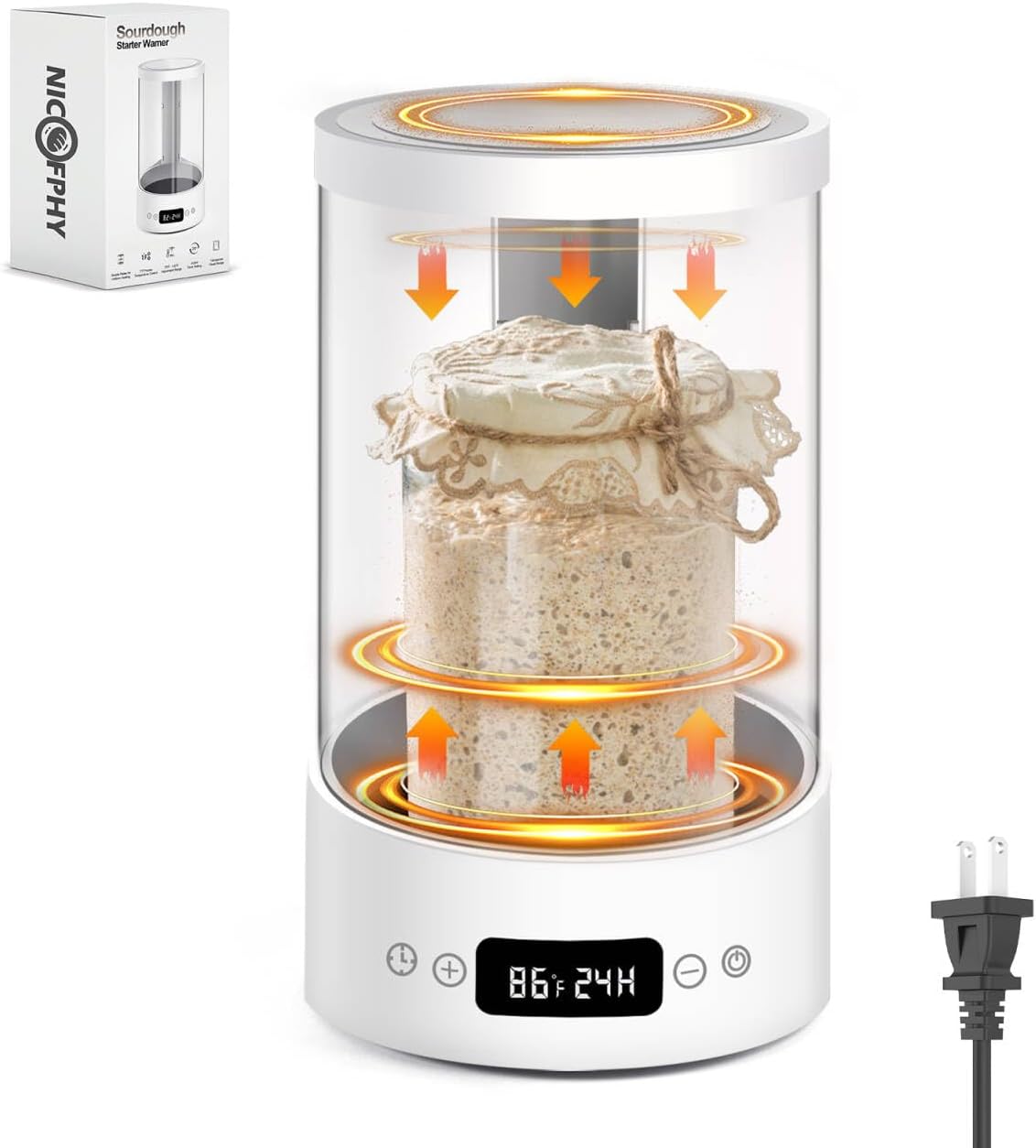
NICOFPHY Sourdough Starter Warmer Box with Temperature Control
#1 Best Overall

NICOFPHY Sourdough Starter Warmer Box with Temperature Control

This sourdough starter warmer box uses dual upper and lower heating plates to create a stable, windless environment during cold months. It features precise one-degree Fahrenheit thermostat control ranging from 70°F to 100°F, an exquisite transparent acrylic design, and a low 20W power draw. A built-in memory function retains your last temperature setting for effortless daily operation alongside your kitchen appliances.

Best for Precise temperature control box

Double heating plate designPrecise thermostat control rangeVisual transparent dome designLow 20W power usageBuilt-in memory temperature function
View on Amazon →

What stands out

  • Dual upper and lower heating plates deliver stable 360-degree warmth without wind during cold winter months.
  • Accurate one-degree thermostat control ranges from 70°F to 100°F to speed up cold starter fermentation.
  • Low 20-watt power operation ensures energy savings while maintaining a quiet, safe countertop environment.

What to consider

  • The enclosed design requires your jar to measure strictly under seven inches in height and four point four inches in diameter.
  • The warming box structure does not include a glass container, requiring you to supply your own compatible starter jar.
Key specifications
Wattage
20 watts
Maximum Temperature
100 °F
Material Type
Acrylic
Color
White
Model Number
SSWPP
Manufacturer
NICOFPHY

The practical verdict

This warming box suits bakers struggling with cold kitchen temperatures who need precise thermal control for reviving refrigerated starters. Avoid this option if you already own oversized jars exceeding seven inches in height or prefer an all-in-one bundle containing glassware. The main trade-off is requiring specific jar dimensions to fit beneath the protective warming dome while delivering reliable lower and upper plate heating.

#2
AirVows Sourdough Home Precise Temperature Control Fermentation Chamber
Precision Climate Chamber

AirVows Sourdough Home Precise Temperature Control Fermentation Chamber

Best for Temperature-controlled climate chamber

Designed for versatile fermentation, this climate chamber features advanced dual-semiconductor temperature control ranging from 41°F to 122°F. It includes an upgraded viewing window to monitor your starter without opening the door, an internal removable shelf for small jars, and non-slip EVA foot pads. Operating with dual heating and cooling modes, it takes the hassle out of regular sourdough maintenance and feeding schedules.

What stands out

  • Dual heating and cooling modes support wide temperature ranges from 41°F to 122°F with high precision.
  • Upgraded front viewing window lets you monitor starter rise without opening the door and altering internal conditions.
  • Removable interior shelf accommodates layered small jar storage while non-slip foot pads ensure stable counter placement.

What to consider

  • Requires a dedicated six-hour warm-up or cool-down period to achieve peak performance before placing your refrigerated starter inside.
  • The specific internal chamber volume requires checking your available counter dimensions to ensure a proper fit in smaller kitchens.
Key specifications
Capacity
6 liters
Chamber Volume
10 liters
Frame Material
Plastic
Inner Material
Ethylene Vinyl Acetate (EVA)
Color
White
Model Number
SSH-10W

The practical verdict

Best for bakers demanding wide-ranging temperature control with both cooling and heating modes for extensive fermentation needs. Avoid if you want an instant plug-and-play device that requires no stabilization wait times or if counter space is extremely limited. The primary trade-off involves managing a required warm-up or cool-down period alongside chamber dimensions, balanced against exceptional dual-mode climate flexibility for refrigerated starters.

#3
Farielyn-X 2 Pack Sourdough Starter Jar Kit with Accessories
Dual-Jar Starter Kit

Farielyn-X 2 Pack Sourdough Starter Jar Kit with Accessories

Best for Managing multiple starter varieties

Providing exceptional value, this bundle includes two 40-ounce soda-lime glass jars designed for managing multiple starter types side by side. Each complete kit features a breathable cloth cover, silicone lid, precision thermometer strip, flexible spatula, and day-marked elastic tracking band. Thermal-shock-resistant glass allows safe transitions from fridge to counter, while dishwasher-safe components ensure effortless cleaning between feeding cycles.

What stands out

  • Includes two complete 40-ounce glass jars allowing you to manage separate feeding schedules simultaneously.
  • Thermal-shock-resistant soda-lime glass safely transitions directly from refrigerator storage to the kitchen counter.
  • Comprehensive accessory set provides cloth covers, silicone lids, thermometers, spatulas, and day-marked elastic tracking bands.

What to consider

  • Managing two large 40-ounce glass jars requires substantial storage space on kitchen counters and inside cabinets during weekly maintenance.
  • Relying on dual glass containers means you must handle heavy kitchenware carefully during daily stirring and washing routines.
Key specifications
Capacity
2.5 pounds
Item Dimensions L x W x H
2.9"L x 2.9"W x 4.7"H
Item Volume
40 fluid ounces
Material Type
Glass
Product Care Instructions
Dishwasher Safe
Closure Type
Twist Lock

The practical verdict

Best for dedicated bakers maintaining multiple flour types or wanting a reliable backup jar ready for refrigeration. Avoid this kit if you only need a single container or lack adequate storage space for dual 40-ounce glass vessels. The central trade-off is gaining doubled baking capacity and simultaneous feeding versatility at the cost of managing heavier glass containers and increased footprint on your counter.

#4
Snuvid 1L Glass Sourdough Starter Feeding Jar Set
Single-Jar Feeding Set

Snuvid 1L Glass Sourdough Starter Feeding Jar Set

Best for Single jar daily feeding

This all-in-one kit centers around a one-liter wide-mouth glass jar featuring clear measurement markings and a spherical shape that simplifies stirring and scraping. It comes with interchangeable cloth and bamboo lids, a day-labeled elastic tracking band, a wheat-themed thermometer strip, and a silicone spatula. The dual-lid system accommodates active counter fermentation and secure refrigerator storage without requiring extra purchases.

What stands out

  • Wide-mouth spherical glass jar design allows easy stirring, feeding, and scraping out contents without awkward angles.
  • Interchangeable cloth cover promotes airflow during fermentation while the bamboo lid secures refrigerated storage.
  • Includes a day-labeled elastic band and thermometer strip to track feeding times and jar temperature easily.

What to consider

  • The single one-liter capacity limits the total volume of starter you can nourish during exceptionally heavy baking sessions.
  • Switching between fabric covers and solid bamboo lids requires careful handling to prevent misplacing components in busy kitchens.
Key specifications
Capacity
1 liters
Item Dimensions L x W x H
4.3"L x 4.3"W x 5.7"H
Item Volume
1 liters
Lid Material
Bamboo
Product Care Instructions
Dishwasher Safe, Freezer Safe, Refrigerator Safe
Closure Type
Snap

The practical verdict

Best for everyday bakers looking for a straightforward, single-jar setup with dedicated lids for both counter fermentation and fridge storage. Avoid if you run multiple starter cultures simultaneously and require dual containers right out of the box. The main trade-off is the convenience of an all-in-one single liter kit versus the limitation of managing only one culture batch at a time.

#5
Cozy Bread Climate Cube Sourdough Starter Temperature Control System
Compact Temperature Cube

Cozy Bread Climate Cube Sourdough Starter Temperature Control System

Best for Compact jar temperature control

Built specifically for sourdough starter jars, this compact temperature cube warms and cools within a 50°F to 99°F range to match your baking schedule. It features a clear front window for observing starter rise without disrupting internal conditions, and lightweight dimensions designed to save counter space. It easily accommodates standard 34-ounce starter jars while maintaining consistent thermal environments year-round.

What stands out

  • Warms and cools starter between 50°F and 99°F to actively control fermentation speed and timing.
  • Clear front viewing window lets you watch your starter rise without disrupting the internal climate.
  • Compact, lightweight design takes up minimal counter space compared to larger traditional proofing boxes.

What to consider

  • Cooling capability is restricted to reaching fifteen degrees below ambient room temperature rather than deep refrigeration chilling.
  • The internal chamber dimensions specifically fit standard 34-ounce containers and select models, limiting use with oversized jars.
Key specifications
Voltage
120 volts_of_alternating_current
Capacity
34 fluid ounces
Item Weight
3 pounds
Item Dimensions D x W x H
9"D x 7"W x 10"H
Color
White
Model Number
JCCC001

The practical verdict

Best for home bakers seeking a dedicated, space-saving countertop cube to warm or slightly cool standard starter jars. Avoid this cube if you need heavy-duty chilling power or utilize extra-large custom vessels that exceed internal dimensions. The primary trade-off is gaining precise thermal control in a compact footprint while accepting restricted maximum cooling margins and specific jar size constraints.

Buying guide

Temperature Control and Fermentation Range

Regulating temperature is critical when reviving a sourdough starter from the refrigerator. Cold kitchen environments significantly slow down yeast activity, making precise heating elements essential for speeding up fermentation times. Look for devices offering accurate thermostat adjustments between seventy and one hundred degrees Fahrenheit to restore bubble growth and improve overall bread texture during cold winter months.

Some advanced climate chambers also provide cooling modes to help delay feeding schedules when you are not actively baking. Evaluating your typical kitchen ambient temperature helps determine whether you need a basic warming mat, a dual-plate box, or an active cooling unit to manage your culture effectively. Choosing the right thermal range prevents sluggish fermentation and flour waste.

Jar Capacity and Glass Durability

Selecting the proper jar capacity ensures your starter has enough room to expand during peak feeding cycles without overflowing the container. Standard one-liter or forty-ounce jars offer ample volume for typical weekly baking routines. Ensure the glass construction features thermal-shock resistance so it can safely transition from cold refrigerator storage directly onto warm counters.

Thick soda-lime glass provides dependable durability for daily stirring and washing. Wide-mouth openings make scraping out remnants and adding flour much easier than traditional narrow bottlenecks. Always check the physical dimensions of your chosen glassware to ensure it fits comfortably inside your refrigerator shelves and underneath your preferred warming enclosures.

Dual-Lid Systems and Airflow

A versatile lid system gives you flexibility during different stages of sourdough maintenance. During active counter fermentation, breathable cloth covers promote necessary airflow and yeast respiration. When storing your starter in the refrigerator, switching to a solid bamboo or silicone lid prevents drying out and protects your culture from unwanted refrigerator odors.

Having both lid types included in a single kit eliminates the need for improvised paper towel covers or rubber bands. Ensure that the sealing mechanisms fit securely to maintain a clean countertop. Proper lid selection keeps your feeding routine organized and protects the health of your wild yeast culture over long storage periods.

Tracking Bands and Thermometers

Monitoring your starter rise and temperature prevents guesswork during feeding cycles. Elastic tracking bands labeled with weekdays allow you to mark the exact height of your culture after a feeding. This visual cue helps you determine when the starter has doubled in size and is ready for baking or refrigeration storage.

Integrated thermometer strips provide instant temperature readings directly on the exterior of the glass jar. Maintaining optimal thermal conditions ensures predictable yeast performance. Selecting kits that include these tracking accessories simplifies your daily routine and provides reliable feedback on your starter activity levels.

Countertop Footprint and Storage

Kitchen counter space is often at a premium, making the physical footprint of your sourdough equipment an important consideration. Compact warming boxes and climate cubes take up minimal surface area next to standard appliances. Measure your available counter space and cabinet storage before purchasing multi-jar bundles or enclosed heating machines.

Lightweight designs allow you to store warming units away easily when not in use during warmer months. Consider whether your setup will remain permanently plugged in or if you require portable equipment that packs away neatly. Balancing device dimensions with your kitchen layout ensures a clutter-free baking experience.

Multi-Jar Management and Feeding Routines

Maintaining multiple starter varieties, such as rye and whole wheat, requires a dual-jar management approach. Using two distinct containers lets you stagger feeding schedules and keep backup cultures safely in reserve. This strategy prevents total culture loss if one batch becomes neglected during busy weekly routines.

Rotating jars between refrigerator rest and counter activity ensures you always have a ready-to-use batch of yeast. Dedicated multi-pack kits streamline this process by providing identical measuring markings and accessories for each container. Establishing a consistent feeding routine helps you achieve predictable baking results every single time.

Frequently asked questions

How often should I feed a sourdough starter stored in the refrigerator?

When your sourdough starter is resting in the refrigerator, the cold temperature slows down yeast metabolism significantly. Most bakers find that feeding a refrigerated starter once a week is sufficient to keep the culture healthy and prevent excessive acid buildup. However, if you bake frequently, you may choose to feed it every five days. Always bring the jar out, let it warm up, discard a portion, and replenish it with fresh flour and water during your scheduled maintenance day.

Can I place a cold glass jar directly into a warming box?

Placing a cold glass jar directly into a temperature-controlled warmer box depends primarily on the thermal-shock resistance of your glassware and the heating speed of the device. High-quality soda-lime glass jars designed for baking can generally transition safely. To be cautious and prevent potential glass cracking from rapid temperature shifts, you can let the jar sit on the counter for a short time to take the chill off before activating the heating plates or climate cube.

Why is a breathable cloth cover used instead of an airtight lid during fermentation?

A breathable cloth cover is essential during active fermentation because wild yeast and lactic acid bacteria produce carbon dioxide gas as they consume flour. Allowing air circulation through fabric prevents pressure from building up inside the glass container. It also provides necessary oxygen exchange to support healthy yeast activity and rapid bubble formation. Once your feeding cycle peaks and you transition the starter into cold refrigerator storage, you should switch to a sealed lid to prevent drying.

What role do tracking bands play in managing feeding schedules?

Day-labeled elastic tracking bands serve as a visual marker on your sourdough jar to indicate when the last feeding occurred and how high the culture has risen. After feeding your starter, you simply slide the band down to match the initial mixture level. As the yeast consumes the flour and expands, you can easily track its progress against the weekday markers. This eliminates guesswork, helping you identify the exact peak activity window required for successful bread baking.

How do temperature-controlled boxes improve cold kitchen baking?

Cold winter kitchens often drop below ideal fermentation temperatures, causing your sourdough starter to become sluggish or stop rising altogether. Temperature-controlled boxes and climate cubes provide a stable, windless environment with precise heating adjustments ranging from seventy to over one hundred degrees Fahrenheit. By maintaining consistent warmth, these specialized enclosures speed up fermentation times, reduce waiting periods, and ensure your refrigerated starter wakes up quickly and reliably for your next baking day.

Final thoughts

Successfully managing a sourdough starter from the fridge relies on combining reliable glassware with precise temperature control. Whether you choose a dual-plate warmer box, a versatile climate cube, or a comprehensive multi-jar kit, having the right equipment removes the guesswork from weekly feeding routines and active baking preparation.

By evaluating your kitchen environment, storage space, and baking frequency, you can select the ideal tools to keep your wild yeast culture thriving year-round. Consistent feeding schedules paired with proper thermal management ensure delicious, predictable results for every loaf you bake.