Appliances · Buying Guide

Best Ideal Temp For Sourdough Starter Tools To Master Your Fermentation

Achieving the ideal temp for sourdough starter development is essential for home bakers looking to cultivate active, bubbly yeast cultures. Temperature directly dictates how fast wild yeasts and lactic acid bacteria ferment, turning simple mixtures of flour and water into a lively, predictable loaf base. Without stable warmth, fermentation times stretch out unexpectedly, causing frustration and unpredictable baking schedules in the kitchen.

When ambient kitchen conditions fluctuate seasonally or drop overnight, maintaining consistent heat becomes a significant challenge for daily baking routines. Dedicated proofing mats, temperature-controlled chambers, and probe-equipped warmers offer practical ways to manage warmth precisely. Selecting the right equipment helps regulate fermentation environments, removing guesswork and supporting reliable results across all your favorite baking projects.

As an Amazon Associate, StacyLaughs earns from qualifying purchases.

Pakusane SourKeeper Sourdough Starter Warmer with Temp Probe
#1 Best Overall

Pakusane SourKeeper Sourdough Starter Warmer with Temp Probe

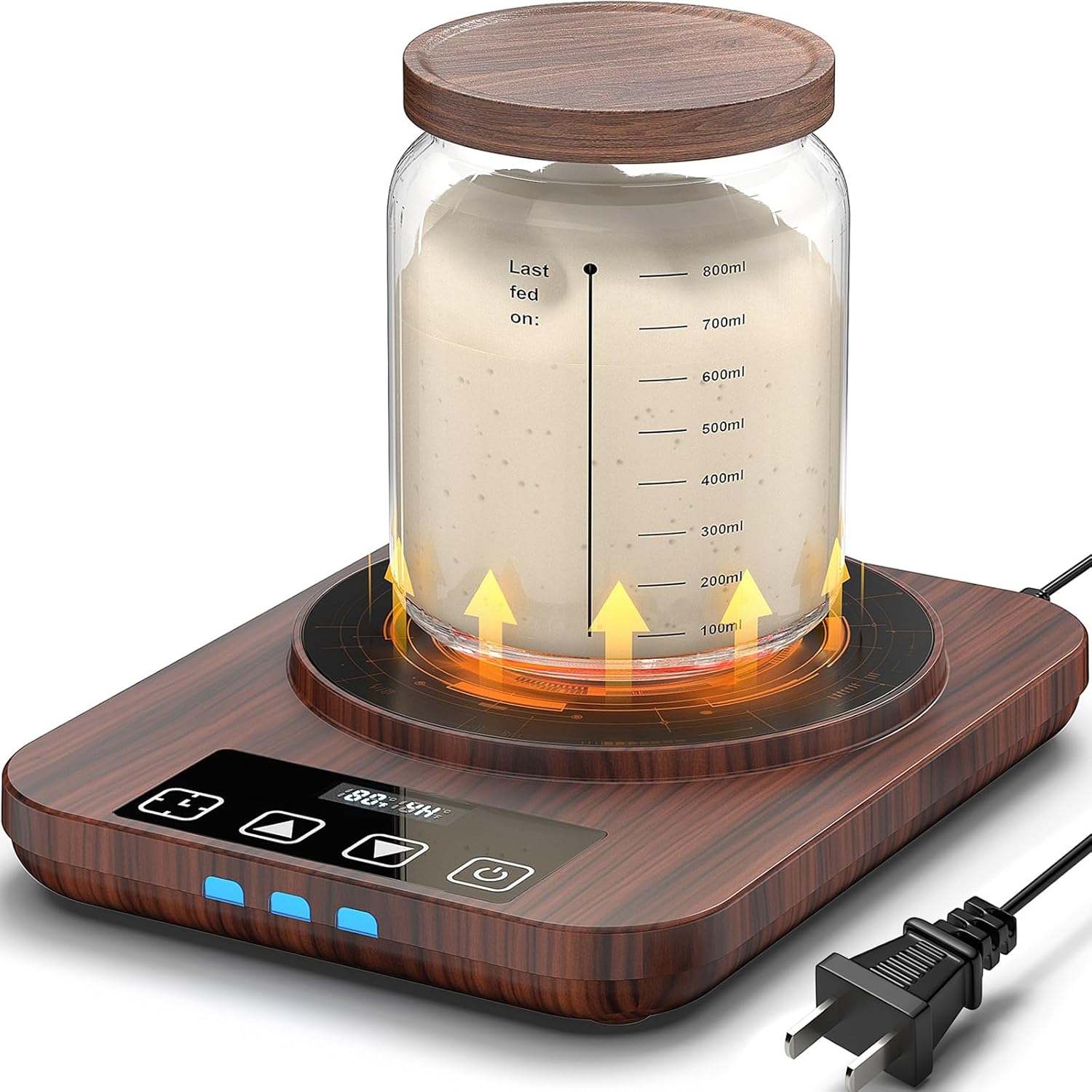
This proofing base features a stainless-steel dough probe designed to measure core temperature directly inside the starter rather than just ambient air. It offers degree-by-degree temperature settings from 70 to 110 degrees Fahrenheit, an auto-warming switch, and a 24-hour timer. Built with food-grade materials and a walnut finish, it fits various mason jars and fermentation vessels.

Best for Direct core temperature tracking

Stainless-steel dough probePrecise temperature settingsFits most jarsFood-grade materialsAutomatic shut-off safety
View on Amazon →

What stands out

  • Measures internal core temperature directly with a stainless steel probe for reliable readings.
  • Offers degree-by-degree settings spanning from 70 to 110 degrees Fahrenheit to match specific recipes.
  • Includes an automatic shut-off safety feature alongside a 24-hour timer for overnight scheduling.

What to consider

  • The plastic construction and specific dimensions limit placement options if you prefer storing larger bulk fermentation vessels directly on the compact base.
  • Relying on direct probe placement requires keeping the stainless steel sensor clean between frequent sourdough feedings to prevent residue buildup.
Key specifications
Item Dimensions L x W x H
6.5"L x 6.5"W x 0.98"H
Material Type
Plastic
Maximum Temperature
110 °F
Included Components
With Temp Probe, instruction, sourdough starter warmer
Manufacturer Warranty Description
2 year manufacture.
Model Number
S3-black

The practical verdict

This warming base suits bakers who want precise internal temperature tracking rather than just relying on surface or ambient readings. It works well with standard jars and offers flexible timer controls for daily routines. Avoid it if you need cooling functions or specialized multi-zone heating for large setups. The primary trade-off involves balancing direct probe maintenance against the benefit of monitoring exact core warmth during fermentation.

#2
MENGBEI Sourdough Starter Warmer Mat with Timer
Compact Graphene Heating Mat

MENGBEI Sourdough Starter Warmer Mat with Timer

Best for Rapid low-wattage jar warming

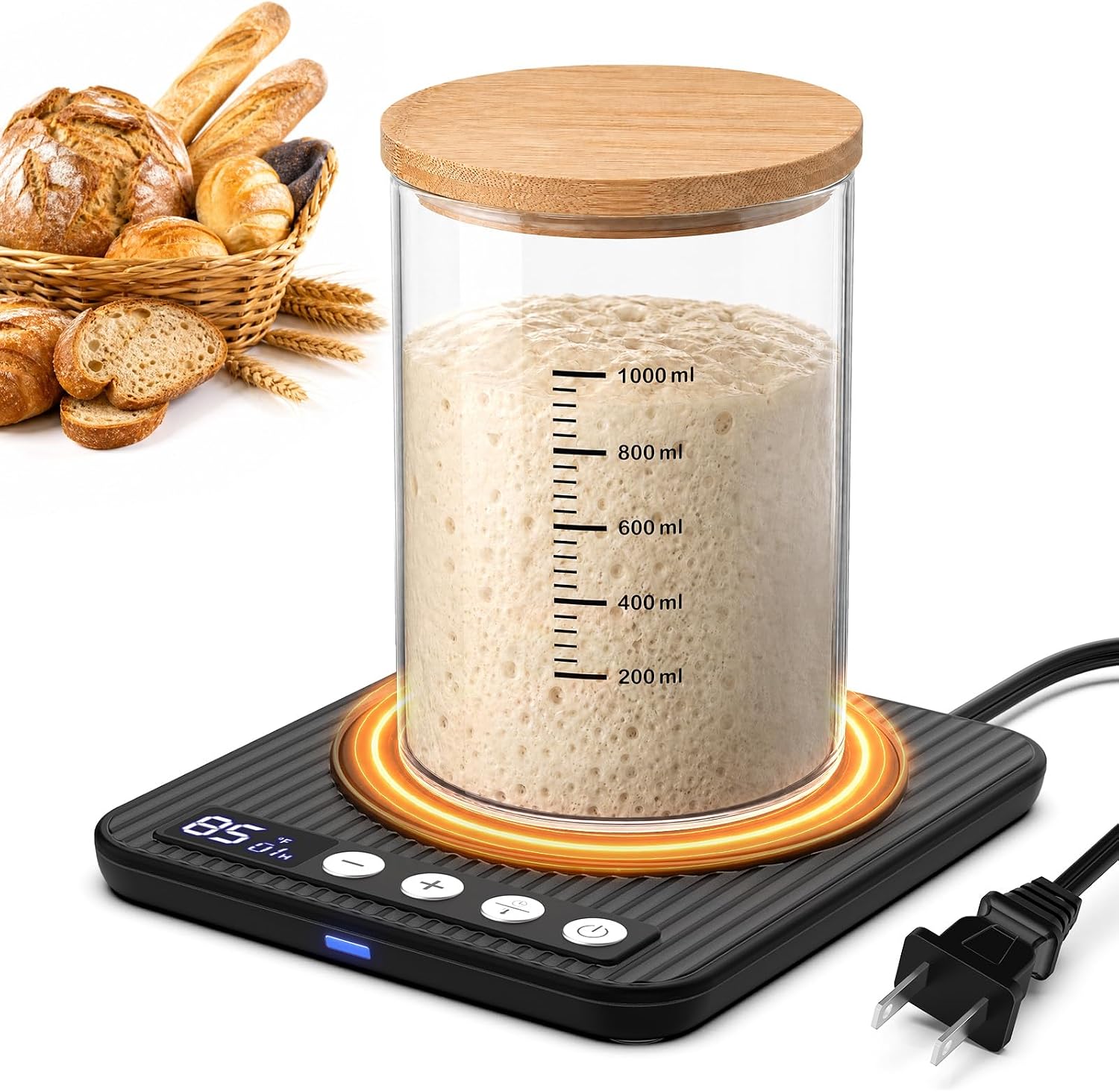
Designed for serious bakers, this warming mat fine-tunes temperatures from 70 to 110 degrees Fahrenheit with one-degree precision. It utilizes graphene and aluminum foil heating film for rapid ten-second heating while consuming minimal power. The compact heating zone fits jars ranging from 24 to 40 ounces, and a smart memory function saves your last timer and temperature settings.

What stands out

  • Applies advanced graphene and aluminum foil heating technology for rapid, uniform warming within ten seconds.
  • Features a smart memory function that conveniently saves your last schedule, time, and temperature settings.
  • Consumes minimal power while delivering stable heat tailored for jars between 24 and 40 ounces.

What to consider

  • The 4.53-inch heating zone restricts jar base widths, meaning very wide or non-standard fermentation vessels might not make full contact with the mat.
  • Operating without an included jar requires you to source compatible glass containers separately before beginning your daily feeding routine.
Key specifications
Capacity
40 fluid ounces
Wattage
12 watts
Material Type
Acrylonitrile Butadiene Styrene (ABS)
Maximum Temperature
100 °F
Included Components
1*heating pad+1*manual
Manufacturer Warranty Description
1 month.

The practical verdict

This warming mat suits bakers looking for a compact, low-power solution that fits standard jars and heats up quickly. It provides dependable temperature stability for daily sourdough maintenance. Avoid it if you require internal probes or need to accommodate oversized fermentation containers. The main trade-off is the limited base size, which requires checking your jar dimensions to ensure proper surface contact with the heating zone.

#3
Colorlife Sourdough Starter Warmer Mat with Dual Mode
Dual-Mode Fermenting Pad

Colorlife Sourdough Starter Warmer Mat with Dual Mode

Best for Versatile dual-mode jar heating

Offering dual fermentation and warming modes, this heating mat spans temperatures from 65 to 140 degrees Fahrenheit. The fermentation mode supports sourdough and yogurt, while the warming mode handles liquids like milk. It features a touch toggle with color-coded modes, a real-time digital temperature display, an aluminum plate for even heat distribution, and a 24-hour safety timer with auto shut-off.

What stands out

  • Provides dual modes that seamlessly shift between fermentation tasks and beverage warming across a broad range.
  • Utilizes a 4.53-inch aluminum plate to distribute steady heat evenly across flat-bottom jars and mason containers.
  • Integrates a 24-hour safety timer with automatic shut-off to manage overnight baking schedules without constant supervision.

What to consider

  • The built-in safety feature prevents activation if ambient room temperature already matches or exceeds your target setting.
  • Turning the device on requires a three-second touch hold, which takes a little getting used to during rushed kitchen workflows.
Key specifications
Product Dimensions
6.3 x 5.3 x 0.59 inches
Item Weight
7.8 ounces
Manufacturer
Colorlife
ASIN
B0H8YQG82D
Item model number
A-2919-1
Best Sellers Rank
#9,245 in Kitchen & Dining (See Top 100 in Kitchen & Dining) #6 in Brewing Heaters & Temperature Controls

The practical verdict

This dual-mode mat suits home bakers who want a versatile surface capable of handling both lower-temperature sourdough fermentation and higher-temperature warming tasks. The wide temperature range offers broad kitchen utility. Avoid it if you prefer automated cooling or need internal dough probes. The primary trade-off involves adapting to the safety lockout mechanism that prevents operation when ambient room warmth already satisfies your target setting.

#4
GIYUDOT Folding Bread Proofing Box with Temperature Control
Enclosed Folding Proofer Box

GIYUDOT Folding Bread Proofing Box with Temperature Control

Best for Enclosed space-saving proofing chamber

This folding proofing box creates a dedicated enclosed environment with temperature controls ranging from 50 to 113 degrees Fahrenheit and a 48-hour timer. It features five layers of insulating material, a waterproof interior, a dual-view window configuration, and a stainless steel shelf to prevent bottom overheating. The entire structure collapses flat for easy storage in compact kitchens when not in use.

What stands out

  • Constructed with five layers of insulating material to maintain consistent internal air temperatures during long fermentation cycles.
  • Features a flexible dual-view window that can be positioned on the front or top for easy monitoring.
  • Collapses flat when not in use, making it ideal for bakers working with limited kitchen storage space.

What to consider

  • The collapsible fabric and insulation layers require careful cleaning of the waterproof interior to maintain hygiene over time.
  • The enclosed box footprint takes up more counter space than a simple jar mat during active baking sessions.
Key specifications
Capacity
22 liters
Item Dimensions D x W x H
11"D x 11"W x 11"H
Wattage
63 watts
Material
Polyester, Oxford Fabric, Acrylic, Polypropylene, Insulation Cotton
Temperature Range
50-113 °F
Control Type
Smart Controller

The practical verdict

This proofing box suits bakers who need a dedicated, insulated environment to protect their sourdough from cold drafty kitchens. The folding design solves storage issues in small homes. Avoid it if you prefer a minimalist heating pad that sits directly under a single jar without an enclosure. The main trade-off is managing a larger footprint on your counter while gaining superior insulation and protection against ambient room temperature shifts.

#5
AirVows Sourdough Home Temperature Controlled Starter Incubator
Dual-Mode Climate Chamber

AirVows Sourdough Home Temperature Controlled Starter Incubator

Best for Controlled heating and cooling cabinet

This climate-controlled chamber delivers dual heating and cooling modes spanning from 41 to 122 degrees Fahrenheit with precise semiconductor control. It features an upgraded viewing window, a removable shelf for layered small jar storage, and non-slip EVA feet. Designed to maintain stable conditions regardless of room temperature swings, it helps eliminate flour waste by regulating feeding schedules from twice a day to once a week.

What stands out

  • Delivers both heating and cooling capabilities to manage exact temperatures regardless of external seasonal weather shifts.
  • Includes a removable shelf inside an enclosed chamber to accommodate multiple small fermentation jars simultaneously.
  • Features an upgraded viewing window that lets you check progress without opening the door and losing warmth.

What to consider

  • The climate-controlled appliance requires dedicated counter space and a stable power source to maintain internal semiconductor temperature settings.
  • Chamber height restrictions mean you must verify jar dimensions before placing taller fermentation vessels inside the cabinet.
Key specifications
Capacity
6 liters
Chamber Volume
10 liters
Frame Material
Plastic
Inner Material
Ethylene Vinyl Acetate (EVA)
Included Components
1 * Sourdough Starter Home, 1 x User Manual
Brand Name
AirVows

The practical verdict

This temperature-controlled chamber suits dedicated enthusiasts who require both heating and cooling capabilities to manage sourdough starters through changing seasons. The enclosed cabinet protects cultures from severe kitchen temperature swings. Avoid it if you need a simple, low-profile mat or have limited counter space for a dedicated appliance. The primary trade-off is the larger appliance footprint and power requirement compared to a basic heating pad.

Buying guide

Understanding Temperature Ranges for Starter Health

Maintaining the ideal temp for sourdough starter activity ensures that wild yeasts and beneficial bacteria multiply efficiently. Most standard sourdough cultures thrive when kept between 75 and 82 degrees Fahrenheit. Within this specific window, fermentation happens at a steady pace, producing predictable bubble formation and balanced sour flavors. Lower temperatures cause sluggish activity, while excessive heat weakens the culture.

Selecting equipment that supports precise adjustments helps you stay within this optimal range throughout changing seasons. Devices offering degree-by-degree controls allow you to fine-tune your setup, preventing accidental overheating while keeping your starter lively. Evaluating how your chosen tool handles heat distribution ensures your sourdough receives consistent warmth from feeding to feeding.

Evaluating Heating Mats Versus Enclosed Proofing Boxes

Choosing between a flat warming mat and an enclosed proofing box depends largely on your kitchen environment and available counter space. Heating mats sit directly beneath your fermentation jar, providing direct conductive warmth through an aluminum plate or graphene film. They take up minimal room and tuck away easily in drawers when not in use.

Enclosed proofing boxes, by contrast, surround the entire container with insulated walls to stabilize ambient air temperature. This style protects your starter from cold drafts in unheated rooms. While mats work well for spot warmth, boxes provide superior isolation against fluctuating household temperatures, though they require dedicated counter space during active baking projects.

The Role of Timers and Auto Shut-Off Features

Managing fermentation timelines becomes significantly easier when your equipment includes reliable digital timers and safety auto shut-off mechanisms. Many dedicated warming devices offer 24-hour or 48-hour timers, allowing you to set specific heating intervals before bed or leaving for work. This automation prevents your sourdough starter from overheating during extended multi-hour proofing cycles.

Look for models with smart memory functions that save your preferred temperature and schedule settings between uses. These thoughtful features streamline daily baking routines by letting you restart familiar cycles with a single touch. Combining precise thermal control with programmable shut-off timers removes the guesswork, ensuring consistent loaf development without requiring constant supervision throughout the day or night.

Assessing Container Compatibility and Heating Zone Sizing

Ensuring your fermentation jars fit properly on a warming device is a critical step when shopping for baking accessories. Heating mats typically feature designated circular heating plates sized for standard 24-ounce to 40-ounce mason jars and flat-bottom containers. Measuring your favorite glass vessels beforehand ensures they make full contact with the heated surface.

If you prefer using wide bowls or specialized fermentation crocks, you may need an adjustable probe warmer or a collapsible box with a spacious interior shelf. Standard mats might underperform if the jar base exceeds the active heating zone dimensions. Matching your container geometry to the heating element guarantees even thermal transfer across every feeding cycle.

Incorporating Cooling Capabilities for Year-Round Control

While most baking warmers focus exclusively on raising temperatures during cold winter months, dual heating and cooling devices offer essential year-round utility. Summer heatwaves and humid days can cause sourdough starters to ferment far too rapidly, leading to exhausted yeast and overly acidic results. Climate-controlled chambers equipped with semiconductor cooling technology help counteract hot ambient room conditions effectively.

Investing in a device that spans both cool and warm thresholds allows you to maintain stable conditions regardless of seasonal weather shifts. This flexibility is particularly useful for bakers living in warm climates or homes without central air conditioning. By regulating both extremes, you protect your starter culture and reduce flour waste over time.

Maintenance, Cleaning, and Material Safety Considerations

Keeping your sourdough equipment clean ensures longevity and maintains high food safety standards in busy home kitchens. Look for surfaces made from durable, food-grade materials or waterproof interiors that resist sticky flour residue and accidental starter spills. Smooth metal heating plates can be wiped down quickly with a damp cloth after each feeding cycle is complete.

Reviewing manufacturer guidelines for daily maintenance helps prevent electrical damage and preserves delicate internal temperature sensors. Probe-equipped units require careful wiping around stainless steel sensors to avoid sticky residue buildup between feedings. Selecting thoughtfully designed materials ensures your warming mat or proofing box remains a reliable kitchen companion for years of consistent baking adventures.

Frequently asked questions

What is the ideal temp for a sourdough starter to ferment properly?

The ideal temp for a sourdough starter typically ranges between 75 and 82 degrees Fahrenheit. Within this specific window, wild yeast strains and lactic acid bacteria multiply at an optimal rate, producing steady gas bubbles and a balanced flavor profile. If temperatures drop significantly below this range, fermentation slows down dramatically, requiring longer proofing times. Conversely, temperatures exceeding 85 or 90 degrees Fahrenheit can cause the culture to ferment too quickly, exhausting the available food supply and leading to overly sour or weakened yeast activity.

Do I need a special heating mat, or can I use my room temperature?

Relying on ambient room temperature works well if your kitchen naturally stays within the comfortable 75 to 82 degree range year-round. However, many homes experience seasonal drops, especially overnight or during winter months, which causes sourdough starters to become sluggish and inactive. Using a dedicated warming mat or proofing box provides reliable, controlled heat that removes seasonal guesswork from your baking routine. If your kitchen remains warm and stable naturally, specialized equipment may not be necessary for daily maintenance.

How do I prevent my sourdough starter from overheating on a warming mat?

Preventing overheating starts with choosing a device that offers precise degree-by-degree temperature controls and built-in safety timers. Many modern warming mats and proofing bases feature automatic shut-off functions or thermal limiters that prevent temperatures from exceeding safe baking thresholds. Additionally, checking your manufacturer guidelines and placing a small insulating towel or barrier around your jar can help manage heat transfer. Always verify that your chosen temperature setting matches the specific recommendations for your sourdough starter recipe.

Can I use these warming devices for other fermentation tasks like yogurt or proofing bread dough?

Many sourdough warming mats and proofing boxes are explicitly designed for versatile multi-purpose kitchen fermentation tasks. Devices featuring adjustable temperature ranges between 50 and 140 degrees Fahrenheit can easily accommodate homemade yogurt, kombucha, pizza dough, and standard bread proofing. Dual-mode units often include separate settings tailored for lower-temperature fermentation and higher-temperature warming. Reviewing the product specifications ensures your chosen appliance supports all your desired kitchen projects beyond just sourdough maintenance.

What maintenance is required for sourdough starter warmers and probes?

Maintaining your sourdough warmer requires simple, routine cleaning to prevent flour residue and sticky starter spills from accumulating on sensitive surfaces. Waterproof interiors and BPA-free plastic bodies can typically be wiped down easily with a damp cloth after use. For units equipped with stainless steel temperature probes, gently cleaning the metal sensor after each contact with sticky dough prevents buildup and ensures accurate core temperature readings. Always follow manufacturer instructions regarding power disconnection and cleaning methods.

Final thoughts

Finding the ideal temp for sourdough starter development transforms unpredictable kitchen routines into a seamless, enjoyable baking experience. Whether you choose a compact heating mat, a probe-equipped warming base, or a fully enclosed proofing chamber, managing warmth properly helps maintain active, bubbly cultures throughout all four seasons.

Carefully evaluating your kitchen's natural climate, available counter space, and preferred jar sizes will guide you toward the most practical equipment. Investing in precise temperature control removes seasonal guesswork, empowering you to bake consistent, flavorful sourdough loaves with confidence every single week.