Appliances · Buying Guide

Best Sourdough Starter Warmers for Precise Temperature Control

Maintaining the ideal temperature for sourdough starter development is a fundamental challenge for home bakers dealing with seasonal weather changes. Yeast and beneficial bacteria rely on consistent warmth to produce predictable gas bubbles and reliable rise times. When kitchens run cold, fermentation stalls, turning a routine baking schedule into an exercise in guesswork. Dedicated warming equipment helps bypass these environmental variables by delivering steady, monitored heat directly to the jar or vessel.

Modern sourdough heating accessories range from compact warming bases with direct core probes to fully enclosed proofing boxes and insulated mats. Each appliance utilizes specific design elements, such as dual heating plates or digital thermostats, to maintain exact thermal thresholds. Evaluating these options depends on available counter space, vessel dimensions, and preferred fermentation styles. Selecting the right tool ensures your culture stays active, bubbly, and ready for your next baking project.

As an Amazon Associate, StacyLaughs earns from qualifying purchases.

SourKeeper Larger 2-in-1 Sourdough Starter Warmer Pro with Dough Temp Probe
#1 Best Overall

SourKeeper Larger 2-in-1 Sourdough Starter Warmer Pro with Dough Temp Probe

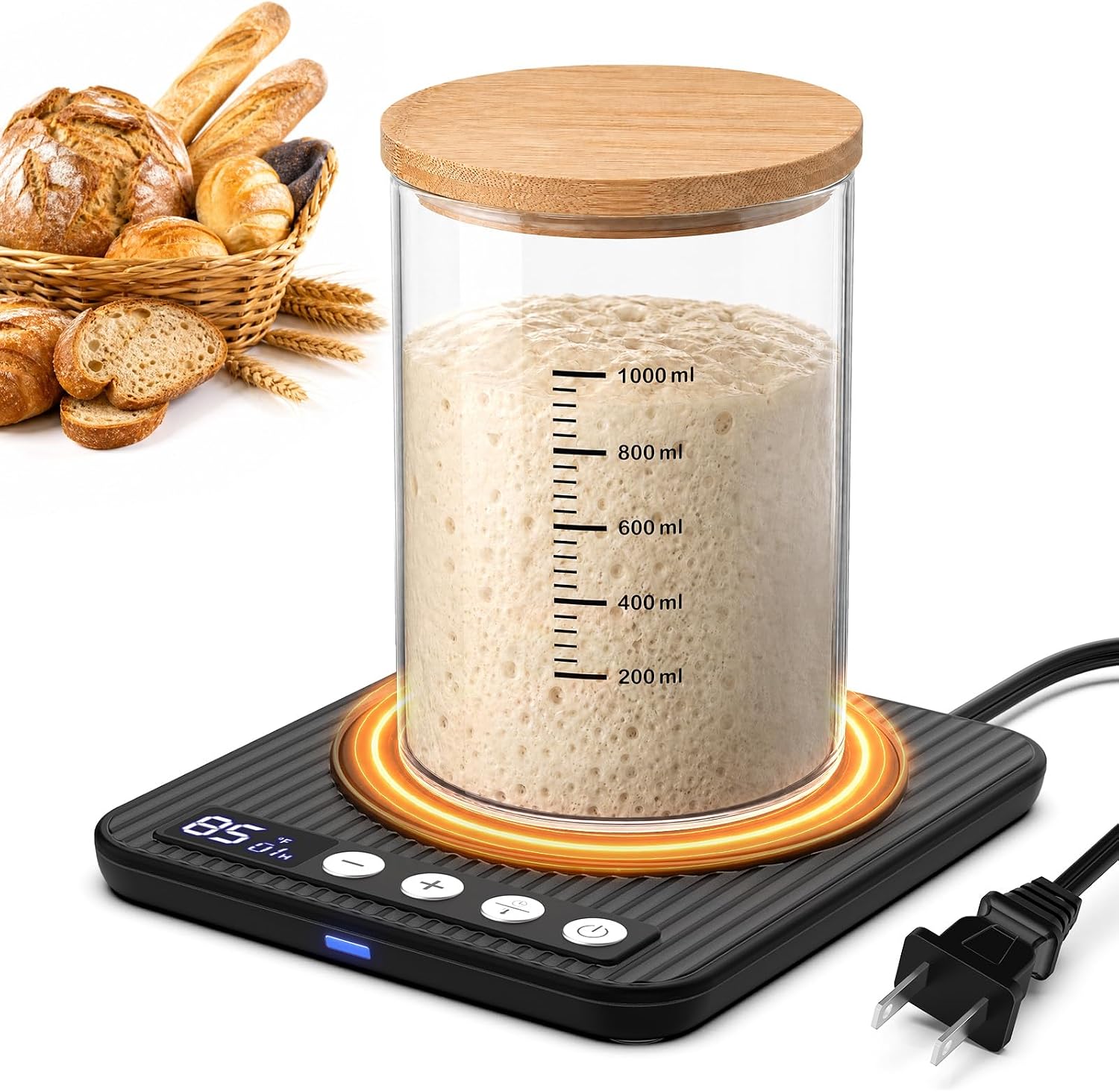
This warming base features a stainless steel dough probe to measure core temperature directly inside the starter. It offers degree-by-degree settings from seventy to one hundred ten degrees Fahrenheit, a twenty-four hour timer, and automatic shut-off within a walnut finish housing.

Best for Direct core temperature tracking

Stainless steel dough probeDegree-by-degree temperature settings24-hour timer functionFits most jarsFood-grade materials
View on Amazon →

What stands out

  • Measures core temperature directly inside the starter with a stainless steel probe for precise thermal feedback during activation.
  • Offers degree-by-degree temperature adjustments ranging from seventy to one hundred ten degrees Fahrenheit to suit various recipes.
  • Includes a twenty-four hour timer with an automatic shut-off feature for reliable and safe overnight fermentation cycles.

What to consider

  • The compact six-and-a-half inch square footprint requires careful measurement when pairing with unusually wide fermentation crocks or oversized glass storage vessels.
  • Relying on a direct physical probe means bakers must clean the stainless steel component thoroughly after each individual use.
Key specifications
Item Dimensions L x W x H
6.5"L x 6.5"W x 0.98"H
Material Type
Plastic
Maximum Temperature
110 °F
Color
Black
Model Number
S3-black
Manufacturer
Pakusane

The practical verdict

Best suited for bakers who want precise core temperature measurements rather than relying on external air warmth. Avoid this model if you prefer a completely hands-off setup without physical probes entering your starter culture. The primary trade-off involves balancing advanced internal sensing accuracy against the daily routine of cleaning the attached stainless steel probe after every fermentation cycle.

#2
Sourdough Starter Warmer Box Home Incubator for Starter Fermentation
Dual-Plate Enclosed Incubator

Sourdough Starter Warmer Box Home Incubator for Starter Fermentation

Best for Enclosed windless jar incubation

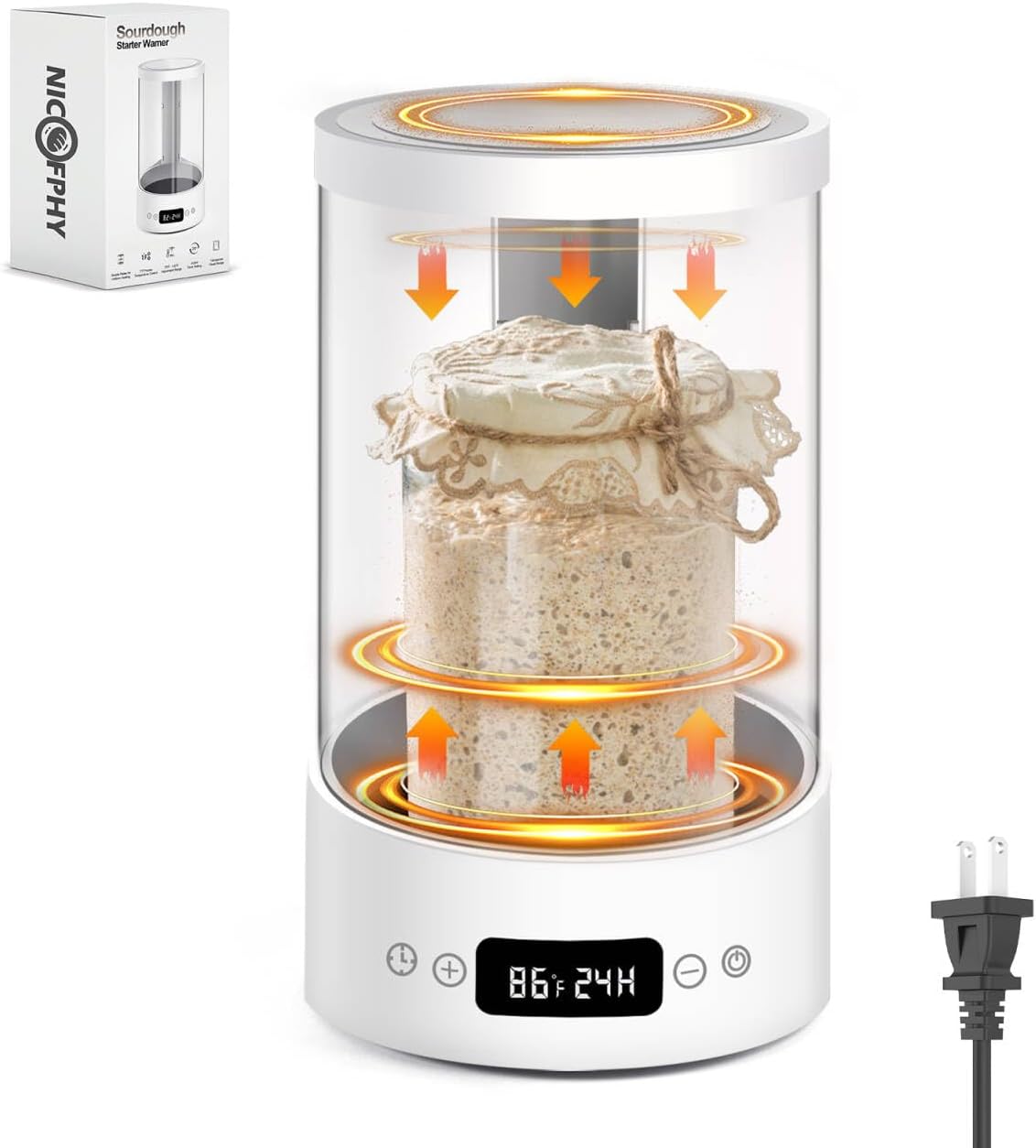
Designed with upper and lower heating plates connected through magnetic conductivity, this enclosed incubator creates a stable, windless warming environment. It features a precise one-degree Fahrenheit thermostat ranging from seventy to one hundred degrees Fahrenheit, a transparent protective dome, and a low twenty-watt power consumption profile.

What stands out

  • Employs dual heating plates located at both the top and bottom to generate a stable thermal environment.
  • Features a transparent warming dome that lets you monitor the starter without removing the cover.
  • Operates on a low twenty-watt power profile to maintain energy efficiency during extended fermentation periods.

What to consider

  • The enclosed dome restricts jar dimensions to a maximum height of seven inches and a diameter of four point four inches.
  • Operating the upper heating plate requires ensuring the protective dome is properly secured to maintain electrical contact.
Key specifications
Wattage
20 watts
Material Type
Acrylic
Maximum Temperature
100 °F
Color
White
Model Number
SSWPP
Manufacturer
NICOFPHY

The practical verdict

Best for bakers seeking an enclosed, windless environment that protects cultures from drafts during cold winter months. Avoid if your preferred fermentation jars exceed seven inches in height or four point four inches in width. The main trade-off is the physical dimension constraint of the protective dome versus the benefit of uniform top-and-bottom heating coverage.

#3
Sourdough Starter Warmer Mat with Precise Temp Control and Timer
Dual-Mode Heating Mat

Sourdough Starter Warmer Mat with Precise Temp Control and Timer

Best for Compact dual-mode warming mat

This dual-mode heating mat delivers steady temperatures across a broad sixty-five to one hundred forty degree Fahrenheit range, accommodating both fermentation and general warming tasks. It features a four point five three inch aluminum plate designed for twenty-four to forty ounce jars, a one to twenty-four hour safety timer, and a compact footprint.

What stands out

  • Provides dual-mode functionality supporting lower fermentation ranges and higher warming ranges for beverages or dairy.
  • Equipped with a four point five three inch aluminum plate designed to fit standard mason jars.
  • Includes a one to twenty-four hour safety timer with an automatic shut-off feature for overnight use.

What to consider

  • The built-in safety feature prevents the warmer from activating if the surrounding room temperature already equals or exceeds your target setting.
  • The compact aluminum surface is specifically optimized for small twenty-four to forty ounce jars rather than large containers.
Key specifications
Product Dimensions
6.3 x 5.3 x 0.59 inches
Item Weight
7.8 ounces
Manufacturer
Colorlife
ASIN
B0H8YQG82D
Item model number
A-2919-1
Best Sellers Rank
#9,245 in Kitchen & Dining (See Top 100 in Kitchen & Dining) #6 in Brewing Heaters & Temperature Controls

The practical verdict

Best for users looking for a versatile mat that handles both sourdough activation and beverage warming in a compact format. Avoid if your kitchen routinely stays warmer than your target fermentation setting, as the safety mechanism will block activation. The core trade-off is compact storage and multi-mode flexibility paired with physical limitations on container sizing and ambient activation thresholds.

#4
Folding Bread Proofing Box with Temp Control and Timer
Large Capacity Folding Proofer

Folding Bread Proofing Box with Temp Control and Timer

Best for High-capacity collapsible proofing chamber

Built for versatility, this folding proofing box offers a twenty-two liter capacity and adjustable temperatures from fifty to one hundred thirteen degrees Fahrenheit. It utilizes a multi-layer insulating construction, an internal stainless steel shelf to prevent bottom overheating, a forty-eight hour timer, and a collapsible design that folds flat when not in use.

What stands out

  • Provides a spacious twenty-two liter capacity suitable for handling multiple jars or larger dough bowls simultaneously.
  • Features a collapsible design that folds flat into a compact profile for easy storage in crowded kitchens.
  • Includes an internal stainless steel shelf to elevate containers and prevent bottom overheating from the heating element.

What to consider

  • The larger fabric and insulated structure requires significantly more counter space during operation than a simple flat warming mat.
  • Consumes sixty-three watts of operating power, which demands slightly more electrical capacity than smaller dedicated single-jar warming bases.
Key specifications
Capacity
22 liters
Size
M - 12" x 12" x 12"
Wattage
63 watts
Material
Polyester, Oxford Fabric, Acrylic, Polypropylene, Insulation Cotton
Temperature Range
50-113 °F
Item Dimensions D x W x H
11"D x 11"W x 11"H

The practical verdict

Best for bakers managing large bread batches, multiple fermentation vessels, or diverse projects like yogurt and kombucha. Avoid if you only need a tiny footprint for a single mason jar on a crowded counter. The primary trade-off is gaining massive internal capacity and versatile temperature ranges at the expense of a larger physical footprint during baking sessions.

#5
Sourdough Starter Warmer with Glass Dome and Precise Thermostat
Glass Dome Starter Warmer

Sourdough Starter Warmer with Glass Dome and Precise Thermostat

Best for Visual monitoring glass dome base

Combining a digital warming base with a thick glass cover, this unit offers degree-by-degree temperature control from seventy to one hundred degrees Fahrenheit. It features heat compensation technology to minimize environmental errors, a zero to twenty-four hour timer with auto shut-off, and an ABS plastic body designed for standard two-prong electrical outlets.

What stands out

  • Features a thick glass cover that reduces heat loss while allowing clear visual monitoring of the starter.
  • Includes heat compensation technology designed to minimize temperature inaccuracies during actual operation.
  • Offers a zero to twenty-four hour timer with automated scheduling for shut down and startup cycles.

What to consider

  • The glass dome imposes strict height and width boundaries, restricting compatible fermenters to four point two inches in diameter.
  • Relying on a breakable glass component requires careful handling and cleaning routines compared to all-plastic or metal units.
Key specifications
Item Dimensions L x W x H
7.09"L x 5.4"W x 8.9"H
Material Type
Plastic
Maximum Temperature
100 °F
Color
White
Model Number
Starter Warmer with Glass Cover
Manufacturer
Yendse

The practical verdict

Best for bakers who prioritize clear visual inspection through a glass cover while maintaining precise thermal levels. Avoid if you work with wide fermentation crocks that exceed the four point two inch diameter limit of the dome. The main trade-off is the exceptional visibility and insulation provided by the glass cover balanced against its strict vessel size restrictions and breakage considerations.

Buying guide

Evaluating Temperature Control Ranges

Selecting a sourdough warmer requires careful attention to the precise thermal spectrum provided by the device. Different wild yeasts and lactic acid bacteria respond dynamically to subtle thermal shifts, making degree-by-degree adjustments particularly valuable for consistent results. Units offering narrow settings between seventy and one hundred degrees Fahrenheit allow bakers to fine-tune activity levels with absolute confidence.

Broader ranges extending up to one hundred forty degrees provide extra utility for other fermented foods like yogurt, kefir, or kombucha. However, wide ranges must be managed carefully to avoid overheating delicate cultures. Matching the thermostat capability to your specific kitchen environment ensures steady fermentation without accidental overheating or yeast dormancy.

Assessing Physical Footprint and Counter Space

Kitchen counter space is often at a premium during active baking sessions, making the physical footprint of a starter warmer an important selection factor. Compact heating bases and slim mats take up minimal room, slipping easily between appliances without creating clutter. These small formats suit kitchens where storage is tight and daily prep areas remain crowded.

Larger enclosed proofing boxes or units paired with tall glass domes require significantly more vertical and horizontal clearance. While these larger chambers provide superior environmental isolation, they demand dedicated space during operation. Evaluating your available countertop layout before purchasing prevents workflow bottlenecks and ensures your baking equipment integrates smoothly into your kitchen routine.

Understanding Vessel Compatibility Limits

Every warming device imposes distinct physical boundaries regarding the size and shape of the fermentation jar it can accommodate. Flat heating plates and open mats typically rely on a flat bottom surface and adequate base diameter to transfer heat effectively. If your preferred glass storage jar features an unconventional base or excessive width, it may fail to make proper contact.

Enclosed units featuring protective domes or collapsible fabric walls enforce strict height and diameter restrictions to maintain their internal thermal microclimate. Failing to measure your jars beforehand can result in equipment that physically cannot close over your container. Reviewing manufacturer specifications regarding maximum vessel dimensions guarantees your existing glassware will fit inside the chosen warming environment.

Comparing Timer and Safety Features

Managing long fermentation cycles becomes considerably easier when a warming device includes programmable timers and automated safety controls. Built-in clocks spanning up to twenty-four or forty-eight hours allow bakers to set specific operational windows without needing constant manual supervision. This scheduling capability is particularly useful for overnight proofs, extended feeding schedules, or busy workdays.

Automatic shut-off mechanisms provide essential peace of mind by preventing continuous heating once the designated time expires or if safety thresholds are crossed. Some mats also feature environmental lockout sensors that refuse to activate if ambient room temperature already meets the target. Prioritizing these protective functions safeguards your starter from accidental overheating and reduces electrical risks.

Examining Power Consumption and Efficiency

Energy efficiency is a practical consideration for equipment designed to run continuously over many hours or days. Most specialized sourdough warmers operate on very low wattage profiles, consuming minimal electricity compared to traditional kitchen ovens or large appliances. Low-power heating pads and twenty-watt incubator boxes maintain stable warmth without creating noticeable spikes in household utility bills.

Units requiring higher wattages, such as larger collapsible proofing chambers, draw more electrical current to heat expansive internal volumes. While this increased power supports rapid thermal recovery and larger batch sizes, it requires careful placement near accessible wall outlets. Weighing energy draw against your typical batch frequency helps align operating costs with your actual baking habits.

Selecting Enclosed Versus Open Warmers

Deciding between an open warming mat and an enclosed proofing chamber depends heavily on ambient kitchen drafts and seasonal temperature drops. Open heating bases and mats deliver direct conductive warmth to the bottom of the jar, making them quick to set up and easy to access. However, they leave the upper portions of the container exposed to cool room air.

Enclosed warmers and domed incubators surround the entire vessel in a stable thermal microclimate, shielding the culture from cold drafts and moisture loss. This complete enclosure ensures uniform temperature distribution from base to top. Selecting the right style depends on how severely your kitchen temperature fluctuates during winter months and your personal preference for jar accessibility.

Frequently asked questions

What is the ideal temperature for a sourdough starter?

The ideal temperature for maintaining an active sourdough starter generally ranges between seventy and eighty degrees Fahrenheit. Within this thermal window, wild yeast and beneficial lactic acid bacteria thrive symbiotically, producing consistent carbon dioxide bubbles and predictable rise times. When temperatures drop below this range, fermentation slows down dramatically, leading to sluggish activity or flat dough. Conversely, exposing the culture to excessive heat above ninety degrees can stress or weaken the microbial population. Using a specialized warming base or mat helps maintain this specific temperature range consistently.

Can I use a sourdough warmer with any type of jar?

Compatibility depends heavily on the specific design of the warming device and the dimensions of your container. Flat heating mats and bases generally require flat-bottomed vessels, such as standard mason jars or glass storage containers, to ensure proper thermal conductivity. Enclosed boxes and domed warmers enforce strict height and width limits, often restricting jars to specific maximum diameters and heights. Always check the manufacturer specifications for your chosen warmer before attempting to use oversized crocks or uniquely shaped fermentation vessels.

Why does my starter warmer refuse to turn on?

Some sourdough warming mats and bases incorporate built-in safety mechanisms that prevent operation under certain environmental conditions. For instance, if your surrounding room temperature is already at or above your programmed target setting, the internal safety feature will block the heating element from activating. Additionally, certain models require specific user inputs, such as holding the power button down for several seconds to initiate power. Checking the user manual for safety protocols and ambient lockout features usually resolves initial operation confusion.

Do sourdough warmers consume a lot of electricity?

Most dedicated sourdough starter warmers are engineered for high energy efficiency, frequently operating on very low wattage profiles ranging from twenty to sixty-three watts. Because they are designed to run for extended periods, including overnight or twenty-four-hour cycles, their low power draw ensures minimal impact on your household electricity usage. Compact mats and heating bases draw significantly less power than running an entire kitchen oven with the light on, making them economical tools for daily bread baking routines.

How do I clean and maintain a sourdough warmer?

Maintenance requirements vary depending on the construction materials of the specific warming device. Many heating pads feature smooth, BPA-free surfaces that resist sticking and residue, allowing for quick wipedowns with a damp cloth after use. Models equipped with integrated stainless steel probes require careful cleaning of the metal prong after each fermentation cycle to remove starter residue. Always unplug the device before cleaning and follow manufacturer guidelines to protect electronic components and heating surfaces from moisture damage.

Final thoughts

Choosing the right tool to maintain the ideal temperature for your sourdough starter transforms unpredictable baking schedules into a reliable routine. Whether you prefer a compact heating mat, a direct core probe, or an enclosed glass dome incubator, targeted thermal control eliminates guesswork during cold months.

Assessing your kitchen environment, counter space limitations, and jar sizes ensures you select a warming accessory that fits seamlessly into your daily baking workflow. Investing in consistent temperature management empowers you to achieve bubbly, active starters and better artisan bread every single time.