Appliances · Buying Guide

Best Machine for Making Dough: Finding Your Ideal Baking Capacity

Baking homemade bread, pizza bases, and fresh pasta relies heavily on achieving the right gluten structure without exhausting your arms during preparation. An electric dough maker automates both the mixing and resting phases, transforming a tiring manual chore into a streamlined kitchen routine for everyday home bakers and growing families.

Modern countertop kneading appliances combine motorized mixing blades with integrated temperature controls to handle heavy loads efficiently across various kitchen recipes. Whether you need a compact device for small batches or a high-capacity bowl for large family gatherings, comparing specific motor specs, control styles, and bowl sizes ensures a practical kitchen match for your daily baking habits.

As an Amazon Associate, StacyLaughs earns from qualifying purchases.

AIZIYO DoughChief 7.4QT Electric Dough Maker and Mixer
#1 Best Overall

AIZIYO DoughChief 7.4QT Electric Dough Maker and Mixer

This 7.4-quart electric dough maker is built for home bakers managing family-size batches of bread, pizza, or pasta dough. It features a 250-watt motor, a touch control panel, and a removable S-shaped blade that simulates hand kneading. The built-in constant-temperature ferment function maintains 77 to 100 degrees Fahrenheit, while a removable lid lets you add ingredients safely without stopping the mixing cycle.

Best for Family bread and pizza prep

7.4QT stainless steel bowlFerment function includedHand-kneading simulation mixingTouch panel controlsRemovable ingredient lid
View on Amazon →

What stands out

  • Includes a removable S-shaped blade designed to simulate natural hand kneading for proper gluten development without overworking your dough.
  • Features a built-in constant-temperature ferment function that maintains a stable 77 to 100 degrees Fahrenheit to support proper proofing.
  • Equipped with a removable top lid allowing users to easily add flour or water while the mixing machine is running.

What to consider

  • Operating exclusively at a 250-watt power level means heavy, dense dough loads may require careful monitoring compared to higher-wattage commercial units.
  • The digital touch panel requires clean, dry fingers during operation, which can present a minor inconvenience when handling flour-covered hands.
Key specifications
Capacity
7.4 quarts
Item Dimensions D x W x H
11.42"D x 12.2"W x 9.6"H
Wattage
250 watts
Material
304 Stainless Steel
Special Features
Digital Display, Fermentation Function, Lightweight, Low Noise, Time Setting Function
Controls Type
Touch

The practical verdict

This machine suits home bakers seeking a high-capacity bowl and automated fermentation for regular bread or pizza making. Avoid it if you prefer mechanical knobs or require a higher wattage motor for extremely dense commercial-scale recipes. The main trade-off lies between the spacious 7.4-quart stainless steel capacity paired with gentle touch controls and the inherent power limits of a 250-watt motor system during extended kneading sessions.

#2
HaiiuzHi 7.4 Qt Electric Dough Maker with Dual Knobs
Seasonal Ferment Kneader

HaiiuzHi 7.4 Qt Electric Dough Maker with Dual Knobs

Best for Year-round climate-adjusted dough proofing

Designed for everyday home baking, this 7.4-quart electric dough maker incorporates a stainless steel heating base with dedicated summer and winter fermentation modes. It operates with a 250-watt motor and features dual knobs for precise 1-minute time adjustments. An S-shaped stainless steel blade combines flour and water uniformly, while the removable lid provides straightforward access to ingredients throughout the mixing and preparation process.

What stands out

  • Provides dedicated summer and winter fermentation modes on a stainless steel heating base to maintain steady warmth for proofing.
  • Utilizes dual mechanical knobs that allow precise time adjustments in exact one-minute increments for both mixing and fermenting cycles.
  • Features an S-shaped stainless steel blade engineered to blend flour and water into a uniform texture from multiple angles.

What to consider

  • The dual knob interface requires manual resetting for multi-stage recipes, lacking the advanced programmable memory presets found in higher-end appliances.
  • Consuming 250 watts of power across a large 7.4-quart capacity means it is optimized for domestic batch sizes rather than heavy commercial dough loads.
Key specifications
Capacity
7.4 quarts
Item Dimensions D x W x H
11"D x 10"W x 11"H
Wattage
250 watts
Material
Stainless Steel
Special Features
Dual knobs, Overload Protection, Season Ferment Function, Stainless Steel Heating Base, Time Setting Function
Controls Type
Digital Touch Panel With Timer

The practical verdict

This appliance is best for home bakers who want explicit seasonal fermentation controls and precise dual-knob time adjustments for traditional recipes. Avoid it if you need advanced programmable profiles or a heavy-duty motor for continuous commercial baking tasks. The main trade-off is between the convenient seasonal heating base controls and the straightforward manual attention required for multi-stage kneading tasks.

#3
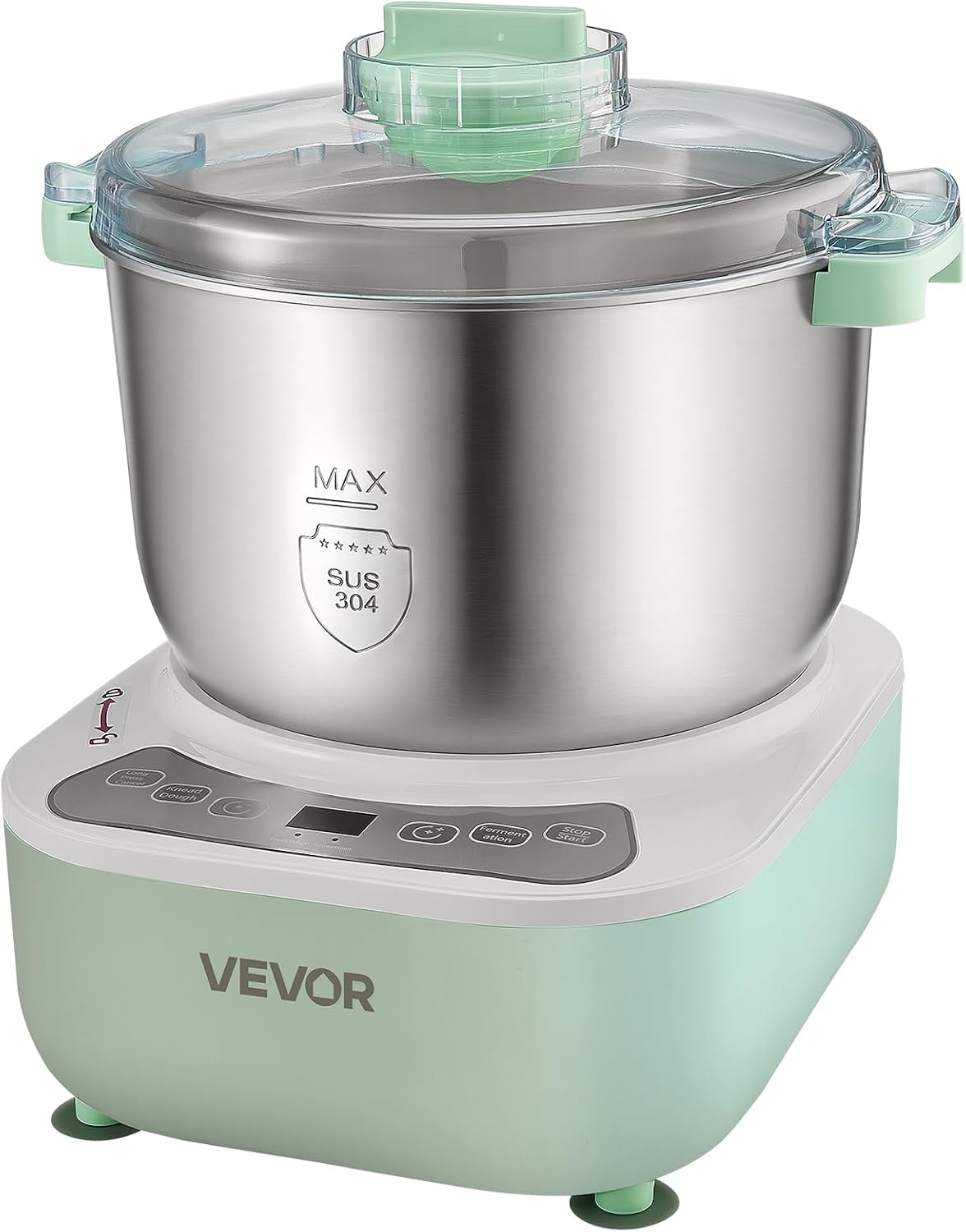
VEVOR 6.9 Quart Electric Dough Maker with Ferment Function
Dual-Function Bread Maker

VEVOR 6.9 Quart Electric Dough Maker with Ferment Function

Best for Large family daily kneading

Offering a 6.9-quart capacity bowl that accommodates up to 1600 grams of flour, this electric dough maker suits larger households. It runs on a 250-watt motor operating at 150 RPM to continuously blend ingredients. The unit combines kneading and constant-temperature proofing in one housing, featuring a detachable ingredient chute for adding water or yeast mid-cycle without interrupting the active mixing process.

What stands out

  • Accommodates up to 1600 grams of flour within its spacious stainless steel bowl, serving larger families or gatherings efficiently.
  • Combines continuous kneading motor performance with constant-temperature proofing functions to handle multiple baking steps in one appliance.
  • Includes a detachable ingredient chute allowing you to add liquids or seasonings without pausing the ongoing mix cycle.

What to consider

  • The ABS body construction combined with a 250-watt motor provides lighter structural durability compared to all-metal commercial-grade kneading appliances available on the market.
  • Operating at a fixed speed of 150 RPM limits your ability to fine-tune blade velocity for specialized pastry recipes requiring variable speeds.
Key specifications
Capacity
6.9 quarts
Item Dimensions D x W x H
11.61"D x 11.42"W x 13.19"H
Wattage
250 watts
Material
ABS Body + SUS304 Stainless Steel Bowl + AS Bowl Sover
Special Features
Easy Operation
Voltage
120 volts_of_alternating_current

The practical verdict

This machine is best for families needing to process large flour batches for daily bread and dumpling making in one go. Avoid it if you require variable speed selections or a heavy metallic exterior housing. The main trade-off balances the generous 1600-gram flour capacity and convenient ingredient chute against the fixed operational speed and lighter ABS exterior construction.

#4
SAMSAIMO 6.5QT Electric Dough Mixer with Knob Control
High-Power Stand Kneader

SAMSAIMO 6.5QT Electric Dough Mixer with Knob Control

Best for Heavy-duty home bread processing

Powered by a robust 600-watt motor, this 6.5-quart stand dough maker handles 300 to 1400 grams of dough efficiently. It simulates hand kneading using an S-shaped stainless steel blade on an intermittent schedule to build gluten. The unit features smart constant temperature fermentation, a mechanical knob control interface, a suction-cup base for stability, and double safety buckles on the removable top lid.

What stands out

  • Features a powerful 600-watt motor that drives the kneading blade effectively through dense flour batches without bogging down.
  • Utilizes a suction-cup base paired with double safety buckles to maintain exceptional stability during high-speed kneading operations.
  • Includes smart intermittent operation and base ventilation vents to prevent excessive heat buildup and protect motor longevity.

What to consider

  • The manufacturer explicitly recommends against cleaning the main mixing bowl in a dishwasher, requiring manual cleanup routines after every baking session.
  • Weighing in with a compact footprint, the 6.5-quart capacity may still feel bulky on crowded countertops during everyday kitchen storage.
Key specifications
Capacity
6.5 quarts
Item Dimensions D x W x H
11.3"D x 10.7"W x 10.82"H
Wattage
600 watts
Material
304 Stainless Steel
Controls Type
Rotary Knob
Voltage
120 volts

The practical verdict

This machine suits bakers who require a high-wattage motor and robust stability features for heavy, dense bread or pizza doughs. Avoid it if you strictly demand dishwasher-safe bowl maintenance or require a lightweight, portable appliance. The main trade-off highlights the exceptional power of the 600-watt motor and secure suction-cup base against the manual washing requirement for the stainless steel bowl.

#5
HEYNEMO 5.2QT Electric Dough Maker with Scale
Precision Scale Dough Maker

HEYNEMO 5.2QT Electric Dough Maker with Scale

Best for Integrated weighing and kneading

Combining automated mixing, fermentation, and an integrated digital scale ranging from 0.04 ounces to 11 pounds, this 5.2-quart dough maker streamlines baking prep. It runs on a 200-watt DC motor designed for quiet operation and features an adjustable timer for custom cycles. Removable parts including the mixing pot and scraper simplify cleanup, while the openable top cover permits easy ingredient additions during operation.

What stands out

  • Includes a built-in precision digital scale measuring from 0.04 ounces up to 11 pounds to streamline recipe ingredient weighing.
  • Employs a quiet DC motor that operates at conversational noise levels to minimize kitchen disturbance during kneading tasks.
  • Provides programmable time settings for both kneading and fermentation cycles to customize your dough preparation routine completely.

What to consider

  • The 200-watt motor is among the lowest powered options, making it less suitable for exceptionally stiff or overloaded dough batches.
  • Offering a 5.2-quart capacity, it handles smaller maximum flour batches compared to larger 7.4-quart alternatives on this list.
Key specifications
Capacity
5.2 quarts
Item Dimensions D x W x H
12.2"D x 10.83"W x 9.45"H
Wattage
200 watts
Material
Stainless Steel
Special Features
Programmable
Controls Type
Touch

The practical verdict

This appliance is best for bakers who value an integrated digital scale and quiet DC motor operation for streamlined kitchen workflows. Avoid it if you need a high-capacity bowl for massive family baking sessions or a high-wattage motor for heavy doughs. The main trade-off balances the exceptional convenience of built-in ingredient weighing and quiet operation against a lower 200-watt power rating and smaller bowl capacity.

Buying guide

Motor Power and Wattage

Motor wattage determines how effectively an electric dough maker handles dense loads like whole-wheat bread or stiff pizza dough without straining internal mechanical components. Units equipped with higher wattages deliver robust torque, preventing the machine from slowing down, stalling, or overheating during prolonged kneading cycles over years of regular home baking.

When selecting a machine, carefully match the motor power rating to your typical baking volume and recipe stiffness requirements. Lower-wattage models suit lighter pastries, pasta, and everyday doughs, whereas high-wattage options provide the enduring power required for heavy, continuous gluten development in busy family kitchens and group gatherings. Proper power ensures longevity.

Bowl Capacity and Batch Size

Bowl capacity dictates how much flour and water you can process in a single batch, directly impacting preparation time for large families. Capacities typically range from five to over seven quarts, allowing bakers to choose options that accommodate small everyday loaves or massive batches of holiday dumplings and savory pizza crusts.

Evaluating your household size helps determine the appropriate bowl volume without purchasing an appliance that consumes excessive counter space. Larger bowls handle substantial flour weights efficiently, but compact alternatives fit neatly into smaller kitchens while still delivering adequate room for standard weekly baking routines and individual recipes. Measure your storage space.

Integrated Fermentation Features

Built-in fermentation functions transform a standard kneading machine into a complete proofing box by maintaining a stable, warm temperature environment for active yeast development. Maintaining consistent warmth between seventy-seven and one hundred degrees Fahrenheit ensures your dough rises evenly and develops rich honeycomb internal structures regardless of external room conditions.

Some advanced models even feature dedicated seasonal modes to calibrate internal heating based on whether your kitchen environment is naturally warm or cold. Selecting a machine with reliable temperature control simplifies the entire baking workflow, eliminating guesswork and reducing the need for separate proofing containers during cold winter months or air-conditioned rooms.

Control Interfaces and Timers

Control interfaces range from digital touch panels and clear LED displays to traditional mechanical rotary knobs, each offering distinct advantages during messy baking sessions. Mechanical knobs allow precise adjustments even when your fingers are covered in flour, while digital touch panels provide sleek aesthetics and exact minute-by-minute timer settings for complete automation.

Programmable timers eliminate the need to watch the clock constantly, allowing the machine to run for a specific kneading or resting duration before automatically stopping. Consider which interface matches your personal workflow preferences and kitchen habits to ensure seamless operation every time you prepare fresh bread or pasta dough at home.

Blade Design and Kneading Action

The shape and movement of the internal kneading blade dictate how effectively flour, water, and yeast combine to form a strong, elastic gluten network. S-shaped stainless steel blades mimic traditional hand-kneading motions, gripping the dough and working it from multiple angles to develop uniform texture without overworking the mixture over time.

Intermittent mix-pause-mix cycles prevent excessive heat buildup from friction, protecting yeast viability and preventing premature rising during the initial mixing phase. Inspecting the blade material and removable design ensures you can easily detach the component for thorough cleaning after completing your daily baking recipes without any hidden residue buildup.

Cleanup and Maintenance Ease

Kitchen appliances that handle sticky dough require thoughtful design features to ensure cleanup remains quick and effortless after every single home baking session. Smooth stainless steel bowls, removable lids, and detachable blades eliminate hard-to-reach corners where flour and dough residue typically accumulate during active mixing cycles in busy households.

Always review manufacturer guidelines regarding dishwasher compatibility, as certain metal bowls or motorized components require gentle hand washing to preserve their surface finish and operational lifespan. Selecting an appliance with easily accessible removable parts saves significant time and effort, making routine maintenance a seamless part of your daily baking routine without frustration.

Frequently asked questions

How does an electric dough maker simulate hand kneading?

An electric dough maker simulates hand kneading primarily through specially designed S-shaped stainless steel blades and programmed intermittent mixing cycles. Instead of spinning continuously at high speeds, which can generate excessive friction and heat, these machines utilize a mix-pause-mix rhythm. This structured pause allows the gluten strands to relax and develop naturally, resulting in dough that is softer, chewier, and more elastic. Furthermore, the multi-angle blade design grips the flour and water mixture efficiently, folding it over repeatedly to mimic the physical stretching and folding motions of a professional baker.

Can I add extra flour or water while the machine is mixing?

Yes, most modern electric dough makers are specifically designed with a removable top lid or an integrated ingredient chute that allows you to add flour, water, butter, or seasonings while the machine is actively running. This convenient feature enables you to adjust the hydration level of your dough dynamically depending on how the mixture feels during the initial mixing phase. You can safely pour liquids or sprinkle extra flour through the opening without having to pause the motor or remove the entire lid, keeping your kitchen counter clean and your workflow uninterrupted.

How does the built-in fermentation function work?

The built-in fermentation function works by utilizing a heated base or temperature-controlled housing to maintain a stable, optimal environment for yeast activity, typically ranging between seventy-seven and one hundred degrees Fahrenheit. This consistent gentle warmth encourages yeast to produce carbon dioxide efficiently, allowing the dough to double in size and develop rich honeycomb internal structures even if your room temperature is cool. Some models even offer dedicated summer and winter settings to compensate for seasonal ambient temperature shifts, ensuring reliable proofing results year-round when used with proper yeast or baking powder.

Are stainless steel mixing bowls and blades dishwasher safe?

Cleaning requirements vary significantly depending on the specific manufacturer guidelines and part materials for each model. While many stainless steel mixing blades and removable lids are safe to place in the dishwasher for quick sanitation, several manufacturers explicitly recommend washing the main stainless steel mixing bowl by hand. Hand washing helps protect specialized base attachments, sealants, or exterior finishes from harsh dishwasher detergents and high heat. Always check the specific user manual instructions provided with your machine to determine the safest cleaning method and prevent premature wear on your equipment.

What capacity do I need for a typical family baking batch?

Choosing the right bowl capacity depends heavily on your household size and how frequently you bake large batches of bread, pizza crusts, or dumplings. Capacities ranging from 5.2 quarts to 7.4 quarts are widely available, with larger 6.5 to 7.4-quart bowls easily handling substantial flour weights between 1,200 and 1,600 grams in a single operation. If you regularly bake for a large family or entertain guests frequently, opting for a higher-capacity bowl ensures you can complete your entire recipe at once without needing to divide ingredients into multiple smaller mixing batches.

Final thoughts

Investing in a dedicated machine for making dough removes the physical strain and guesswork from regular bread and pizza preparation. By automating both the intensive kneading phase and the precise temperature-controlled proofing process, these countertop appliances help home bakers achieve consistent gluten development and even rises without manual exhaustion.

Choosing the ideal model depends on balancing your preferred bowl capacity, motor wattage, and control style against your daily baking habits. Whether you prioritize built-in digital scales, seasonal fermentation modes, or simple mechanical knobs, selecting a well-matched appliance ensures enjoyable baking sessions and delicious homemade results for years to come.