Appliances · Buying Guide

Best sourdough starter float test tools for tracking fermentation rise

Knowing when yeast culture is ready for baking often involves traditional methods like the sourdough starter float test, where a small piece of dough is placed in water to see if it swims. Modern home bakers also rely on specialized warming bases, borosilicate glass jars, aliquot tubes, and temperature probes to monitor fermentation activity accurately.

Using dedicated equipment helps remove uncertainty from daily feedings and dough rising stages. Whether you manage your culture in a wide-mouth glass jar with a temperature strip or use a precision-controlled heating base, having the right setup supports consistent results across every baking project without relying solely on traditional spot-checks.

As an Amazon Associate, StacyLaughs earns from qualifying purchases.

Pakusane SourKeeper Sourdough Starter Warmer Pro Black
#1 Best Overall

Pakusane SourKeeper Sourdough Starter Warmer Pro Black

This proofing base integrates a stainless-steel dough probe that measures core temperature directly inside the dough rather than just ambient air. It offers degree-by-degree temperature settings from 70 to 110 degrees Fahrenheit, a built-in sensor, a 24-hour timer, and automatic shut-off safety features. The walnut-finished plastic device accommodates various mason jars and glass containers for consistent fermentation management.

Best for Direct core temperature fermentation monitoring

Precise temperature settingsBuilt-in dough probe24-hour timer functionFits most jarsAutomatic shut-off safety
View on Amazon →

What stands out

  • Measures core dough temperature directly with a stainless-steel probe rather than relying only on surrounding air warmth.
  • Provides adjustable degree-by-degree temperature settings ranging from 70 to 110 degrees Fahrenheit for precise control.
  • Includes a 24-hour timer function and automatic shut-off capabilities to support unattended operation during long rises.

What to consider

  • Constructed primarily from plastic materials, which may not appeal to bakers who exclusively prefer traditional all-glass or ceramic containers for their kitchen counter setup.
  • Features a compact physical footprint measuring 6.5 by 6.5 inches, potentially limiting placement stability for exceptionally wide or heavy specialized crocks.
Key specifications
Item Dimensions L x W x H
6.5"L x 6.5"W x 0.98"H
Maximum Temperature
110 °F
Lower Temperature Rating
21 °C
Material Type
Plastic
Color
Black
Included Components
With Temp Probe, instruction, sourdough starter warmer

The practical verdict

This warming base suits bakers who want direct core temperature tracking during fermentation. Avoid this device if you prefer unpowered, passive glass jars without electronic controls or cords on your countertop. The primary trade-off involves relying on a plastic-bodied electronic base with a stainless-steel probe rather than a traditional passive storage container, requiring proximity to an electrical outlet while taking up designated counter space during daily baking routines.

#2
Yendse Sourdough Starter Warmer with Glass Dome
Glass Dome Warmer Station

Yendse Sourdough Starter Warmer with Glass Dome

Best for Visual monitoring with regulated warmth

Combines a precision warming mat with a thick clear glass dome that accommodates fermenters up to 4.2 inches wide and 7 inches tall. Features adjustable 70-100°F temperature controls, heat compensation, and a 0 to 24-hour timed auto shut-off function with clear indicator lights. Constructed from durable ABS material for reliable kitchen countertop use.

What stands out

  • Includes a thick clear glass dome that reduces heat loss while allowing visual monitoring of your rising ferment.
  • Provides adjustable temperature settings from 70 to 100 degrees Fahrenheit with built-in heat compensation technology.
  • Offers a 0 to 24-hour timer with indicator lights that change color when the target temperature is reached.

What to consider

  • The glass dome accommodates fermenters up to 4.2 inches in diameter and 7 inches in height, restricting use with larger vessels.
  • Requires a dedicated electrical connection on your counter space, limiting placement options away from active wall outlets in crowded kitchens.
Key specifications
Item Dimensions L x W x H
7.09"L x 5.4"W x 8.9"H
Maximum Temperature
100 °F
Lower Temperature Rating
70 °F
Material Type
Plastic
Color
White
Included Components
Glass Dome, Starter Warmer

The practical verdict

Best for home bakers wanting visual monitoring combined with regulated heating under a protective glass cover. Avoid if your preferred fermentation jars exceed 4.2 inches in width or 7 inches in height. The main trade-off is the physical size restriction of the included dome, which limits container dimensions while keeping your starter warmed and visible during active feeding schedules.

#3
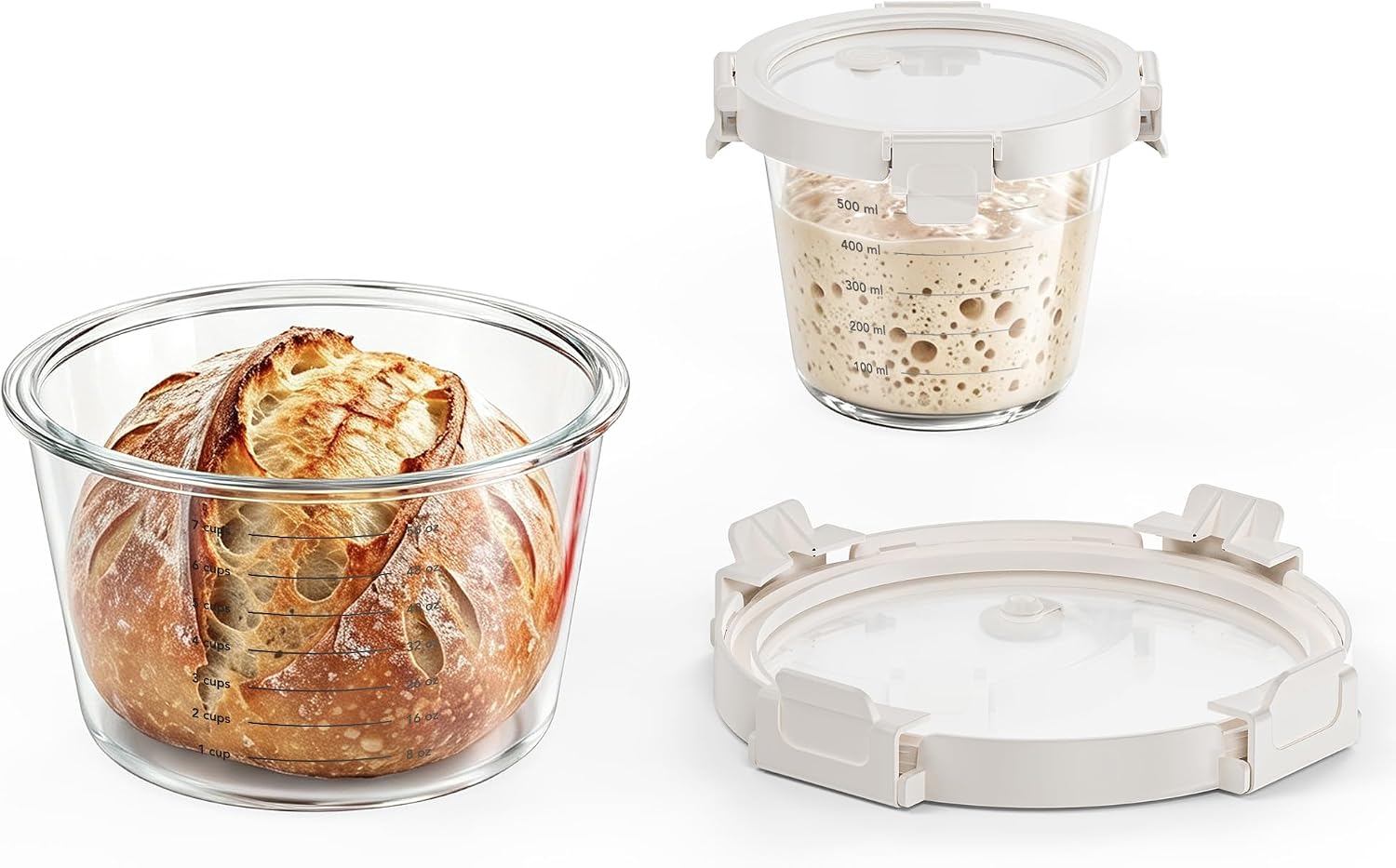
GENICOOK Sourdough Starter Glass Container Set
Dual-Size Borosilicate Glass Set

GENICOOK Sourdough Starter Glass Container Set

Best for Versatile baking prep and proofing

Includes two borosilicate glass containers with capacities of 24 ounces and 71 ounces for feeding starters, mixing batter, and proofing dough. Features crystal-clear glass walls, measurement markings, and BPA-free airtight lids with silicone seals. Safe for microwave, oven use without lids, refrigerator, and dishwasher cleaning.

What stands out

  • Provides two distinct container sizes, with a 24-ounce jar for feeding and a 71-ounce bowl for large dough mixing tasks.
  • Manufactured from durable borosilicate glass that handles temperature changes safely across microwaves, ovens, and refrigerators.
  • Features crystal-clear walls and measurement markings to monitor starter activity and ingredient volumes with ease.

What to consider

  • Lids are made of glass cover plates with silicone seals, requiring removal before placing the containers inside a heated oven.
  • The larger 71-ounce capacity bowl demands substantial storage space in kitchen cabinets and refrigerators compared to compact single-jar setups used for small cultures.
Key specifications
Capacity
4.4 pounds
Size
Large
Material Type
Borosilicate Glass
Product Care Instructions
Dishwasher Safe, Microwave Safe
Lid Material
Glass cover plate
Item Dimensions L x W x H
4.6"L x 3.2"W x 1.5"H

The practical verdict

Best for bakers needing multiple container sizes for both small starter feedings and large dough mixing. Avoid if you only require a single compact jar for minimal yeast maintenance. The main trade-off involves managing two separate glassware pieces that require cabinet storage space, balanced against the versatility of handling both tiny starters and massive bread dough batches in matching vessels.

#4
YILIHCIA 34 oz Wide Mouth Sourdough Starter Jar
Wide-Mouth Tracker Jar Kit

YILIHCIA 34 oz Wide Mouth Sourdough Starter Jar

Best for Tracked room-temperature starter jar

Features a heavy-duty 34-ounce wide-mouth glass jar designed to provide ample headroom for wild yeast expansion without overflow risks. The kit includes a built-in temperature strip, a rotatable elastic tracking band for logging feeding times, dual lids with unbleached linen and aluminum options, and a long custom silicone spatula for scraping deep container walls cleanly.

What stands out

  • Equipped with a built-in temperature strip and elastic tracking band to monitor climate zones and exact feeding schedules.
  • Supplies dual lids featuring unbleached linen for breathable fermentation and secure aluminum for refrigerator storage.
  • Includes a long custom silicone spatula designed specifically to scrape deep jar bottoms and sides cleanly.

What to consider

  • Relies on ambient room temperature rather than active electronic heating elements, requiring a naturally warm kitchen environment for rapid yeast activation.
  • The 34-ounce capacity may require frequent dividing if you maintain a very large volume of active baking culture daily.
Key specifications
Product Dimensions
3.74 x 3.74 x 7.28 inches
Item Weight
1.21 pounds
Manufacturer
YILIHCIA
Item model number
YL-SSJ-34
ASIN
B0GZDCMDM8
Date First Available
May 3, 2026

The practical verdict

Best for bakers wanting an all-inclusive jar kit with manual tracking bands and dual lid options. Avoid if you require active electronic temperature regulation rather than passive room-temperature fermentation tracking. The main trade-off is relying on manual observation and ambient kitchen warmth instead of automated heating, balanced by the convenience of included tracking bands and dedicated mixing spatulas.

#5
Solrify Sourdough Aliquot Glass Fermentation Tracker Tube
Aliquot Fermentation Tracker Tube

Solrify Sourdough Aliquot Glass Fermentation Tracker Tube

Best for Precise small-sample rise tracking

Designed with clear durable glass featuring a precise 0 to 150 percent scale to monitor a small sample portion of dough rise independently. The set includes a glass tube with a lid, a supportive silicone base, a vacuum pump for sample transfer, and a dedicated cleaning brush to maintain clarity between baking sessions.

What stands out

  • Features a clear 0 to 150 percent scale printed on durable glass to track exact dough rise percentages easily.
  • Isolates a small aliquot sample portion so you can monitor fermentation progress without disturbing a larger mixing bowl.
  • Comes complete with a silicone base, vacuum pump for transfers, and a cleaning brush for straightforward maintenance.

What to consider

  • Designed specifically for small sample portions, meaning it does not store your main bulk sourdough starter culture or handle mixing tasks.
  • Includes specialized accessories like a vacuum pump and cleaning brush that require dedicated storage space in your kitchen drawers separate from standard baking tools.
Key specifications
Capacity
1 ounces
Size
Small
Material Type
Glass
Color
White
Included Components
Base, Glass Jar, Lid, brush, pump
Model Number
Mini01

The practical verdict

Best for bakers who want precise percentage-based tracking using a dedicated small dough sample tube. Avoid if you need a primary container for feeding, mixing, and storing your main bulk starter culture. The main trade-off is managing a separate glass tube alongside your main container, trading general bulk storage convenience for highly specific rise measurement accuracy during proofing stages.

Buying guide

Temperature Regulation Methods

Maintaining optimal warmth for wild yeast cultures requires understanding how environmental climate affects daily fermentation speed. Active warming bases and specialized glass domes offer controlled thermal environments that keep your sourdough starter active regardless of chilly indoor temperatures. These powered devices remove seasonal guesswork by delivering steady heat directly to the vessel, ensuring reliable yeast behavior during colder months.

On the other hand, unpowered glass jars rely entirely on ambient household heat, which can introduce timing inconsistencies when room temperatures fluctuate. Choosing between active electronic warmth and traditional passive setups depends heavily on your local climate and baking schedule. Evaluating your kitchen environment helps determine whether an automated warming tool or a simple countertop jar best suits your routine.

Material Selection and Durability

Selecting the right material for your baking vessels impacts both daily maintenance and long-term durability. Borosilicate glass offers superior resistance to thermal shock, allowing safe transitions between refrigerators, microwaves, and warm ovens without cracking. This specialized glass also provides crystal-clear visibility, letting you inspect bubbles and yeast activity easily from every angle during active feeding routines.

Plastic components appear frequently in electronic warming bases and digital control panels, offering lightweight construction and easy cleaning surfaces. While plastic lacks the heat tolerance of borosilicate glass for oven baking, it provides practical housing for heating elements and sensors. Balancing glass and plastic components ensures your kitchen setup meets both high-heat baking demands and reliable daily measurement needs.

Capacity and Jar Sizing

Choosing appropriate container capacities prevents overflow messes and accommodates your specific baking batch sizes. Smaller vessels around 24 to 34 ounces work exceptionally well for daily starter maintenance, yeast activation, and minor feedings without wasting flour. These compact jars fit easily on crowded countertops and inside standard refrigerators during dormant storage stages.

Larger bowls exceeding 70 ounces provide necessary headroom for mixing heavy bread dough and large batter quantities during active prep days. However, oversized mixing containers demand substantial storage space in kitchen cabinets and require more countertop footprint. Assessing your typical loaf output ensures you select capacity sizes that match your baking volume without creating unnecessary clutter.

Tracking Fermentation Progress

Monitoring yeast rise accurately helps bakers catch their culture at peak activity before shaping artisanal loaves. Built-in temperature strips and rotatable elastic bands attached directly to storage jars allow you to record exact feeding times and track volume expansion visually. These physical markers eliminate memory guesswork during busy baking schedules, giving you clear indicators for when your culture reaches maximum vigor.

Advanced aliquot tracking tubes isolate a tiny sample portion of dough to measure exact rise percentages on a printed scale. This targeted method lets you monitor fermentation progress independently from your main bulk storage container without disturbing the entire batch. Combining visual tracking bands with specialized scale tubes ensures precise timing control across multiple daily proofing stages.

Lid Types and Sealing Options

Selecting the correct lid type depends on whether your starter is currently active or resting in dormancy. Unbleached linen cloth covers permit breathable air exchange during active room-temperature fermentation, supporting wild yeast respiration. In contrast, silicone-sealed glass lids and secure aluminum covers prevent moisture loss and block kitchen odors during cold refrigerator storage.

Having dual lid options gives you the flexibility to transition smoothly between active feeding phases and long-term storage without buying separate accessories. Airtight seals also minimize accidental spills if a jar gets bumped on a crowded shelf. Reviewing included lid configurations ensures your kit adapts seamlessly to every stage of your baking routine.

Included Tools and Accessories

Complete baking kits often include specialized accessories that simplify routine maintenance and ingredient mixing tasks. Long custom silicone spatulas reach deep into narrow jar bottoms and straight sides to scrape flour clumps cleanly without scratching delicate glass surfaces. Vacuum pumps and dedicated cleaning brushes also assist with precise aliquot sample transfers and post-baking cleanup chores.

Evaluating what accessories come bundled with your container helps determine overall value and day-to-day kitchen convenience. Tools designed specifically for jar geometry prevent awkward scraping angles and keep your workspace tidy during messy feeding sessions. Investing in a well-equipped kit streamlines your preparation workflow from the initial flour and water mix all the way to the final dough rise.

Frequently asked questions

How do warming bases help maintain sourdough starter activity?

Warming bases provide regulated thermal energy directly to your fermentation vessel, bypassing chilly room temperatures that can slow down wild yeast development. By utilizing adjustable thermostats ranging from 70 to 110 degrees Fahrenheit, these devices keep your culture in its ideal growth zone. Integrated temperature probes measure core heat directly inside the dough rather than just surrounding air, ensuring consistent fermentation speeds. This active warming approach removes seasonal guesswork, helping your sourdough starter reach peak activity predictably regardless of household climate changes.

Why is borosilicate glass preferred for fermentation jars?

Borosilicate glass is specifically chosen for fermentation jars due to its superior resistance to thermal shock compared to standard glassware. This durability allows bakers to safely transition containers between refrigerated storage, microwave heating, and warm oven environments without risking cracks or breaks. Additionally, the crystal-clear walls provide unobstructed visibility, enabling you to monitor bubbles, yeast expansion, and batter consistency in real time. Combined with dishwasher-safe properties, borosilicate glass offers a sanitary and long-lasting environment for cultivating wild yeast cultures.

What are the benefits of using an aliquot jar set?

An aliquot jar set allows bakers to isolate a small sample portion of their dough inside a dedicated glass tube to monitor fermentation progress independently. Featuring a precise 0 to 150 percent scale, these tubes let you track exact rise percentages without disturbing the main bulk starter container. This specialized tracking method helps determine the exact moment your dough reaches target expansion for shaping or chilling. Complete with supportive silicone bases and vacuum pumps, aliquot sets bring scientific precision to home bread baking.

How do tracking bands and temperature strips assist daily baking?

Tracking bands and temperature strips offer simple passive tools to monitor your sourdough culture without requiring electronic devices. Rotatable elastic bands let you mark the exact starting level of your fed starter and rotate the marker to log feeding times, making it easy to catch peak rise. Built-in temperature strips display ambient climate conditions in real time, ensuring your jar stays within the active 70 to 80 degree Fahrenheit zone. Together, these accessories eliminate memory guesswork and streamline daily maintenance routines for home bakers.

Why are wide-mouth jars and custom spatulas important for starters?

Wide-mouth jars provide generous physical openings that make feeding flour and water significantly easier while reducing messy spills on your counter. The wider entry also allows your hand or cleaning tools to reach inside effortlessly for thorough washing. Paired with custom long silicone spatulas designed to scrape deep jar bottoms and vertical sides, these kits prevent dry flour clumps from forming. This combination ensures your culture remains evenly mixed and your storage containers stay clean for accurate volume tracking throughout every baking cycle.

Final thoughts

Cultivating healthy wild yeast requires reliable tools that match your kitchen environment and baking habits. Whether you choose an electronically controlled warming base with core temperature probes or a passive borosilicate glass jar set with manual tracking bands, having the right equipment simplifies daily maintenance routines.

Evaluating container capacities, material durability, and included accessories helps you build a practical setup for consistent bread making. By selecting products tailored to your specific temperature and volume needs, you can approach every fermentation stage with confidence and precision.