Appliances · Buying Guide

Best Fresh Roast Coffee Roaster Choices for Every Batch Size

Roasting coffee at home or in a small commercial environment allows enthusiasts and business operators to control flavor profiles directly from green beans. Selecting a dedicated roaster depends heavily on heating methods, batch capacities, and digital or manual control features. Equipment choices range from compact electric countertop appliances to gas-powered glass drum setups and heavy-duty commercial machines designed for continuous production.

Understanding these distinct hardware differences helps buyers match equipment to specific roasting volumes, ventilation needs, and desired flavor outcomes. Whether you require automated cooling systems, precise temperature dials, or large-capacity rotating drums, exploring available models clarifies which design suits your daily routine and spatial constraints without guesswork.

As an Amazon Associate, StacyLaughs earns from qualifying purchases.

JAYUDQE Electric Coffee Bean Roaster Machine with 300g Capacity
#1 Best Overall

JAYUDQE Electric Coffee Bean Roaster Machine with 300g Capacity

This electric coffee bean roaster delivers 1200W of heating power for home use, accommodating a recommended 300 to 500g batch size. Designed with adjustable temperature settings, it supports various roast levels from light to dark. The plastic housing incorporates an energy-saving mode and easy-to-clean design, while its multifunctional capability extends to roasting peanuts and popcorn alongside green coffee beans.

Best for Home batch bean roasting

Adjustable temperature settings1200W electric heating power300g batch capacityNonstick pan designEasy to clean
View on Amazon →

What stands out

  • Provides a high 1200-watt heating capacity that helps green coffee beans reach proper roasting temperatures effectively.
  • Offers adjustable temperature controls to let users target specific roast levels and experiment with different bean profiles.
  • Features a multifunctional design that accommodates alternative foods like peanuts and popcorn for added kitchen versatility.

What to consider

  • The plastic material construction requires careful adherence to recommended batch sizes to maintain balanced heating performance during operation.
  • Operating at a fixed 110V power level limits high-voltage electrical compatibility for certain international power configurations.
Key specifications
Capacity
300 g
Item Dimensions D x W x H
12"D x 13.6"W x 5.9"H
Material
Plastic
Other Special Features of the Product
Easy to Clean, Energy-Saving Mode, Temperature Adjustment
Specific Uses For Product
baking fresh coffee beans
Coffee Maker Type
Bean-To-Cup

The practical verdict

This electric roaster is best suited for home enthusiasts looking for a high-wattage appliance capable of handling 300 to 500-gram batches of green coffee beans or snacks. Avoid it if you require commercial-grade capacities or advanced programmable profiling features. The main trade-off involves balancing the plastic exterior build with the powerful 1200-watt heating element for consistent everyday roasting results.

#2
MAGO MAGA Roma Pro Smart Home Coffee Bean Roaster
Smart Digital Roaster

MAGO MAGA Roma Pro Smart Home Coffee Bean Roaster

Best for Smart home coffee roasting

The Roma Pro smart home roaster combines a 0.3kg capacity with an upgraded bean bin door switch and ultra-low smoke operation. It features a digital display with Celsius and Fahrenheit switching, automated and manual modes, a double-layer glass window, and an auto-cooling function. Designed specifically for green coffee beans, it delivers consistent results supported by hot air roasting technology.

What stands out

  • Includes dual automatic and manual operating modes to accommodate both beginner setups and customized roasting profiles.
  • Equipped with a double-layer glass window and an auto-cooling function to monitor progress and lock in flavor.
  • Employs an efficient chaff collector and hot air system to maintain ultra-low smoke output during indoor use.

What to consider

  • The 0.3kg capacity restricts single-batch output, making it less practical for high-volume commercial or large family demands.
  • Decaf green beans require manual mode operation for optimal results, adding complexity for novice users.
Key specifications
Capacity
0.3 kg
Item Dimensions D x W x H
6"D x 8.3"W x 18.5"H
Material
Glass
Operation Mode
Semi-Automatic
Coffee Input Type
green coffee beans
Other Special Features of the Product
Timer

The practical verdict

This smart roaster is best for home coffee enthusiasts seeking digital temperature control, automated cooling, and low-smoke operation. Avoid it if you need to process large quantities of beans in a single batch. The primary trade-off is the compact 0.3kg capacity, which prioritizes precise countertop convenience over high-volume commercial output.

#3
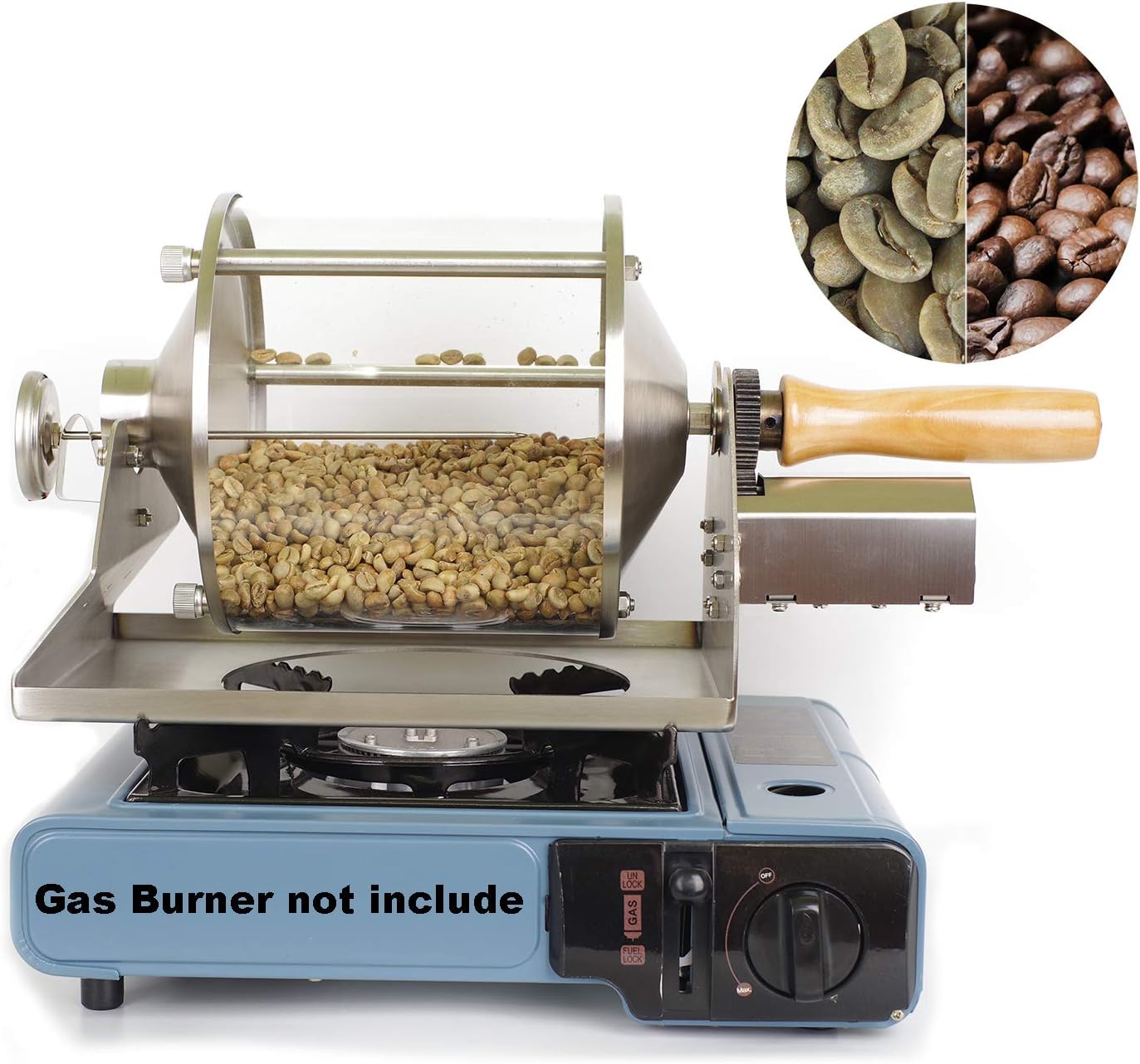
DYVEE KAKA-G400 Gas Burner Coffee Roasting Machine 300g
Gas-Powered Drum Roaster

DYVEE KAKA-G400 Gas Burner Coffee Roasting Machine 300g

Best for Visual gas-source roasting

Featuring a quartz glass drum and a 304 stainless steel frame, this gas burner coffee roaster accommodates up to 400 grams max capacity with a recommended 200 to 300 grams per batch. It operates on a safe 12V electrical motor with an included power adapter. The transparent quartz drum allows direct visual monitoring of bean color changes when paired with an external gas heat source.

What stands out

  • Combines a quartz glass drum with a stainless steel frame for high visibility and robust heat resistance.
  • Employs a safe 12-volt low-voltage electrical motor paired with an included power adapter for drum rotation.
  • Allows direct flame heating control via a gas burner to track bean development closely through cracks.

What to consider

  • Requires an external gas burner setup, which may limit placement options compared to self-contained electric heating appliances.
  • The recommended 200 to 300-gram batch size means users must process multiple runs for larger quantities.
Key specifications
Capacity
300 g
Item Dimensions D x W x H
8.46"D x 8.27"W x 16.93"H
Wattage
400 watts
Voltage
12 volts
Material
Glass
Power Source
gas, electricity

The practical verdict

This gas-powered roaster is best for hobbyists who enjoy traditional flame-based roasting and visual monitoring through a quartz glass drum. Avoid it if you prefer an all-in-one electric appliance without external gas line requirements. The main trade-off is managing a separate gas heat source alongside the rotating glass drum mechanism.

#4
Chef Prosentials BAMI-200G Electric Coffee Bean Roaster 200g
Compact Direct-Fire Roaster

Chef Prosentials BAMI-200G Electric Coffee Bean Roaster 200g

Best for Small-batch direct roasting

This newly upgraded electric roaster features a patented direct fire imitating design with a maximum 200g bean capacity. Constructed with a stainless steel body, it comes equipped with a chimney pipe, smoke purifier, and toolkits. Designed for whole coffee beans, the unit supports manual and programmable operation to help beginners start home roasting with structured equipment support.

What stands out

  • Incorporates a patented direct fire imitating design to replicate traditional roasting methods using electric power.
  • Includes essential accessory components like a chimney pipe, smoke purifier, and toolkits for immediate setup.
  • Offers manual and programmable operation modes suitable for beginners exploring whole coffee bean roasting.

What to consider

  • The 200g maximum capacity is relatively small, requiring frequent batch processing for higher daily coffee consumption.
  • Managing the included chimney pipe and smoke purifier setup requires dedicated vertical space on your countertop.
Key specifications
Capacity
200 g
Item Dimensions D x W x H
12.6"D x 8"W x 10.2"H
Material
Stainless Steel
Coffee Input Type
whole bean
Other Special Features of the Product
Manual, Programmable
Included Components
Chimney Pipe, Roaster Body, Smoke Purifier, Toolkits

The practical verdict

This electric roaster is best for beginners and small households wanting a direct-fire simulation with included purification tools. Avoid it if you require larger batch capacities exceeding 200 grams. The trade-off centers on the compact unit size and included chimney accessories versus the need for frequent batch reloading during heavy use.

#5
HNZXIB Commercial Electric Coffee Bean Roaster 8.8LBS
Commercial Stainless Roaster

HNZXIB Commercial Electric Coffee Bean Roaster 8.8LBS

Best for High-volume commercial roasting

Built for commercial environments, this electric roaster features an industrial microcomputer panel with a wide 86 to 572-degree Fahrenheit temperature range and 360-degree rotating drum heating. Available in 4.4LBS and 8.8LBS models, it uses food-grade stainless steel construction and supports multi-purpose roasting for coffee beans, nuts, and grains. The removable inner drum allows complete cleaning between varied product batches.

What stands out

  • Delivers 360-degree uniform rotational heating across a wide industrial temperature range for consistent commercial processing.
  • Constructed entirely from food-grade stainless steel with a removable inner drum to prevent flavor cross-contamination.
  • Offers large 4.4-pound and 8.8-pound capacity options to satisfy busy cafe and nut-roasting production demands.

What to consider

  • Strictly limits single continuous heating sessions to a maximum of four hours to protect internal components.
  • The heavy-duty commercial construction and high capacity require dedicated floor or heavy countertop space.
Key specifications
Capacity
8.8 pounds
Item Dimensions D x W x H
10"D x 10"W x 10"H
Other Special Features of the Product
PID Temperature Control
Coffee Input Type
whole bean
Included Components
Coffee Bean Roaster 8.8LBS
Style
Modern

The practical verdict

This commercial roaster is best for boutique cafes, snack shops, and high-volume studios requiring precise temperature control and large batch capacities. Avoid it if you only need casual, small-batch home roasting solutions. The primary trade-off is the heavy-duty commercial footprint and the four-hour continuous heating limit.

Buying guide

Evaluating Batch Capacities for Home Versus Commercial Roasting

When choosing a fresh roast coffee roaster, matching the machine capacity to your daily coffee consumption or business volume is an essential first step. Home-focused models typically handle between two hundred and five hundred grams per batch, which easily suits personal daily routines and small households. Selecting a unit that aligns with your typical output prevents unnecessary reloading cycles and ensures steady freshness.

Commercial environments require significantly larger capacities, ranging from four to nearly nine pounds per run to meet steady customer demand. Evaluating how much coffee you consume or sell helps determine whether a compact countertop appliance or a heavy-duty stainless steel rotating drum machine represents the correct long-term fit for your workspace.

Comparing Electric Heating Elements Versus Gas Burner Setups

The choice between electric heating and gas-powered drum roasters dictates where and how you operate your equipment. Electric roasters offer self-contained convenience, plugging directly into standard household outlets with integrated digital displays or adjustable temperature dials. They provide controlled heating without requiring external fuel lines or specialized burner adjustments during the roasting cycle.

Gas burner roasters utilize external heat sources alongside quartz glass drums, offering direct visual tracking of bean color changes. While gas setups require careful flame management and proper ventilation, they appeal to hobbyists who prefer traditional roasting methods. Assessing your kitchen layout and comfort level with flame adjustments will guide your final equipment selection.

Understanding Temperature Control and Programmable Profile Options

Precise temperature management allows you to target light, medium, or dark roasts with reliable flavor development across every batch. Advanced roasters feature digital panels with wide temperature ranges and integrated timers, supporting both automated beginner modes and detailed manual profiling. These sophisticated controls help eliminate guesswork by letting you monitor heat progression accurately throughout the entire roasting session.

Simpler models rely on basic adjustable dials, offering straightforward operation without complex programming requirements or steep learning curves. Consider your willingness to experiment with custom heat profiles versus your desire for straightforward, one-touch automation when selecting a machine. Matching control complexity to your personal experience level ensures an enjoyable and repeatable roasting routine.

Managing Smoke Output and Ventilation Requirements Indoors

Roasting green coffee beans naturally produces loose chaff and smoke, making smoke management an important factor for indoor kitchen use. Many modern home roasters incorporate efficient chaff collectors and hot air circulation systems designed to maintain ultra-low smoke output during operation. These built-in features help keep indoor air clear without requiring complex external ductwork installations.

Other specialized units include dedicated chimney pipes and external smoke purifiers to filter emissions effectively during direct-fire roasting processes. Carefully evaluating your existing kitchen ventilation or workspace setup ensures you choose a machine whose smoke reduction capabilities match your indoor environment, preventing unwanted lingering odors or air quality issues.

Material Construction and Long-Term Durability Considerations

The materials used in building a coffee roaster affect both its thermal performance and its overall ease of maintenance over time. Stainless steel frames and food-grade interior drums resist corrosion, rust, and high-temperature dry burning, ensuring reliable durability for frequent users. Removable inner drums further simplify thorough residue cleaning between successive batches.

Quartz glass drums provide excellent visibility for monitoring bean transformation, though they require careful handling during routine cleaning. Plastic housings offer lightweight portability but demand strict adherence to manufacturer guidelines regarding operating temperatures and batch limits. Balancing material durability with cleaning preferences helps protect your equipment investment over years of use.

Versatility Beyond Coffee Beans for Multi-Use Kitchens

Many electric and commercial roasters offer multi-purpose functionality that extends well beyond standard green coffee beans. These versatile machines can readily accommodate alternative food items such as peanuts, popcorn, sunflower seeds, chestnuts, and various grains. Choosing a multi-use appliance allows you to expand your home or business snack-making capabilities with a single countertop device.

Dedicated coffee-only roasters focus exclusively on bean development and chaff management, optimizing their internal airflow and thermal profiles strictly for coffee roasting applications. Assessing whether you want a specialized single-purpose coffee machine or a flexible multi-functional roaster helps align your final purchase decision with your broader daily habits and snacking preferences.

Frequently asked questions

Can I roast coffee beans in any electric home roaster?

Not all electric home roasters function identically, as some appliances are specifically designed for green coffee beans while others accommodate alternative foods like peanuts and popcorn. It is important to review manufacturer specifications regarding input types and recommended batch sizes before starting. Using a machine outside its intended parameters can lead to uneven roasting results or potential equipment strain. Always verify whether a model requires manual monitoring or employs automated modes for your specific beans.

How do I control roast levels from light to dark?

Controlling roast levels depends on the features built into your chosen roaster, such as adjustable temperature dials, digital control panels, or manual monitoring windows. By observing bean color changes and tracking development through the first and second cracks, you can determine when to stop the roasting process. Units with precise temperature settings allow you to replicate specific flavor profiles consistently across multiple batches, while simpler machines require close visual attention from the operator.

Do home coffee roasters produce a lot of smoke?

Smoke output varies depending on the specific roasting technology and ventilation design of the machine. Many modern home roasters incorporate built-in chaff collectors and hot air systems to maintain ultra-low smoke during operation. Other models may include chimney pipes or external purification tools for direct-fire setups. Reviewing the design details of each appliance helps you select a unit that fits your indoor kitchen ventilation capabilities without creating excessive smoke.

What is the typical batch size for home coffee roasters?

Typical batch sizes for home coffee roasters generally range from two hundred to five hundred grams per session, depending on the appliance design and manufacturer recommendations. Staying within the recommended batch capacity ensures proper airflow and balanced heating performance across all beans. Attempting to overload a roaster can cause uneven heating, resulting in burnt edges or undercooked cores, which compromises the overall flavor quality of your freshly roasted coffee.

How should I clean and maintain my coffee roaster?

Cleaning and maintenance procedures depend on the materials and construction of your roaster. Stainless steel models often feature removable inner drums that allow complete residue cleaning between batches to prevent flavor cross-contamination. Glass drums and plastic housings require careful wiping and adherence to manufacturer guidelines regarding operating limits. Following specific maintenance instructions for heating elements and chaff trays ensures long-term durability and consistent roasting performance.

Final thoughts

Investing in a dedicated fresh roast coffee roaster transforms how you experience coffee by unlocking the rich, complex flavors of freshly processed green beans. Whether you choose an electric countertop appliance with adjustable temperature dials, a gas-powered glass drum, or a heavy-duty commercial machine, understanding batch capacities and heating methods ensures you select the right tool.

By carefully evaluating your available kitchen space, indoor smoke management needs, and desired roasting volume, you can enjoy customized coffee profiles tailored to your exact taste preferences right at home or in your commercial workspace.