Appliances · Buying Guide
Best Food Mill for Applesauce Choices for Canning and Pureeing
Making smooth homemade applesauce requires the right mechanical separation tool to keep out unwanted skins, seeds, and tough cores without slowing down your kitchen workflow. A reliable food mill automates this filtering process smoothly using interchangeable metal discs and a manual rotary crank operated entirely by hand power.
Whether you are processing a modest batch of fresh orchard fruit or tackling massive preserving projects during peak harvest season, selecting a dedicated manual mill ensures consistent textures for every recipe. We examine five distinct models equipped with varied disc configurations, stability hooks, and comfortable handles to match your exact cooking and canning habits.
As an Amazon Associate, StacyLaughs earns from qualifying purchases.
Buying guide
Disc Variety and Texture Control
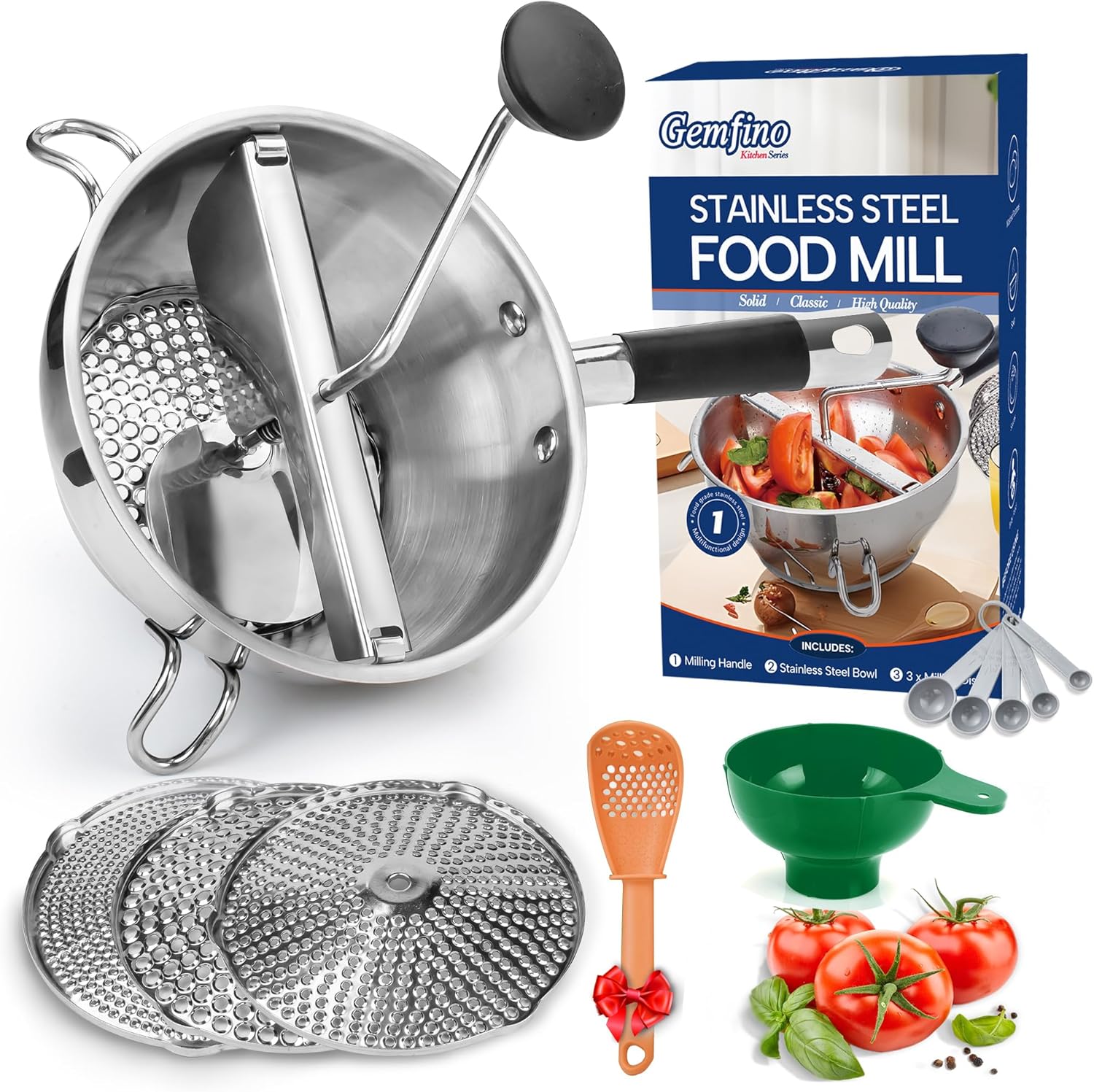
Selecting a food mill with multiple interchangeable stainless steel discs gives you complete control over your applesauce consistency. Whether you prefer a chunky, rustic style or an ultra-smooth puree, having access to fine, medium, and coarse grinding options transforms how you handle raw fruit. Swapping discs lets you adapt one tool for different recipes.
Beyond apples, these multi-disc configurations successfully process tomatoes for marinara, root vegetables for smooth mashes, and berries for seedless jams. Matching the pore size to your ingredients prevents clogging and ensures clean separation. Always verify how many discs are included so your equipment accommodates both everyday cooking tasks and large harvest preservation goals without needing additional kitchen attachments.
Bowl Capacity and Batch Size
The total volume capacity of your food mill directly dictates how efficiently you can process large batches of autumn apples during canning season. Smaller units around two quarts work wonderfully for quick side dishes and small family meals, but they demand constant emptying. Larger 3.5-quart basins reduce interruption frequency significantly.
Assess your typical harvest yield before purchasing to avoid buying a model that requires endless stopping and refilling. Keep in mind that wider bowls also require larger storage footprints inside your kitchen cabinets. Balancing your storage constraints against your average cooking batch ensures you select a practical model that fits your lifestyle.
Stability Hooks and Mounting Design
A secure mounting system prevents the food mill from sliding around or tipping over into your hot fruit puree while you turn the crank. Look for models featuring dual hooks or molded support legs that anchor firmly across the rims of your mixing bowls and cooking pots.
These stabilizing structural elements create a firm triangle of support, transferring downward force safely onto your countertop vessel rather than your tired wrists. Check the maximum pot diameter specifications to ensure compatibility with your existing kitchen cookware collection. Proper anchoring makes active batch processing much safer and far less messy overall.
Handle Ergonomics and Crank Comfort
Turning a manual crank through pounds of cooked fruit can quickly cause hand fatigue if the equipment lacks thoughtful ergonomic features. Look for models incorporating soft silicone grips on both the stationary handle and the rotating crank. These non-slip surfaces improve leverage and cushion your palms during extended canning sessions.
Spring-loaded levers also ease the mechanical strain by smoothing out the rotational motion. Investing in a comfortable, well-balanced handle design ensures you can finish processing bushels of apples without experiencing painful cramping or losing your grip on sticky kitchen days.
Material Durability and Cleaning Ease
Stainless steel construction provides exceptional resistance against rust, corrosion, and staining from acidic ingredients like tomatoes and citrus fruits. Selecting food-grade stainless parts guarantees long-term durability across many preserving seasons. Additionally, smooth polished metal surfaces prevent food particles from clinging stubbornly to the basin walls.
Many modern stainless steel mills offer dishwasher-safe construction, simplifying post-cooking cleanup routines significantly. If a model includes wooden handles or plastic exterior jackets, review manufacturer care instructions to maintain those specific components properly over time. Durable materials protect your kitchen investment.
Multi-Function Kitchen Versatility
While applesauce is a primary motivation for purchasing a food mill, a truly versatile kitchen tool should handle much more than just orchard fruits. Consider models that excel at straining tomato seeds for smooth sauces, ricing potatoes for fluffy holiday sides, and pressing berries for homemade jams.
Evaluating the broader utility of included accessories, such as scraping spoons or extra-fine mesh trays, helps maximize your kitchen equipment value. Choosing a multi-functional mill turns a seasonal canning instrument into a year-round helper for purees, baby food, and vegetable prep.
Frequently asked questions
Do I need to peel or core apples before putting them through a food mill?
You generally do not need to peel or core apples before using a food mill, provided you cook or steam the fruit until it is soft first. The mechanical action of the rotary crank and metal disc automatically separates smooth apple pulp from tough skins, stems, and seed cores. However, quartering the apples beforehand helps them fit comfortably into the basin and ensures smoother cranking rotation. Cooking the fruit thoroughly softens the flesh so the blades can press out maximum yield without jamming the mechanism.
Can I use a food mill for making tomato sauce as well as applesauce?
Yes, a food mill is exceptionally effective for making tomato sauce because the fine and medium discs easily strain out stubborn tomato skins and tiny seeds. You can process cooked or softened tomatoes directly through the basin, leaving you with a silky, seedless puree for canning or immediate cooking. Many models are specifically designed with corrosion-resistant stainless steel to handle acidic ingredients like tomatoes without rusting or degrading over time. Always select a disc with smaller pores for the smoothest tomato texture.
How do I choose the right bowl size for my food mill?
Choosing the correct bowl size depends directly on the volume of fruit or vegetables you plan to process during a typical cooking session. Smaller food mills holding around two to two-and-a-half quarts work wonderfully for quick side dishes, baby food, and modest family meals without taking up excessive storage space. If you regularly tackle massive autumn harvests or bulk canning projects, a larger three-and-a-half-quart model will save you time by reducing the frequency of emptying waste pulp from the basin.
Are food mills difficult to clean after processing sticky fruits?
Cleaning a food mill is generally straightforward, especially if the model features dishwasher-safe stainless steel construction and easily removable milling discs. Sticky fruit residues and apple pulp rinse away quickly under warm running water, particularly when using the included scraper spoons to clear the bottom filter mesh. Models with spring-loaded levers allow you to pop discs out instantly without struggling with tools. Always check manufacturer guidelines regarding wooden handles or plastic exterior parts to ensure proper long-term maintenance.
Do food mills require electricity to operate?
Food mills do not require electricity or power outlets because they rely entirely on a manual rotary hand crank operated by physical strength. This non-electric design offers wonderful portability, allowing you to set up your preserving station anywhere in the kitchen, on a porch, or even during off-grid cooking without worrying about cord lengths. While turning the crank requires some manual effort during large batches, the direct tactile control helps you pace the grinding process and ensures you never overheat or over-process delicate fruit purees.