Appliances · Buying Guide
Best Heavy Duty Roasting Pan Options for Holiday Meals and Everyday Baking
Choosing a heavy duty roasting pan can transform how you prepare holiday turkeys, large roasts, and everyday family meals. Selecting the right materials and design ensures food cooks evenly while providing enough structural support to handle heavy ingredients without warping during high-temperature baking sessions and busy kitchen routines.
Different models feature distinct construction types, ranging from multi-clad stainless steel to carbon steel and aluminum-encapsulated bases. Understanding these construction variations helps you find a roasting pan that matches your specific cooking habits, stovetop compatibility requirements, maximum oven temperature limits, and preferred cleanup methods. Reviewing available sizes and rack styles further ensures you select versatile cookware suited for your favorite recipes and hosting needs.
As an Amazon Associate, StacyLaughs earns from qualifying purchases.
Buying guide
Material Composition and Heat Distribution
Material selection dictates how a heavy duty roasting pan performs during prolonged baking sessions. Pure stainless steel offers lasting durability, rust resistance, and a non-reactive cooking surface that preserves natural food flavors. Models featuring aluminum-encapsulated bases or multi-clad layers significantly improve thermal conductivity, preventing localized hot spots and ensuring uniform cooking results across the entire base.
Alternatively, carbon steel provides sturdy structural support for heavy holiday birds while distributing heat efficiently in standard ovens. Nonstick coatings simplify food release and cleanup, though they often impose strict maximum temperature limits. Carefully evaluate your typical cooking temperatures, stovetop needs, and cleaning preferences before deciding on a specific material build for your kitchen.
Size and Dimensional Capacity
Choosing the correct pan dimensions ensures your roaster easily accommodates large holiday turkeys, prime ribs, and family-size lasagna dishes without forcing ingredients together. Standard roasting pans frequently measure between seventeen and twenty inches in length, providing ample surface area for large cuts of meat surrounded by root vegetables. Verifying exterior dimensions prevents frustrating oven sizing conflicts during busy meal preparations.
In addition to surface length and width, interior sidewall depth plays a crucial role in preventing messy oven spills during active roasting. Taller walls ranging from four to six inches safely contain splattering pan juices and allow you to bake multi-layered casseroles. Always measure your oven interior and storage cabinet dimensions to guarantee a proper fit before purchasing your cookware.
Racks and Air Circulation Design
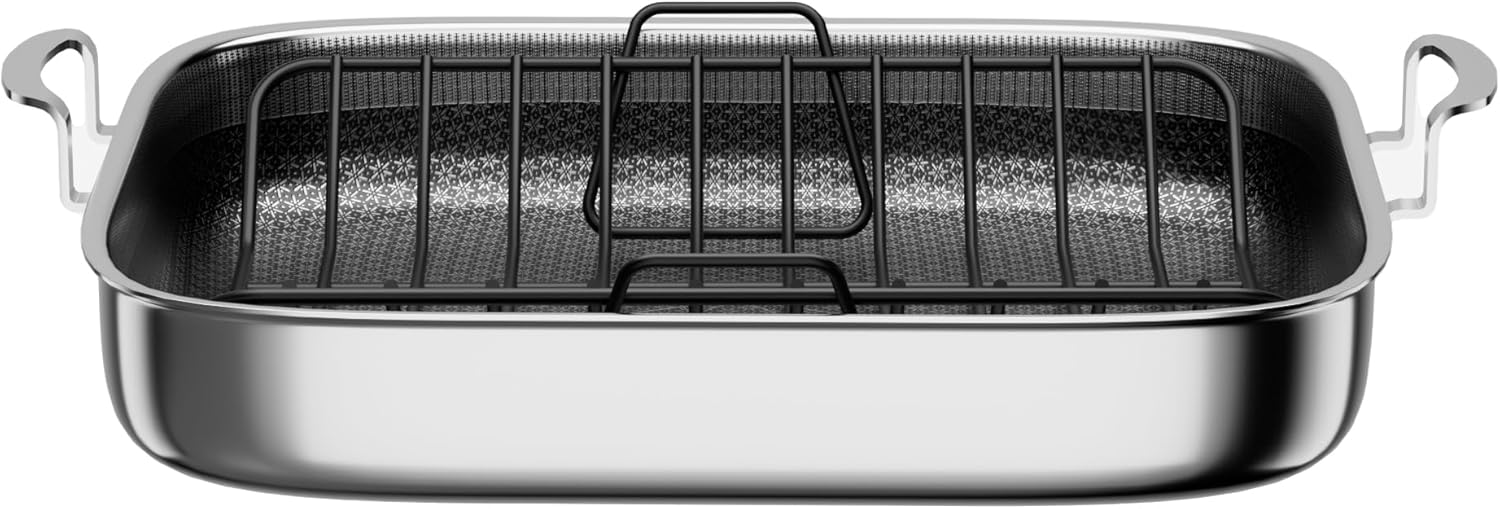
An included roasting rack is an essential component for achieving evenly browned poultry and crisp meat exteriors. Elevating meat above the floor of the pan allows hot air to circulate completely underneath, preventing the base of your roast from boiling in accumulated fats and liquids. Selecting the right rack style directly improves overall texture and roasting efficiency.
Removable U-shaped and V-shaped racks offer distinct structural advantages depending on what you plan to cook. V-shaped wires cradle round poultry securely in place during carving, while standard U-shaped inserts work exceptionally well for general beef roasts and root vegetables. You can also remove these wire inserts entirely when utilizing the deep pan base for baking large multi-layered casseroles.
Handle Design and Safe Transport
Moving a heavy loaded roasting pan from a hot oven to a kitchen counter requires secure and reliable handles. Fixed stainless steel or aluminum handles provide rigid anchor points, offering greater structural confidence than pivoting drop handles when carrying heavy holiday meals and oversized turkeys. Strong handle welding ensures long-term durability under heavy loads and repeated use.
Because metal handles absorb oven heat rapidly during extended baking cycles, you must always use thick protective oven mitts. Wide handle loops ensure your gloved fingers maintain a firm, confident grip, reducing the risk of accidental slips or spills when transporting heavy roast poultry and hot liquids across your kitchen floor. Proper grip confidence is paramount for kitchen safety.
Stovetop Compatibility and Heat Limits
Not all roasting pans are designed to transition seamlessly from the oven to a stovetop burner for making pan gravies or reduction sauces. Multi-clad stainless steel pans typically offer broad compatibility with gas, electric, and induction cooktops, allowing direct stovetop use. This versatility simplifies complex kitchen routines by consolidating cooking tasks into a single versatile vessel.
In contrast, carbon steel and standard aluminum models are usually restricted strictly to oven use and cannot handle direct induction or stovetop burner heat sources safely. Furthermore, maximum temperature ratings vary by material construction, with certain nonstick pans capped below five hundred degrees Fahrenheit. Always check manufacturer heat limits before starting your recipe to prevent accidental cookware damage.
Maintenance and Cleaning Considerations
Keeping a heavy duty roasting pan clean depends heavily on its surface finish and protective coatings. Stainless steel models with mirror finishes often resist rust and withstand dishwasher cleaning, though hand-washing is frequently recommended to protect exterior sheens from chipping or marring during aggressive wash cycles. Proper cleaning maintenance extends overall cookware lifespan significantly.
Nonstick and carbon steel roasters require gentle washing methods and non-metal utensils to preserve their delicate coatings over years of holiday cooking. Avoid harsh abrasive scouring pads that can scratch specialized cooking surfaces, and always follow specific manufacturer cleaning instructions to maintain long-term product appearance and performance durability across countless family dinners and holiday events.
Frequently asked questions
What size roasting pan do I need for a holiday turkey?
Selecting the appropriate roasting pan size depends directly on the total weight of your holiday turkey and your oven's interior capacity. For large birds up to twenty-five pounds, a spacious pan measuring seventeen to eighteen inches long with adequate depth is ideal to prevent overcrowding and contain juices. Smaller roasters around sixteen inches work well for everyday family meals, moderate roasts, and smaller chickens. Always measure your oven racks and interior cavity before purchasing to ensure the pan fits comfortably with enough clearance for heat circulation.
Can I use metal utensils on a nonstick roasting pan?
Using metal utensils on standard nonstick roasting pans is generally discouraged because sharp edges can easily scratch, mark, or peel the delicate coating over time. Instead, opt for silicone, wooden, or heat-resistant plastic utensils to protect the nonstick surface during cooking and serving. However, certain advanced hybrid stainless steel pans feature specially etched scratch-resistant designs explicitly engineered to accommodate metal utensils without sustaining damage. Always verify the specific manufacturer guidelines for your exact pan model before using metal tools in the kitchen.
Are all roasting pans safe for use on induction cooktops?
Not all roasting pans are compatible with induction cooktops. Traditional carbon steel and standard aluminum roasters lack the necessary magnetic properties or construction required to function on induction burners, restricting their use strictly to standard ovens. Conversely, multi-clad stainless steel roasting pans and models featuring aluminum-encapsulated induction-compatible bases can transition smoothly from your oven to induction, gas, or electric cooktops. Checking the product specifications beforehand ensures you select cookware that matches your specific kitchen stove capabilities.
Why should I use a roasting rack inside the pan?
Using a roasting rack provides significant cooking advantages by lifting meats, poultry, and vegetables off the direct floor of the pan. This elevation promotes superior hot air circulation completely around the food, resulting in even browning and a crisp exterior texture. Furthermore, the rack keeps your roast from sitting and boiling in its own accumulated fats and liquids, while allowing savory drippings to collect cleanly in the bottom of the pan for preparing gravies and sauces later.
How should I clean and maintain my stainless steel roasting pan?
Cleaning and maintaining a stainless steel roasting pan typically involves washing the vessel with warm soapy water and a soft sponge to remove food residues. While many stainless steel roasters are technically dishwasher safe, manufacturers often recommend hand-washing to prevent improper dishwasher loading from chipping or marring exterior mirror finishes over time. For stubborn baked-on foods, soaking the pan in warm water before gentle scrubbing helps preserve the polished surface and ensures lasting durability for your kitchen cookware collection.