Appliances · Buying Guide

Best 5 Tray Food Dehydrator Options for Home Snacking

Finding the right appliance to preserve garden harvests, craft homemade jerky, or prepare dried fruit snacks can transform your kitchen routine. A 5 tray food dehydrator provides an efficient footprint for processing moderate batches of produce without dominating countertop space. These compact machines utilize internal heating elements and fans to circulate warm air, gently removing moisture while retaining natural flavors and textures.

Exploring the available market reveals diverse configurations featuring adjustable temperatures, transparent stacking trays, and digital timers. Whether you prefer basic dial controls or precise programmable settings, selecting a model depends on your specific snack preferences and available storage space. Understanding the core attributes of each option helps streamline your search for reliable home food preservation.

As an Amazon Associate, StacyLaughs earns from qualifying purchases.

Elite Gourmet 5-Tray Food Dehydrator with Adjustable Temperature
#1 Best Overall

Elite Gourmet 5-Tray Food Dehydrator with Adjustable Temperature

This Elite Gourmet model features five 11.4-inch clear drying trays that expand from 8.5 to 10.75 inches tall to accommodate thicker items. Driven by a 350-watt base-mounted heating system and temperature dial ranging from 95 degrees Fahrenheit to 158 degrees Fahrenheit, it circulates warm air evenly. Transparent tiers let you monitor progress directly, and removable components simplify cleanup after processing batches of jerky or fruit chips.

Best for Compact countertop fruit and jerky drying

Adjustable temperature dialFive expandable traysEven heat distributionBPA-free constructionDishwasher safe parts
View on Amazon →

What stands out

  • Adjustable temperature dial ranges from 95 degrees Fahrenheit to 158 degrees Fahrenheit to suit fruits, vegetables, and jerky.
  • Transparent drying trays expand vertically to accommodate thicker cuts of food while allowing visual progress monitoring without lid removal.
  • Base-mounted fan circulates warm air evenly across all five levels to maintain consistent drying performance for batches.

What to consider

  • The power indicator is a static blue light rather than a digital temperature display, meaning you must rely on manual dial adjustments for heat levels.
  • Stackable configuration relies on physical height adjustments that may limit internal vertical clearance compared to larger cabinet-style dehydrator units.
Key specifications
Number of Trays
5
Item Dimensions D x W x H
11.4"D x 11.4"W x 8.5"H
Wattage
350 watts
Temperature Range
158 °F
Material
Aluminum
Voltage
120 volts

The practical verdict

This dehydrator suits users seeking a straightforward, compact appliance for processing moderate quantities of fruit chips, vegetables, and jerky at home. Avoid this model if you require precise digital timing controls or stainless steel construction. The primary trade-off involves balancing the convenience of expandable transparent plastic trays and a manual temperature dial against the lack of automated shutoff timers or digital readout screens.

#2
FOHERE 5-Tray Food Dehydrator with Digital Control
Programmable Stackable Tray Dehydrator

FOHERE 5-Tray Food Dehydrator with Digital Control

Best for Quiet overnight snack preparation

The FOHERE dehydrator combines a 400-watt heating engine with precise digital controls, allowing users to set temperatures from 95 to 158 degrees Fahrenheit and timers up to 48 hours via an LED display. It includes five flexible, BPA-free stackable trays that adjust between two height settings. Designed for quiet overnight operation, it features an integrated cord wrap and non-slip feet for convenient storage.

What stands out

  • Intuitive LED display supports precise digital temperature and timer adjustments spanning up to forty-eight hours for unattended processing.
  • Stackable trays adjust to two distinct heights, providing flexibility to accommodate varying food thicknesses during snack preparation tasks.
  • Integrated cord wrap and non-slip feet support compact storage and stability on standard kitchen countertops during operation.

What to consider

  • Stackable plastic tray architecture requires manual rearrangement and careful handling when stacking multiple tiers for larger drying cycles.
  • Maximum temperature threshold tops out at 158 degrees Fahrenheit, which may require careful adherence to specific meat processing guidelines.
Key specifications
Number of Trays
5
Item Dimensions D x W x H
8.27"D x 11.42"W x 8.66"H
Wattage
400 watts
Temperature Range
95-158 °F
Material
Polycarbonate (PC), Stainless Steel
Voltage
120 volts

The practical verdict

Best suited for home cooks who value quiet operation and precise digital timing controls for overnight snack creation. Avoid if you prefer heavy-duty stainless steel racks or maximum temperatures exceeding 158 degrees Fahrenheit. The primary trade-off centers on utilizing adjustable plastic stackable tiers with digital scheduling convenience, contrasted against the limitations of a capped temperature range and manual tier stacking requirements during heavy batch processing.

#3
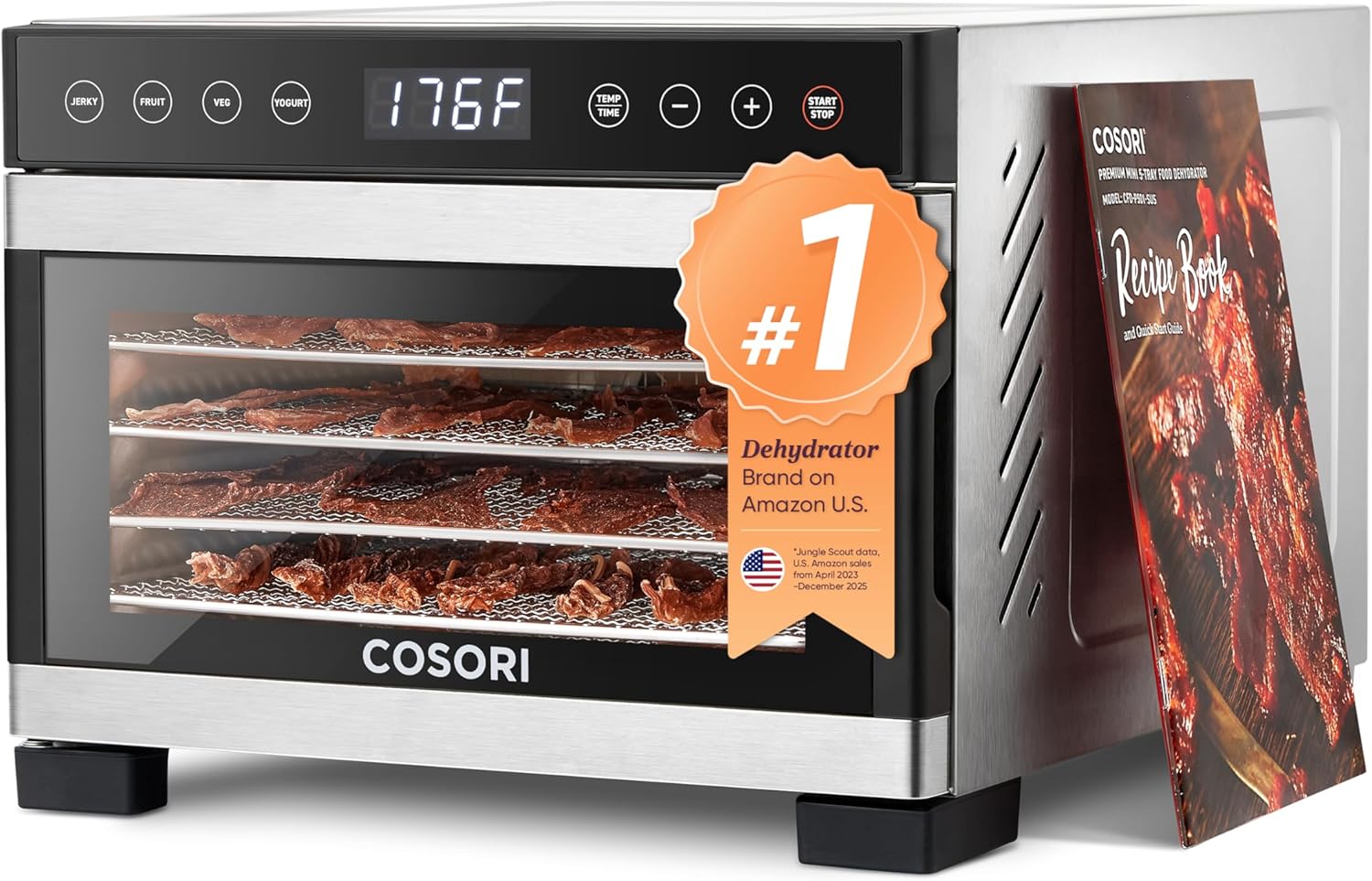
Cosori 5-Tray Stainless Steel Food Dehydrator
Stainless Steel Tray Dehydrator

Cosori 5-Tray Stainless Steel Food Dehydrator

Best for High-temperature jerky and fruit drying

Built with five stainless steel trays offering 3.1 square feet of drying space, this Cosori model reaches temperatures up to 176 degrees Fahrenheit in one-degree increments. It features four convenient presets for jerky, fruit, vegetables, and yogurt, paired with a rear-mounted fan for balanced airflow. The package includes a recipe cookbook, mesh screen, and fruit roll sheet to support diverse culinary projects.

What stands out

  • Reaches a maximum temperature of 176 degrees Fahrenheit in one-degree increments to accommodate higher heat requirements for meat jerky.
  • Five stainless steel trays provide a durable drying surface spanning 3.1 square feet for processing moderate food quantities.
  • Includes specialized accessories like a mesh screen and fruit roll sheet alongside four convenient preset cooking modes.

What to consider

  • Stainless steel tray configuration occupies a fixed rectangular footprint that requires adequate counter space during operation and storage.
  • Rear fan placement demands clear airflow clearance behind the unit, limiting placement options against tight kitchen backsplash areas.
Key specifications
Number of Trays
5
Item Dimensions D x W x H
13.9"D x 11.3"W x 8.9"H
Wattage
480 watts
Temperature Range
95-176 F °F
Material
Stainless Steel
Voltage
110 volts

The practical verdict

This appliance excels for users prioritizing stainless steel construction and higher temperature thresholds for making traditional meat jerky. Avoid if you require expandable vertical stacking rings or a round footprint. The primary trade-off involves gaining durable metal surfaces and temperature precision up to 176 degrees Fahrenheit while managing a fixed rectangular appliance footprint and rear airflow clearance requirements on kitchen counters.

#4
Cosori 5-Tray Compact Food Dehydrator Machine
Expandable BPA-Free Dehydrator

Cosori 5-Tray Compact Food Dehydrator Machine

Best for Quiet expandable batch drying

Featuring five large BPA-free trays with an outer diameter of 12.2 inches, this Cosori unit reaches up to 165 degrees Fahrenheit and operates at noise levels under 47 decibels. The system allows expansion up to seven trays and features adjustable heights for thick-cut foods. Solid polypropylene construction ensures durability, while digital controls support run times up to 48 hours in 30-minute increments.

What stands out

  • Operates quietly below 47 decibels, making it suitable for running overnight without disrupting household environments.
  • Expandable design supports adding two extra trays to the existing five-tier setup for increased food processing capacity.
  • Solid polypropylene construction provides robust durability compared to fragile clear plastic shell alternatives on the market.

What to consider

  • Maximum temperature tops out at 165 degrees Fahrenheit, which sits slightly below units designed for specialized high-heat drying applications.
  • Additional trays and accessory sheets must be sourced separately if you decide to expand beyond the initial five-tier configuration.
Key specifications
Number of Trays
5
Item Dimensions D x W x H
12.2"D x 12.2"W x 8.98"H
Wattage
350 watts
Temperature Range
95-165 F °F
Material
Polypropylene (PP)
Voltage
120 volts

The practical verdict

Ideal for buyers seeking a quiet, expandable plastic dehydrator with solid construction for general household fruit and vegetable drying. Avoid if you need metal trays or temperatures exceeding 165 degrees Fahrenheit. The main trade-off balances low operational noise and expandable tray capacity against the necessity of purchasing extra tiers separately and working within a moderate temperature ceiling.

#5
Hamilton Beach Digital 5-Tray Food Dehydrator
Digital Timer Snack Dehydrator

Hamilton Beach Digital 5-Tray Food Dehydrator

Best for Automated shutoff snack making

Driven by a 500-watt base-mounted heater, this Hamilton Beach dehydrator delivers 4.2 square feet of drying space across five stackable BPA-free trays. It features adjustable temperatures from 100 to 160 degrees Fahrenheit and a digital timer with automatic shutoff. A clear vented lid permits visual monitoring, while the included mesh screen and fruit leather tray accommodate herbs and purees.

What stands out

  • Digital timer features automatic shutoff functionality, turning off the heating system once the selected drying duration concludes.
  • Base-mounted heater delivers 500 watts of power across five stackable trays to process up to 4.2 square feet of food.
  • Includes a specialized mesh screen for herbs and a solid sheet dedicated to making fruit leather snacks.

What to consider

  • Stackable plastic trays require careful alignment during setup and take up significant vertical storage space inside crowded kitchen pantries or cabinets when not in use.
  • Temperature range caps at 160 degrees Fahrenheit, which may require adherence to specific processing guidelines for certain meat jerky recipes.
Key specifications
Number of Trays
5
Item Dimensions D x W x H
10.4"D x 13.2"W x 11.3"H
Wattage
500 watts
Temperature Range
100-160 °F
Material
Plastic
Voltage
110

The practical verdict

This dehydrator suits users looking for ample square footage and automatic shutoff capabilities for unattended fruit and vegetable processing. Avoid if you require metal construction or temperatures surpassing 160 degrees Fahrenheit. The primary trade-off involves utilizing a powerful 500-watt base with digital timing features against the manual stacking requirements of plastic trays and a moderate temperature ceiling for meat preparation tasks.

Buying guide

Temperature Control Ranges

Temperature ranges dictate which ingredients you can process safely. Most standard consumer dehydrators operate between 95 and 160 degrees Fahrenheit, accommodating herbs, fruits, and vegetables effectively. Higher temperature thresholds reaching 176 degrees Fahrenheit provide added reassurance when preparing meat jerky by aligning with recommended food safety guidelines. Selecting the right thermal ceiling ensures your equipment matches your preferred recipes.

Adjustable dials offer simple manual control, whereas digital interfaces allow precise one-degree increments and exact scheduling. Evaluate whether you need basic warmth for delicate herbs or higher heat capabilities for dense cuts of protein. Matching the temperature span to your culinary goals prevents processing limitations and expands your homemade snack repertoire significantly over time.

Tray Materials and Construction

Tray composition influences durability, maintenance, and overall longevity. Many entry-level models utilize BPA-free plastic or polypropylene, offering lightweight handling and transparent visibility to monitor food progress easily. Alternative configurations feature stainless steel trays that withstand heavy use and provide a robust metal surface for demanding drying tasks. Assessing these material differences helps determine daily cleanup effort.

Plastic components often feature dishwasher-safe designs for quick cleaning, though they may require careful handling to avoid scratching. Stainless steel alternatives resist staining and offer enduring structural integrity across frequent heavy usage cycles. Consider your storage habits and cleaning preferences when deciding between lightweight plastic tiers and durable metal drying racks.

Airflow Systems and Fan Placement

Airflow mechanics play a vital role in determining how evenly your food dehydrates across multiple levels. Base-mounted fans circulate warm air vertically through stackable tiers, driving moisture upward through the drying chamber. Rear-mounted fans push horizontal airflow across each individual tray, ensuring consistent distribution from front to back without requiring manual tier rotation during long processing cycles.

Understanding fan placement helps you manage counter space and placement clearance around your appliance. Units with rear fans require open space behind the housing, while vertical base models fit neatly into tighter corners. Choosing the correct airflow design minimizes babysitting chores and ensures uniform results for every batch of snacks.

Capacity and Footprint Dimensions

Evaluating physical dimensions ensures your dehydrator fits comfortably on kitchen counters and inside storage cabinets. Five-tray configurations typically offer between three and four square feet of drying space, balancing batch capacity with compact storage requirements. Measuring your available vertical and horizontal space prevents purchasing an appliance that overwhelms your workspace.

Expandable models allow you to add extra tiers when processing larger garden harvests, adapting to changing seasonal needs. Fixed-tray rectangular units maintain a consistent height profile but cannot accommodate extra levels if your batch size increases unexpectedly. Balance your typical batch volume against available kitchen storage before finalizing your selection.

Timer Features and Automation

Timing mechanisms range from simple manual dials to advanced digital displays with automatic shutoff capabilities. Programmable timers let you set exact processing durations up to 48 hours, freeing you from manually monitoring the machine overnight. Units featuring automatic shutoff power down the heating element once the countdown finishes, preventing over-drying if you are away from home.

Basic models without timers require you to track elapsed hours manually, relying on external clocks or kitchen timers. If you frequently run overnight drying cycles, investing in a digital timer with automatic shutoff adds considerable convenience and peace of mind. Prioritize timing features based on your daily schedule and desire for unattended operation.

Included Accessories and Extras

Accessories expand the versatility of a food dehydrator beyond basic fruit slices and vegetable chips. Included items like fine mesh screens prevent small herbs and delicate leaves from falling through tray gaps during drying. Dedicated fruit roll sheets allow you to pour purees for homemade fruit leather snacks without sticking or mess.

Reviewing included extras helps you determine if you need to purchase specialized sheets separately for specific recipes. Recipe cookbooks bundled with certain models provide helpful inspiration and baseline timing guides for beginners. Selecting a package with the right accessory mix enhances your initial dehydrating experience right out of the box.

Frequently asked questions

Do I need to rotate trays during the dehydrating process?

Whether you need to rotate trays depends largely on the internal airflow design of your chosen dehydrator. Models equipped with base-mounted fans circulate warm air vertically, and while many modern units are engineered for even drying, some stackable configurations benefit from occasional tier rotation to ensure uniform results. Conversely, units featuring rear-mounted fans direct horizontal airflow across each tray simultaneously, eliminating the need to rotate trays during standard drying cycles. Always consult the manufacturer guidelines for your specific appliance model to determine the best operating practices.

What is the benefit of an automatic shutoff timer?

An automatic shutoff timer provides convenience and safety by powering down the heating element once your set drying time expires. This feature prevents food from over-drying or burning if you are asleep or away from the kitchen when the cycle finishes. Dehydrators without this function continue running indefinitely until manually unplugged, requiring you to monitor time closely. For overnight processing or busy schedules, a programmable digital timer with automatic shutoff eliminates guesswork and ensures consistent texture results across every batch of homemade snacks.

Can I dehydrate different foods at the same time?

You can dry multiple food types simultaneously, provided they share similar moisture content and required drying temperatures. For example, drying apples and pears together works well because they require comparable heat levels and processing times. However, combining strong-scented herbs with delicate fruits can result in flavor transfer, and items with vastly different moisture levels will finish at unequal times. Managing batch combinations carefully ensures each ingredient achieves the desired texture without compromising flavor profiles or prolonging processing unnecessarily.

How do I clean plastic and stainless steel trays?

Cleaning methods depend on the specific tray material and manufacturer instructions provided with your dehydrator. Many BPA-free plastic and polypropylene trays are designated as dishwasher safe on the top rack, allowing for convenient cleanup. Stainless steel trays can also be washed using warm soapy water, and durable metal surfaces resist staining from strongly colored foods. Always avoid using abrasive scrubbing pads or harsh chemical cleaners that could damage the surface finish. Check the user manual for specific maintenance guidelines to preserve your trays.

What temperature should I use for making meat jerky?

Preparing meat jerky safely involves using higher temperatures to eliminate potential bacteria during the drying process. Many standard dehydrators reach maximum temperatures between 158 and 160 degrees Fahrenheit, while specialized models offer higher thresholds up to 176 degrees Fahrenheit. Food safety authorities frequently recommend maintaining temperatures around 165 degrees Fahrenheit for home-prepared meat jerky. When selecting a dehydrator, check the maximum temperature capability to ensure it aligns with your preferred meat preparation methods and safety standards.

Final thoughts

Investing in a 5 tray food dehydrator opens up an efficient way to preserve seasonal harvests and create custom homemade snacks. Balancing factors like tray materials, temperature ranges, and fan placement ensures you select an appliance that fits your daily cooking routine and available counter space.

Whether you choose an expandable plastic stackable model or a robust stainless steel unit with digital presets, understanding these core attributes simplifies your decision. Reviewing your specific storage needs and snack preferences guarantees long-term satisfaction with your home preservation equipment.