Appliances · Buying Guide

Best Commercial Rice Cooker Options for High Volume Kitchens

Equipping a professional food service operation requires reliable cooking hardware designed to handle heavy daily demands. High-capacity electric cookers streamline meal preparation by producing large batches of fluffy grains efficiently. Whether running a bustling restaurant, a catering business, or a large institutional kitchen, choosing the right equipment ensures consistent results across every service.

Modern commercial appliances integrate advanced heating systems, durable stainless steel housing, and automated warming functions to maintain grain texture and aroma. Selecting a model depends on batch size requirements, available kitchen space, and specific operational needs. Reviewing core specifications helps match the ideal appliance to your volume demands without relying on guesswork or inflated marketing claims.

As an Amazon Associate, StacyLaughs earns from qualifying purchases.

Heromind Commercial Rice Cooker 90-Cup Large Capacity
#1 Best Overall

Heromind Commercial Rice Cooker 90-Cup Large Capacity

Designed for high-demand commercial kitchens, this 18-liter total volume unit cooks up to 46 cups of rice per batch in approximately 40 minutes. It features a 1950-watt power draw, a non-stick inner pot, and an automatic keep-warm function to preserve grain aroma and texture. Water level lines and an included measuring cup simplify operation.

Best for Rapid high volume cooking

90-cup large capacityFast 40-minute cookingAutomatic keep warmNon-stick inner potEasy to clean
View on Amazon →

What stands out

  • Cooks large batches of fluffy rice in roughly forty minutes to support fast-paced restaurant and catering environments.
  • Automatic keep-warm functionality maintains grain texture and aroma without requiring repeated manual reheating cycles throughout the day.
  • Non-stick inner pot surface allows for quick and effortless wiping with a damp cloth during cleanup.

What to consider

  • The eighteen point nine inch depth and width footprint demands considerable dedicated countertop space, which may challenge compact kitchen layouts.
  • Operating at 1950 watts requires adequate electrical circuit capacity to handle the high power draw safely during continuous use.
Key specifications
Capacity
16 quarts
Wattage
1950 watts
Material
Metal, Stainless Steel
Product Care Instructions
Dishwasher Safe, Hand Wash, Wipe with Damp Cloth
Item Dimensions D x W x H
18.9"D x 18.9"W x 12.2"H
Other Special Features of the Product
Large capacity, Non-Stick, One-Touch Operation

The practical verdict

Best suited for busy commercial kitchens requiring fast, high-volume grain preparation with minimal downtime. Avoid if your workspace has strict electrical load limits or minimal countertop availability. The primary trade-off involves balancing high wattage power requirements and a large physical footprint against rapid cooking speeds and generous batch output.

#2
TK Commercial Rice Cooker 64-Cup Stainless Steel
Three-Dimensional Heating Cooker

TK Commercial Rice Cooker 64-Cup Stainless Steel

Best for Uniform batch heating

This professional electric cooker prepares sixty cups of cooked rice from thirty cups of uncooked grain in forty-five minutes. It utilizes an advanced three-dimensional heating system for even cooking results and includes a durable stainless steel exterior housing and hinged lid. An automatic warming function and non-stick pot simplify ongoing kitchen tasks.

What stands out

  • Advanced three-dimensional heating system distributes thermal energy evenly to produce consistently cooked and fluffy grains.
  • Stainless steel exterior housing and hinged lid offer robust durability for demanding restaurant service conditions.
  • Includes a plastic measuring cup and a dedicated rice scooping tool to assist with daily prep work.

What to consider

  • Requires a forty-five minute cooking cycle per batch, demanding careful kitchen timing coordination when managing continuous service peak hours.
  • Operating on a specific electrical voltage specification requires verifying local kitchen outlet compatibility before implementing steady daily operational routines in professional spaces.
Key specifications
Capacity
15 liters
Wattage
1725 watts
Material
Stainless Steel
Product Care Instructions
Dishwasher Safe
Item Dimensions D x W x H
18.5"D x 18.5"W x 16.93"H
Voltage
115 volts

The practical verdict

Best for operations seeking uniform thermal distribution and stainless steel durability for standard batch cooking. Avoid if your schedule requires ultra-fast turnarounds under thirty minutes. The trade-off centers on relying on a specialized three-dimensional heating cycle that takes slightly longer to complete compared to higher-wattage alternatives.

#3
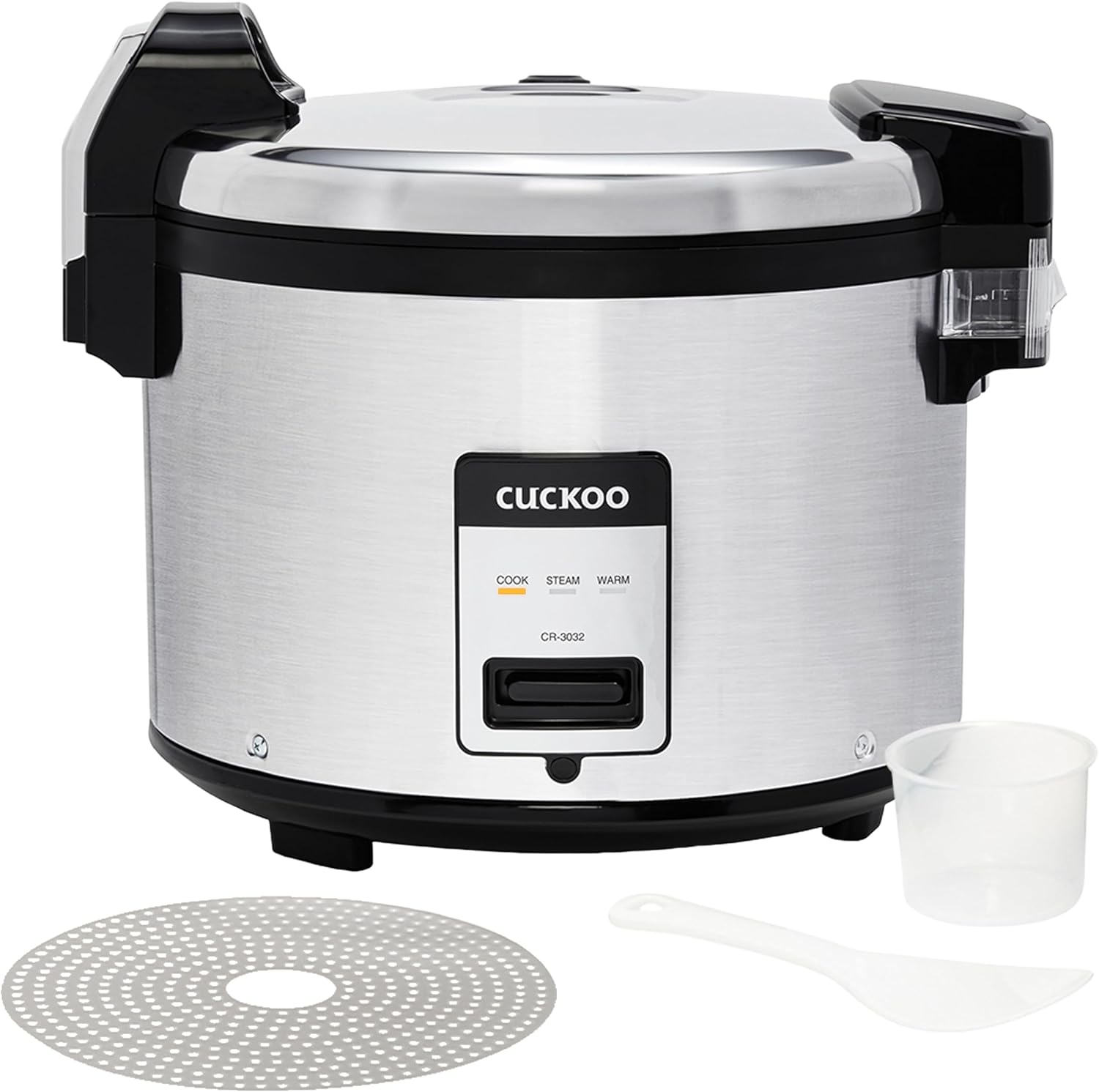
CUCKOO Commercial Rice Cooker and Warmer 60-Cup
Certified Commercial Warmer

CUCKOO Commercial Rice Cooker and Warmer 60-Cup

Best for Certified institutional use

Built for institutional and restaurant applications, this model yields sixty cups of cooked rice from thirty cups of uncooked grain. It carries both cETL and NSF safety and quality certifications. A simple switch press activates the cooking cycle before transitioning automatically to keep-warm mode, supported by an included cooking silicone pad and non-stick inner pot.

What stands out

  • Holds both cETL and NSF certifications, verifying compliance with established commercial safety and quality standards.
  • Simple switch press operation allows staff to transition effortlessly between cooking and automatic keep-warm modes.
  • Includes a cooking silicone pad alongside a durable non-stick inner pot and serving spatula.

What to consider

  • Operating at 890 watts delivers slower thermal recovery compared to higher wattage alternatives during continuous heavy output demands.
  • The specific dimensional footprint requires measuring available staging areas carefully prior to permanent placement in cramped commercial preparation stations.
Key specifications
Capacity
30 cups
Wattage
890 watts
Material
Stainless Steel
Product Care Instructions
Hand Wash
Item Dimensions D x W x H
18"D x 10"W x 18"H
Voltage
120 volts

The practical verdict

Best for facilities requiring official safety certifications and straightforward switch-press operation. Avoid if you need rapid high-wattage thermal recovery for extremely fast high-volume turnarounds. The main trade-off is accepting a lower wattage profile in exchange for certified compliance and included silicone padding accessories.

#4
Aroma Housewares 60-Cup Commercial Rice Cooker Stainless Steel
Heavy-Duty Stainless Cooker

Aroma Housewares 60-Cup Commercial Rice Cooker Stainless Steel

Best for Continuous restaurant service

Part of a dedicated commercial line, this unit prepares sixty cups of cooked rice from thirty cups of uncooked grain. It features a heavy-duty stainless steel lid and durable body designed for continuous restaurant use. Electronic operation, automatic keep-warm functionality, and an easy-to-clean removable non-stick inner pot streamline kitchen workflows.

What stands out

  • Heavy-duty stainless steel lid and durable body construction withstand continuous daily use in commercial kitchens.
  • Simple electronic operation includes an automatic keep-warm feature to hold grains at serving temperature.
  • Removable non-stick inner pot facilitates straightforward hand washing and routine maintenance tasks.

What to consider

  • Restricted strictly to commercial applications, making it unsuitable for casual residential electrical setups or lighter domestic use.
  • Hand wash maintenance requirements demand dedicated manual cleaning time from kitchen staff compared to automated dishwasher-safe alternatives.
Key specifications
Capacity
30 cups
Wattage
500 watts
Material
Stainless Steel
Product Care Instructions
Hand Wash
Item Dimensions D x W x H
15.75"D x 19"W x 13.75"H
Voltage
120 volts

The practical verdict

Best for professional environments needing a rugged stainless steel body built for continuous heavy service. Avoid if your staff relies strictly on dishwasher-compatible cookware for rapid cleanup cycles. The key trade-off is committing to manual hand-washing upkeep in exchange for a heavy-duty commercial body construction.

#5
Oshenic 84 Cups Cooked Commercial Rice Cooker
Programmable Digital Cooker

Oshenic 84 Cups Cooked Commercial Rice Cooker

Best for Multipurpose programmable cooking

Featuring an 84-cup cooked rice capacity and a 15-liter volume, this multifunctional cooker utilizes a digital panel with an LED display. It offers six functional programs, adjustable cooking times from 45 to 120 minutes, and 3D heating with up to 12 hours of keep-warm capability. Boil-dry protection and a cool-touch exterior enhance safety during use.

What stands out

  • Digital panel and LED display provide access to six functional programs and adjustable cooking durations.
  • Three-dimensional heating paired with automatic keep-warm maintains serving temperatures for up to twelve hours.
  • Includes boil-dry protection and a cool-touch exterior design for improved safety around busy kitchen staff.

What to consider

  • Extended cooking duration flexibility up to 120 minutes requires staff training to prevent scheduling errors during peak periods.
  • Multifunctional digital controls introduce more complex menu setting procedures than traditional single-switch commercial rice cookers typically require.
Key specifications
Capacity
15 liters
Wattage
1350 watts
Material
Aluminum, Stainless Steel
Product Care Instructions
Hand Wash
Item Dimensions D x W x H
18.11"D x 18.11"W x 16.33"H
Other Special Features of the Product
Automatic Keep Warm, Boil Dry Protection, Cool-Touch Exterior, Non-Stick, Steam Vent

The practical verdict

Best for operations requiring diverse cooking programs for porridge, stews, and specialized rice varieties. Avoid if your kitchen staff prefers basic single-switch mechanical operation without digital programming interfaces. The primary trade-off involves navigating a digital menu system and longer program cycles in exchange for multi-recipe versatility.

Buying guide

Capacity and Volume Planning

Evaluating grain capacity requires carefully distinguishing between uncooked measurements and final cooked yields. Commercial kitchens must calculate exact portion requirements per seating or event to avoid food shortages or excessive waste. Most professional models specify both metrics clearly on their specification sheets to help buyers plan workflow effectively during busy operational shifts.

Matching the correct batch size to your daily customer volume prevents costly kitchen bottlenecks during rush hours. A unit yielding sixty to ninety cooked cups supports mid-sized restaurants effectively, while larger operations may require multiple concurrent cookers to maintain a steady supply during peak service hours without running dry. Assessing peak output ensures smooth service delivery.

Heating Technologies and Thermal Distribution

Advanced heating technologies directly influence grain texture, moisture retention, and overall cooking consistency across large batches. Three-dimensional heating configurations apply thermal energy from multiple angles around the inner pot structure. This design eliminates hot spots and ensures every grain absorbs moisture uniformly from top to bottom during standard cooking cycles.

Standard bottom-element cookers rely on direct contact heat, which functions adequately for basic white rice preparation. However, complex multi-angle thermal designs prevent scorching and maintain uniform fluffiness, making them valuable investments for establishments serving premium rice varieties consistently throughout the day. Reviewing heating specifications helps maintain strict quality control standards across all menu items.

Power Requirements and Electrical Compatibility

Commercial kitchens operate under strict electrical load constraints that demand careful attention to appliance wattage specifications and plug configurations. Units drawing between 1300 and 1950 watts require dedicated circuits to prevent tripping breakers during peak operational hours. Verifying local voltage and amperage ratings before purchase prevents unexpected installation delays in professional environments.

Matching appliance power demands with existing kitchen infrastructure safeguards staff safety and equipment longevity. Lower wattage alternatives reduce electrical strain but may extend heating and recovery times. Balancing thermal output speed against available facility electrical capacity ensures seamless integration into established commercial prep stations without costly infrastructure upgrades.

Cleaning and Maintenance Protocols

Maintaining sanitary food preparation standards relies heavily on how easily cooking equipment disassembles and cleans. Non-stick inner pots significantly reduce food residue buildup, allowing staff to wipe surfaces quickly with damp cloths or sponges between batches. Choosing dishwasher-safe components further accelerates turnaround times during busy shifts.

Certain heavy-duty stainless steel models mandate strict hand-washing protocols for exterior housing or specific internal parts to preserve protective finishes. Kitchen managers must weigh the time required for manual scrubbing against the convenience of automated washing options when selecting equipment. Establishing clear cleaning routines protects your hardware investment over years of continuous heavy service.

Control Interfaces and Operational Simplicity

Kitchen workflow efficiency depends heavily on how intuitively staff can operate food preparation hardware under pressure. Simple single-switch mechanical models allow cooks to initiate cooking cycles and transition to keep-warm modes instantly without navigating complex menus. This straightforward approach minimizes training time for new kitchen employees during exceptionally busy service shifts.

Conversely, advanced digital control panels with programmable timers and multiple cooking presets offer greater versatility for diverse menu items like porridge, stews, or sushi rice. Assessing whether your staff benefits from programmable customization or prefers foolproof mechanical switches ensures smoother daily execution across all busy food preparation stations.

Build Materials and Structural Durability

Professional food service environments demand rugged construction materials capable of withstanding constant physical contact and elevated operating temperatures in demanding commercial kitchens and restaurants. Stainless steel exterior housings and hinged lids resist corrosion, scratching, and denting better than standard domestic plastics. Investing in robust exterior builds ensures long-term reliability in demanding commercial kitchens.

Inner pot composition also dictates heat transfer efficiency and longevity under heavy daily usage. Aluminum and reinforced non-stick alloys distribute thermal energy evenly while preventing starchy grains from adhering to cooking surfaces. Examining material specifications helps buyers select appliances engineered specifically to endure the intense daily rigors of professional catering operations.

Frequently asked questions

What is the difference between uncooked and cooked rice capacity ratings?

Rice expands significantly in volume as it absorbs water during the cooking process, usually doubling or tripling its original dry size. Manufacturers provide both uncooked dry cup measurements and final cooked yield numbers to help commercial kitchens calculate accurate portion sizes for customers. When planning food quantities for large gatherings or restaurant services, always reference the cooked yield capacity to ensure you prepare enough grain to meet demand without creating excessive food waste that impacts your operational food costs.

How does an automatic keep-warm function operate in commercial rice cookers?

Once the primary cooking cycle completes its programmed duration, the appliance automatically shifts into a lower-wattage warming mode designed to hold grains at safe serving temperatures. This feature eliminates the need for chefs to transfer cooked rice into separate holding cabinets or monitor stovetop burners constantly throughout service hours. It maintains grain moisture, texture, and aroma for extended periods, though operators should consult specific manufacturer guidelines regarding maximum holding durations to preserve optimal food quality standards during continuous shifts.

Are non-stick inner pots difficult to clean in busy restaurant kitchens?

Non-stick inner pots are specifically designed to streamline cleanup by preventing starchy rice grains from adhering stubbornly to cooking surfaces during high-heat operation. Most models allow staff to wipe the interior clean effortlessly using a damp cloth, sponge, or mild detergent after the pot cools down. While many pots support dishwasher sanitization, others require manual hand-washing to protect specialized non-stick coatings and exterior finishes from abrasive detergents or harsh mechanical cleaning cycles over extended periods.

Why do commercial rice cookers require dedicated electrical circuits?

Professional rice cookers draw substantial electrical wattage, frequently ranging from 1300 to nearly 2000 watts depending on batch capacity and heating design. Operating such high-power appliances on shared household circuits can easily overload electrical breakers, causing unexpected power interruptions during critical kitchen service hours. Commercial kitchens must verify voltage, amperage, and circuit capacity specifications prior to installation to ensure safe, continuous operation and prevent equipment downtime during peak meal preparation rushes.

Can commercial rice cookers prepare foods other than standard white rice?

Many advanced commercial rice cookers feature programmable digital panels with multiple cooking modes designed to handle diverse culinary preparations beyond basic white grains. Depending on the specific model, operators can utilize specialized settings to cook brown rice, sushi rice, savory porridges, soups, or stews efficiently. Multifunctional appliances expand kitchen versatility by consolidating multiple cooking tasks into a single countertop footprint, though operators should always follow manufacturer instructions regarding liquid ratios and ingredient types for each specific program.

Final thoughts

Equipping a professional food service operation with the right high-capacity rice cooker transforms daily kitchen efficiency and grain consistency. By carefully evaluating key attributes like batch output, thermal heating technology, electrical power requirements, and robust build materials, buyers can select a model that aligns seamlessly with their specific operational demands.

Whether prioritizing rapid cooking cycles, certified institutional compliance, or multifunctional digital programming, matching equipment specifications to your menu ensures consistent, high-quality results. Careful planning prevents workflow bottlenecks, protects hardware investments, and supports smooth, reliable service during every peak operational shift in busy commercial kitchens.