Appliances · Buying Guide

Best Fruit and Vegetable Dehydrators for Home Kitchens

Preserving seasonal produce at home lets you enjoy healthy fruit chips, savory vegetable crisps, and homemade jerky without relying on store-bought snacks packed with preservatives. A dedicated fruit and vegetable dehydrator removes moisture efficiently while locking in natural flavors and vital nutrients. Whether you are drying thin herb leaves or processing thick fruit slices, these machines apply consistent heat and airflow to ensure even results across every single tray.

Choosing the right dehydrator depends heavily on your available kitchen counter space, the volume of food you plan to process, and your preferred tray layout. Stackable plastic models offer compact footprints for smaller kitchens, while larger stainless steel chamber units provide extensive horizontal drying capacity. Understanding how wattage, temperature ranges, and airflow designs impact your drying routine helps you select a reliable appliance tailored to your daily preserving habits.

As an Amazon Associate, StacyLaughs earns from qualifying purchases.

FOHERE 5-Tray Food Dehydrator with Digital Temperature Control
#1 Best Overall

FOHERE 5-Tray Food Dehydrator with Digital Temperature Control

The FOHERE food dehydrator features a 400-watt heating system and five adjustable BPA-free stackable trays measuring 11.42 inches. It utilizes precise digital controls with an LED display allowing temperature adjustments from 95°F to 158°F and a timer up to 48 hours. Designed for quiet overnight operation, the unit includes non-slip feet and an integrated cord wrap for compact storage when not in active use.

Best for Small batch home snack drying

400W high performancePrecise digital controlBPA-free stackable traysAdjustable tray heightsDishwasher safe parts
View on Amazon →

What stands out

  • Provides adjustable stackable trays that easily change height to accommodate various food thicknesses during processing.
  • Delivers exceptionally quiet operation that remains unobtrusive, making it entirely suitable for overnight drying cycles without disrupting household routines.
  • Features dishwasher-safe trays and lid components alongside an integrated cord wrap for straightforward cleanup and compact storage.

What to consider

  • Stackable tray systems require rearranging individual tiers manually if you need to check lower levels, which can introduce minor workflow friction during large batches.
  • The 400-watt heating capacity paired with a stackable layout means drying times can vary noticeably when processing very dense or heavily loaded food items.
Key specifications
Number of Trays
5
Item Dimensions D x W x H
8.27"D x 11.42"W x 8.66"H
Wattage
400 watts
Material
Polycarbonate (PC), Stainless Steel
Temperature Range
95-158 °F
Material Features
Food Safe

The practical verdict

This dehydrator is best suited for home cooks seeking a compact, adjustable appliance to create small batches of dried fruit, herbs, and jerky. Avoid this model if you require massive horizontal capacity or temperatures exceeding 158°F for specific heavy-duty meat processing. The main trade-off involves balancing a small kitchen footprint with the manual effort required to manage stackable vertical trays during multi-tier drying sessions.

#2
Cosori 6-Tray Stainless Steel Food Dehydrator with 6.5 ft² Space
High Capacity Stainless Dehydrator

Cosori 6-Tray Stainless Steel Food Dehydrator with 6.5 ft² Space

Best for Large batch stainless steel drying

The Cosori dehydrator provides 6.5 square feet of drying space distributed across six stainless steel trays. Driven by a 600-watt motor and a rear-mounted fan with upgraded airflow technology, it ensures even drying without requiring manual tray rotation. Users can set temperatures between 95°F and 165°F using digital controls, while the advanced brushless motor keeps operational noise levels below 48 decibels for peaceful runs.

What stands out

  • Offers a generous 6.5 square feet of drying area across six durable stainless steel trays for large preserving tasks.
  • Combines a 600-watt motor with a rear-mounted fan to circulate warm air evenly without requiring manual tray rotation.
  • Operates quietly using an advanced brushless motor that maintains noise levels below 48 decibels during long drying runs.

What to consider

  • Measuring 17.8 inches deep and 13.4 inches wide, this unit demands substantial counter space, making it less practical for compact or cramped kitchens.
  • The inclusion of fixed stainless steel racks limits vertical flexibility compared to adjustable stackable plastic trays when processing unusually bulky whole foods.
Key specifications
Number of Trays
6
Item Dimensions D x W x H
17.8"D x 13.4"W x 12.4"H
Wattage
600 watts
Material
Stainless Steel
Temperature Range
95-165 F °F
Material Features
Food Safe

The practical verdict

This appliance is best for households that regularly preserve large quantities of produce and require reliable horizontal airflow without manual tray rotation. Avoid it if your kitchen has limited counter space or if you prefer flexible vertical tray adjustments for irregularly shaped items. The primary trade-off is its larger physical footprint, which is necessary to accommodate the expansive six-tray stainless steel drying chamber.

#3
Elite Gourmet 5-Tray Food Dehydrator with Adjustable Temperature Dial
Value Stackable Food Dryer

Elite Gourmet 5-Tray Food Dehydrator with Adjustable Temperature Dial

Best for Budget friendly home snack creation

The Elite Gourmet food dehydrator utilizes a 350-watt heating system paired with a base-mounted fan to circulate warm air across five expandable BPA-free trays. The transparent 11.4-inch trays let you monitor drying progress visually without removing the lid and losing heat. An adjustable temperature dial lets you select ranges from 95°F to 158°F to process fruits, vegetables, and herbs safely at home.

What stands out

  • Features transparent stackable trays that let you monitor food progress visually without removing the lid and losing heat.
  • Employs a base-mounted fan to circulate warm air consistently across all five drying levels for reliable results.
  • Includes removable top-rack dishwasher-safe parts that simplify cleanup after processing sticky fruits or marinated jerky.

What to consider

  • The manual temperature dial lacks precise digital readouts, making it harder to lock in exact degree settings for sensitive herbs or long cures.
  • A 350-watt heating system requires longer processing intervals when tackling thick fruit slices or moisture-heavy vegetable batches compared to higher-wattage units.
Key specifications
Number of Trays
5
Item Dimensions D x W x H
11.4"D x 11.4"W x 8.5"H
Wattage
350 watts
Material
Aluminum
Temperature Range
158 °F
Material Features
Food Safe

The practical verdict

This dehydrator is best for beginners and casual users looking for an affordable, straightforward appliance to make basic dried snacks. Avoid this model if you need precise digital temperature programming or faster drying speeds for heavy workloads. The core trade-off centers on using a simplified temperature dial and lower wattage, which saves money upfront but demands more patience during extensive drying tasks.

#4
Excalibur 8-Tray Select Series Food Dehydrator with Glass Doors
Premium Horizontal Tray Dehydrator

Excalibur 8-Tray Select Series Food Dehydrator with Glass Doors

Best for Professional style multi tray drying

The Excalibur Select Series dehydrator features eight chrome trays and clear glass French doors for effortless monitoring of drying progress. Powered by a 600-watt motor, it uses patented Hyperwave Pulse Technology and horizontal parallax airflow to deliver even drying without manual tray rotation. The intuitive control panel offers an adjustable thermostat ranging from 85°F to 165°F with a timer extending up to 80 hours.

What stands out

  • Utilizes horizontal parallax airflow and pulse technology to dry foods evenly across all eight trays without manual rotation.
  • Provides clear glass French doors that offer an unobstructed view of the interior chamber during active drying cycles.
  • Supports extended drying runs up to 80 hours with an adjustable thermostat ranging from 85°F to 165°F.

What to consider

  • The cabinet measures over 17 inches deep, requiring dedicated counter space and careful placement in kitchens with low overhead cabinetry.
  • Eight chrome trays offer vast capacity, but cleaning multiple wire racks manually can demand more time than smooth plastic dishwasher trays.
Key specifications
Number of Trays
8
Item Dimensions D x W x H
17.32"D x 13.39"W x 14.08"H
Wattage
600 watts
Material
Glass, Stainless Steel
Material Features
Food Safe
Voltage
120

The practical verdict

This dehydrator is best for dedicated enthusiasts and gardeners who process large harvests and demand precise horizontal airflow control. Avoid it if you have limited storage space or prefer dishwasher-safe plastic trays. The primary trade-off involves committing to a larger cabinet footprint and cleaning wire chrome racks in exchange for expansive, rotation-free drying capability.

#5
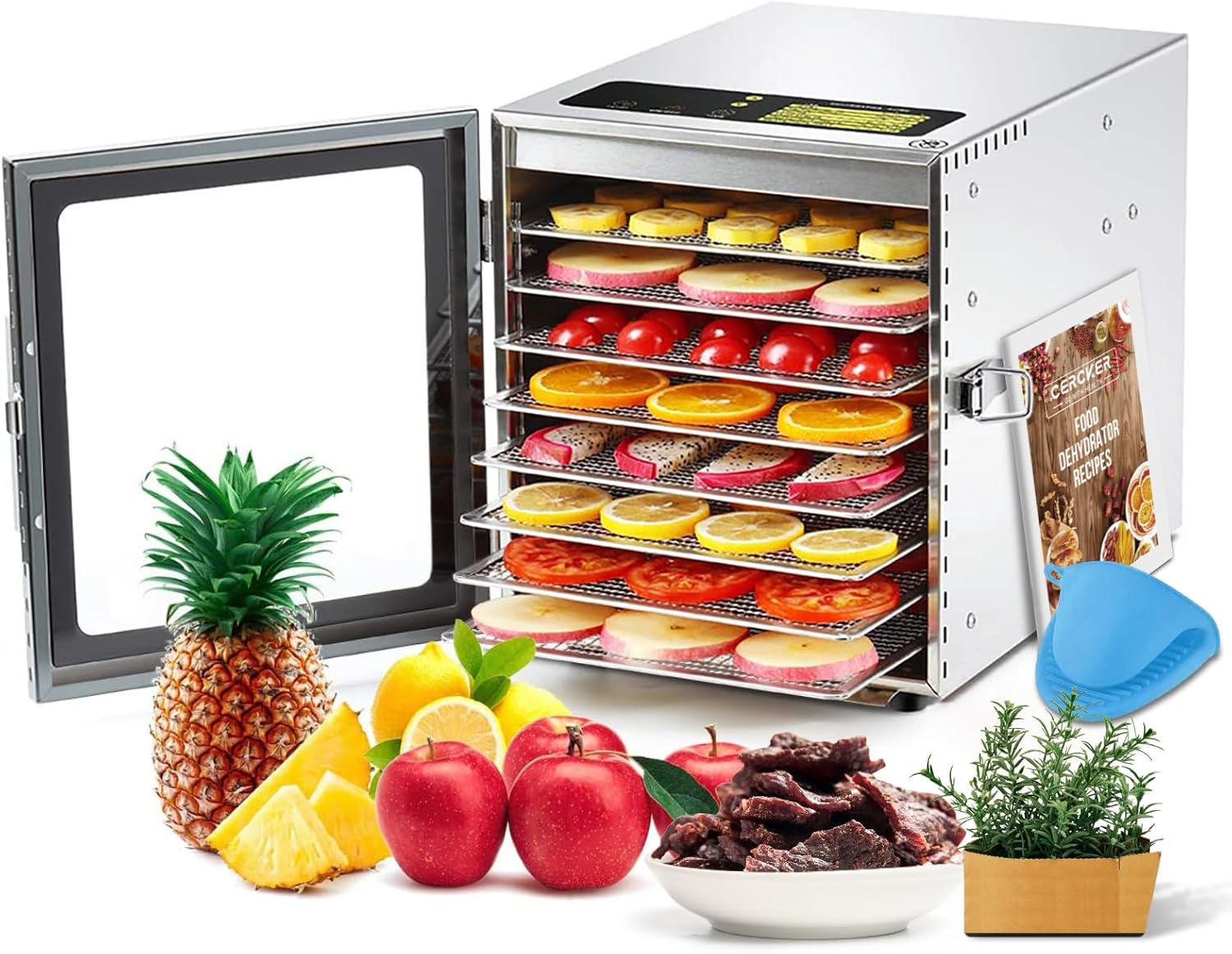
Cercker 8-Tray Stainless Steel Food Dehydrator Machine
High Heat Meat Dehydrator

Cercker 8-Tray Stainless Steel Food Dehydrator Machine

Best for High heat jerky processing

This 500-watt food dehydrator features eight double-layer 316-grade stainless steel trays with rolled edges for superior rust-proof performance. It stands out with a high-heat capability reaching 190°F, driven by a 1600 RPM motor producing strong airflow for efficient drying without tray rotation. The water-resistant control panel includes spill-resistant buttons and precise temperature adjustments spanning from 70°F to 190°F to accommodate diverse culinary projects.

What stands out

  • Delivers a high maximum temperature of 190°F, making it exceptionally well-suited for processing meat jerky and biltong.
  • Equipped with eight double-layer 316-grade stainless steel trays featuring rolled edges for enhanced corrosion resistance and durability.
  • Features a water-resistant control panel with spill-resistant buttons and an efficient motor designed for quiet operation under 45 decibels.

What to consider

  • Operating at higher temperatures for extended jerky sessions demands careful attention to food safety guidelines and meat preparation practices.
  • The 500-watt motor limits continuous maximum-timer runs to protect internal components, requiring adherence to recommended operational time windows.
Key specifications
Number of Trays
8
Item Dimensions D x W x H
10.6"D x 12.8"W x 15.2"H
Wattage
500 watts
Material
Stainless Steel
Temperature Range
70℉-190℉ °F
Material Features
Food Safe

The practical verdict

This machine is best for meat lovers and culinary hobbyists who require high temperature capabilities and durable 316 stainless steel trays. Avoid this unit if you only plan to dry delicate herbs at low temperatures or need a minimal countertop footprint. The main trade-off is managing a heavier-duty appliance designed specifically for high-heat meat dehydration rather than casual fruit snack prep.

Buying guide

Airflow Design and Heat Distribution

Selecting a fruit and vegetable dehydrator requires evaluating how air circulates inside the drying chamber. Models with rear-mounted fans or horizontal parallax airflow distribute heat evenly across every shelf. This design eliminates the need to manually rotate trays during long drying cycles.

Conversely, vertical airflow systems use a base-mounted fan that pushes air upward through stackable trays. While these units require occasional manual shuffling for uniform results, they often feature a smaller footprint. Understanding your drying style helps determine which airflow mechanism suits your workflow.

Tray Material and Construction Quality

The materials used for drying trays directly impact long-term durability and food safety standards across multiple food types. Heavy-duty stainless steel racks resist corrosion, withstand heavy loads of dense meat or sticky fruits, and prevent structural warping under high heat conditions. They offer exceptional reliability for frequent preserving tasks throughout intense harvest seasons without degrading or retaining stubborn odors.

Alternatively, BPA-free polycarbonate or plastic trays provide lightweight handling, transparent visibility, and flexible height adjustments for various food sizes. While plastics may show surface wear over time, they simplify loading bulky items and storing components compactly in tight spaces. Assess your ingredient choices to decide whether metal durability or plastic versatility best fits your daily kitchen workflow.

Temperature Range and Precision Controls

Temperature flexibility is essential for properly dehydrating different types of food without spoiling natural nutrients or cooking them prematurely during long drying cycles. Lower temperature ranges starting around 70°F to 95°F work best for delicate herbs, leafy greens, yogurt, and tender flower blossoms. Maintaining these gentle settings preserves volatile essential oils and vibrant colors effectively across batches.

Higher temperatures reaching up to 165°F or 190°F are necessary for safely processing meat jerky, thick vegetables, and dense pet treats. Digital control panels with exact degree increments allow you to dial in precise environments, whereas manual dials offer simpler adjustments for casual users who prioritize straightforward operation over exact numerical targeting during meal prep.

Capacity and Kitchen Footprint Balance

Balancing food capacity with available kitchen counter space prevents appliance overcrowding and daily storage frustration in busy kitchens. Large horizontal cabinet dehydrators provide extensive square footage, accommodating massive batches of produce simultaneously for gardeners, homesteaders, and large families who preserve seasonal harvests throughout the year without running multiple consecutive cycles.

However, these wide units demand substantial permanent counter space and careful vertical clearance from low overhead cabinets. Stackable vertical dehydrators offer a smaller footprint that fits easily on standard countertops, though they restrict total processing volume per run. Measure your available kitchen storage areas carefully before purchasing to ensure a practical long-term fit for your home.

Noise Levels and Operational Environment

Because dehydration cycles often run for many hours or overnight, operating noise is an important practical consideration for overall household comfort. Advanced brushless motors and optimized internal fan blades keep noise levels below 48 decibels, ensuring the machine remains unobtrusive in living spaces during long drying sessions that span deep into the night hours.

Louder units can cause noticeable disruptions if placed near open-concept living areas or sleeping bedrooms during extended drying runs. Reviewing motor specifications helps you identify models specifically designed for quiet background performance, letting you run overnight batches peacefully without disturbing household members or resting pets nearby in adjacent rooms throughout the entire evening.

Maintenance and Cleaning Convenience

Cleaning sticky fruit residues, thick marinades, and dried crumbs after a drying session is an essential routine task that heavily influences overall user satisfaction. Many modern dehydrators feature dishwasher-safe plastic trays and removable bottom drip trays that simplify the cleanup process significantly after preparing sweet fruit snacks or savory meats at home.

Stainless steel or chrome wire racks require careful manual washing to prevent food build-up in tight mesh joints and corners. Checking whether removable internal components are dishwasher safe or require hand scrubbing ensures you select an appliance that comfortably matches your preferred daily maintenance routine without creating burdensome household chores.

Frequently asked questions

Do I need to rotate trays during the dehydration process?

Whether you need to rotate trays depends entirely on the internal airflow design of your dehydrator. Units equipped with rear-mounted fans or horizontal parallax airflow systems circulate warm air evenly across all levels, eliminating the need for manual tray rotation. Conversely, vertical airflow models that use a base-mounted fan often require you to manually shuffle or rotate stackable trays periodically to ensure uniform drying results. Checking the airflow mechanism before purchasing helps you choose between a hands-free drying experience and one that requires occasional monitoring during long sessions.

What is the difference between plastic and stainless steel trays?

Tray materials affect both durability and everyday maintenance. Stainless steel trays offer superior corrosion resistance, handle heavy loads of dense meats or juicy fruits without warping, and provide long-lasting reliability for frequent users. However, they can be heavier and may require careful cleaning in tight wire mesh joints. On the other hand, BPA-free plastic or polycarbonate trays are lightweight, often dishwasher safe, and frequently feature adjustable heights to accommodate bulky items, though they may show surface wear over time. Your choice depends on whether you prioritize metal longevity or plastic versatility.

Can I dehydrate meats and vegetables at the same time?

Dehydrating meats and vegetables simultaneously is generally not recommended due to differing moisture contents, required temperature settings, and food safety guidelines. Meats like beef jerky require higher temperatures, such as 158°F to 190°F, to eliminate bacteria effectively, whereas delicate fruits and vegetables often require much lower temperatures to preserve nutrients and prevent scorching. Mixing items can lead to uneven drying times and potential cross-contamination risks. It is best to process separate food categories in dedicated, single-batch runs to ensure proper texture, flavor preservation, and safety standards.

How do I choose the right temperature for different foods?

Selecting the correct temperature depends on the specific ingredients you plan to process in your dehydrator. Delicate items like herbs, leafy greens, and yogurt require lower temperature settings between 70°F and 95°F to preserve volatile oils and natural vitamins without cooking them. Fruits and vegetables typically dry best at moderate temperatures ranging from 125°F to 135°F. For meat jerky, higher temperatures between 158°F and 190°F are necessary to ensure safe dehydration. Utilizing digital controls or consulting user manuals helps you dial in accurate settings for every unique batch of homemade snacks.

How much counter space do I need for a food dehydrator?

Counter space requirements vary significantly based on the dehydrator's design and capacity. Vertical stackable models generally have a smaller footprint, making them ideal for compact kitchens and easy storage in cabinets when not in use. In contrast, horizontal cabinet-style dehydrators feature wider footprints and deeper chambers to accommodate extensive chrome or stainless steel trays, demanding permanent countertop space and adequate vertical clearance from low overhead cabinetry. Measuring your available kitchen space beforehand ensures the appliance fits comfortably without crowding your prep areas.

Final thoughts

Investing in a fruit and vegetable dehydrator transforms your kitchen into a home preserving station, allowing you to create wholesome snacks while reducing food waste. By evaluating crucial factors like airflow design, tray materials, and temperature ranges, you can find an appliance that matches your preserving goals.

Whether you prefer a compact stackable plastic unit for occasional fruit chips or a spacious stainless steel cabinet for large harvests, selecting the right model ensures reliable, delicious results. Take time to measure your counter space and review cleaning needs before making your final choice.