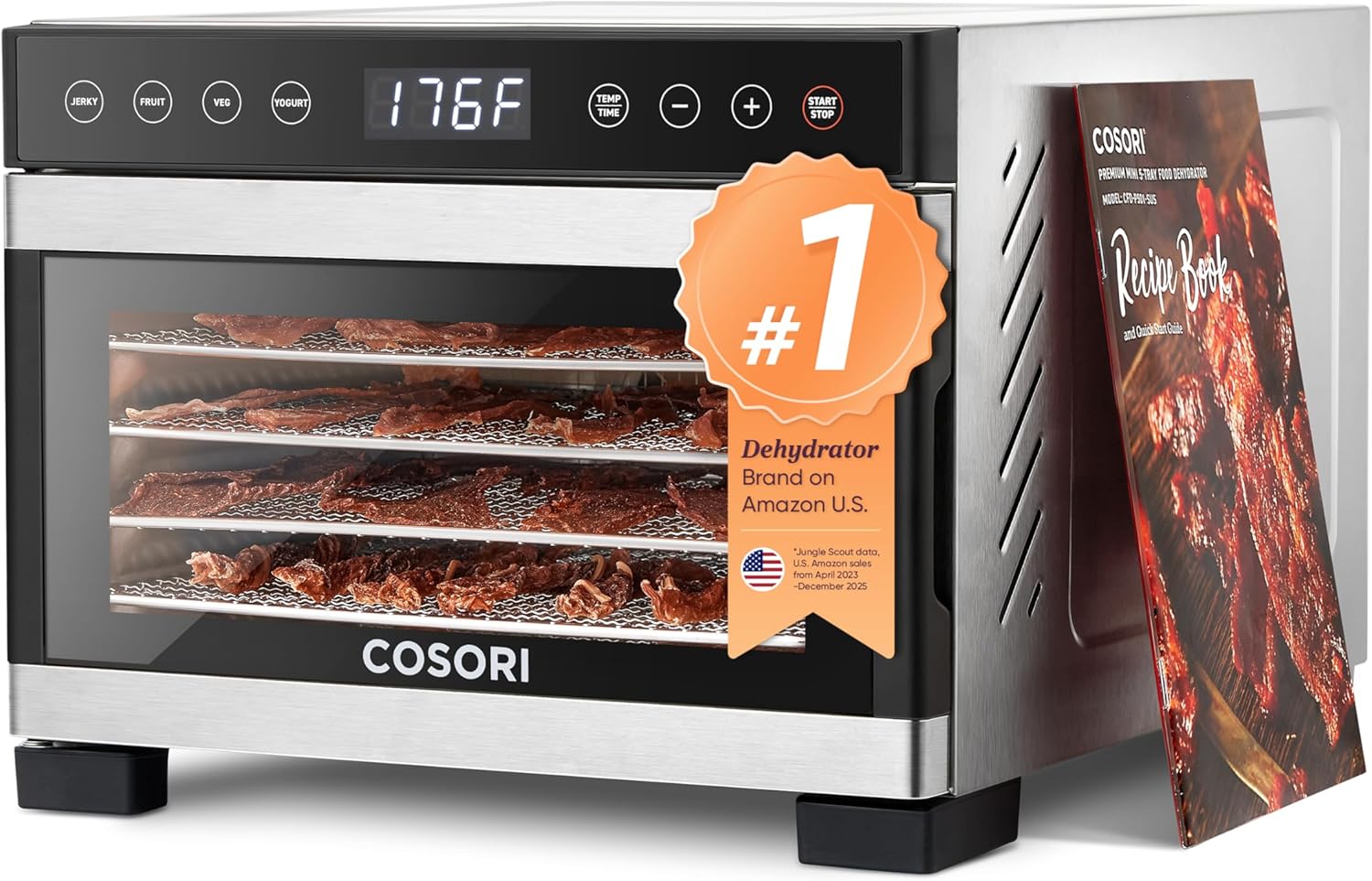
Appliances · Buying Guide
Best Stainless Steel Food Dehydrators for Home Kitchens
Making dried snacks, savory beef jerky, and preserved fruits at home becomes much simpler when you choose a reliable stainless steel food dehydrator. These dedicated kitchen appliances utilize internal heating elements and circulating fans to systematically remove moisture from various fresh ingredients while preserving their original flavors and nutrients for everyday snacking.
Selecting the right machine depends closely on your available counter space, batch sizes, and temperature preferences. Whether you need a compact five-tray unit for occasional herb drying or a larger multi-tray appliance for heavy garden harvests, reviewing the core technical specifications helps match a dehydrator directly to your specific household routine without any unnecessary guesswork.
As an Amazon Associate, StacyLaughs earns from qualifying purchases.
Buying guide
Evaluating Tray Capacity and Surface Area
Choosing the right stainless steel food dehydrator starts with evaluating your typical batch sizes and available tray surface area. Models range from compact five-tray variants offering around three square feet of space up to large twelve-tray appliances. If you only prepare small weekend snack batches, a smaller tier count saves room. Homesteaders processing large harvests benefit from expanded multi-tier setups.
Reviewing how food is laid out across the trays also matters for your routine. Stainless steel trays provide durable surfaces for ingredients. Consider how many items you intend to dry at once. Matching capacity to your actual household needs prevents buying an oversized machine that crowds your kitchen or an undersized unit.
Understanding Airflow and Drying Fan Placement
Airflow design is a critical factor determining how evenly your food dehydrates over many hours. Many modern stainless steel dehydrators utilize rear-mounted fans or horizontal airflow systems. This mechanical layout forces hot air to pass uniformly across every shelf from back to front. Consequently, you rarely need to stop the machine to manually rotate individual trays during long drying cycles.
Uniform air circulation prevents moisture pockets from forming on dense food items like thick meat strips or juicy fruit slices. When evaluating different dehydrator options, check whether the ventilation system supports consistent drying across all levels. Selecting a unit with advanced airflow technology ensures that every single tray achieves balanced texture and flavor without constant user intervention.
Temperature Ranges and Precision Control
Temperature flexibility allows you to process a wide variety of ingredients ranging from delicate herbs to thick beef jerky. Most quality dehydrators feature adjustable digital thermostats ranging from ninety-five degrees up to one hundred ninety degrees Fahrenheit. Precise one-degree or five-degree increments let you dial in exact settings required by specific recipes, ensuring proper moisture removal for different food types.
Higher temperature capabilities are particularly vital when preparing homemade meat jerky where food safety standards recommend reaching specific thermal levels. Review the temperature boundaries of each appliance to ensure it accommodates your favorite recipes. Pairing accurate digital controls with reliable heating elements gives you consistent results across multiple hours of continuous operation.
Motor Power and Operating Noise Levels
Motor wattage directly influences how efficiently a food dehydrator generates and distributes heat across multiple trays. Higher wattage units ranging from six hundred to eight hundred watts handle heavy loads quickly. However, motor power often correlates with operational sound levels. Advanced brushless motors successfully maintain strong airflow performance while keeping noise output below fifty decibels for quiet kitchens.
Considering where you plan to run the appliance helps determine your noise tolerance. Dehydrators running overnight in open-plan homes benefit greatly from quiet motor designs that will not disturb household activities. Balancing motor wattage against decibel ratings ensures your dehydrator delivers powerful drying performance without creating an intrusive humming sound on your kitchen countertop.
Countertop Dimensions and Storage Footprint
Physical dimensions dictate how well a food dehydrator fits within your kitchen layout and storage spaces. Compact models easily rest on standard countertops beneath overhead cabinets, while larger multi-tier commercial style units demand substantial horizontal and vertical clearance. Measure your available counter space carefully before purchasing to make sure the unit footprint aligns with your kitchen setup.
Weight is another practical consideration if you plan to store the appliance in a pantry and retrieve it only for seasonal harvests. Lighter units are easier to move around, whereas heavier multi-tray appliances are best left in a permanent location. Matching physical size and weight to your storage habits prevents daily inconvenience.
Included Accessories and Cleaning Maintenance
Included accessories expand what you can create beyond standard sliced fruits and vegetables. Many stainless steel dehydrators come equipped with mesh screens for small herbs, solid fruit roll sheets for purees, and dedicated drip trays. These additions make handling sticky ingredients or fine particles much simpler. Checking accessory packages ensures you have the right tools right out of the box.
Maintenance ease is equally important for long-term satisfaction after every drying session. Dishwasher-safe stainless steel trays simplify cleanup significantly compared to manual scrubbing. Reviewing removable parts and interior accessibility helps you spend less time washing components and more time enjoying your homemade snacks, maintaining a smooth preservation routine in your home kitchen.
Frequently asked questions
Do I need to rotate trays during the drying process?
Many advanced stainless steel food dehydrators feature rear-mounted fans and horizontal airflow technology designed to distribute heat evenly across every shelf simultaneously. Because of this engineered airflow circulation, most modern units eliminate the need to manually rotate or rearrange trays during long drying cycles. However, checking specific manufacturer instructions for your chosen model is always recommended. If you are drying particularly thick food items or exceptionally overloaded batches, a periodic check can help ensure uniform results from top to bottom.
What temperature should I use for making beef jerky?
Preparing safe homemade beef jerky typically requires higher temperatures to ensure proper moisture removal and food safety. Many USDA food safety guidelines recommend heating meat to around one hundred sixty-five degrees Fahrenheit during the preparation process. Most quality stainless steel dehydrators feature adjustable thermostats that easily reach these required thermal levels, often allowing adjustments up to one hundred seventy-six degrees or higher. Always verify that your specific dehydrator model supports the precise temperature settings recommended for your preferred meat recipes.
Are stainless steel trays dishwasher safe?
A vast majority of stainless steel trays included with modern food dehydrators are engineered to be completely dishwasher safe, simplifying cleanup after long drying sessions. Placing removable trays into a dishwasher removes sticky residues and food particles without requiring intensive manual scrubbing. However, reviewing the specific user manual provided with your machine is important to confirm material care guidelines. Some auxiliary components, such as specialized mesh sheets or fruit roll inserts, may require gentle hand washing to preserve their texture.
How much counter space do I need for a food dehydrator?
The counter space required depends heavily on the tray capacity and overall physical dimensions of the specific dehydrator model you select. Compact five-tray units typically feature smaller footprints around fourteen inches deep, making them easy to accommodate on standard kitchen countertops. Larger multi-tier appliances with eight or twelve trays possess wider and taller profiles that demand dedicated permanent space or large pantry storage. Measuring your available kitchen area before purchasing ensures the appliance fits comfortably.
Can I dry herbs and fruit leather in these dehydrators?
Yes, you can easily dry herbs, fruit leather, vegetables, and meats using most multi-tray stainless steel food dehydrators. Many appliances come fully equipped with specialized accessories such as fine mesh screens designed specifically to prevent small herbs from falling through tray gaps. Additionally, included fruit roll sheets provide smooth, non-stick surfaces for pouring and dehydrating fruit purees. Utilizing these dedicated accessories expands your ability to prepare a wide variety of homemade snacks and pantry staples.