Appliances · Buying Guide

Best Top Rated Food Dehydrator Options for Homemade Snacks

Making your own dried fruits, vegetables, jerky, and herbs at home is straightforward when you use a reliable appliance. A dedicated food dehydrator removes moisture gently and evenly, preserving flavors and textures without commercial additives. Whether you are processing a garden harvest or preparing trail snacks, modern units offer digital controls, consistent airflow, and spacious trays to handle various ingredients.

Selecting the right machine depends on your available counter space, batch size preferences, and the specific foods you plan to dry. Models range from compact five-tray footprints to larger ten-tray configurations equipped with efficient rear-mounted fans. Reviewing the physical dimensions, tray counts, and wattage ratings helps you find a practical setup that integrates smoothly into your kitchen routine.

As an Amazon Associate, StacyLaughs earns from qualifying purchases.

Cosori Food Dehydrator with 6 Stainless Steel Trays and 600W Power
#1 Best Overall

Cosori Food Dehydrator with 6 Stainless Steel Trays and 600W Power

This Cosori dehydrator provides 6.5 square feet of drying space across six stainless steel trays, powered by a 600-watt motor. A rear-mounted fan and upgraded airflow technology circulate heat evenly without requiring manual tray rotation. The digital control panel lets you set temperatures from 95°F to 165°F and program timers up to 48 hours. Operating below 48 decibels, it runs quietly during long drying cycles.

Best for Medium batch home dehydration

6 stainless steel trays600W drying powerQuiet under 48 dBPrecise temperature control48 hour timer
View on Amazon →

What stands out

  • 600W motor with rear fan delivers even airflow across all levels
  • Quiet operation under 48 decibels minimizes household disruption during use
  • Precise digital timer and temperature controls simplify long drying cycles

What to consider

  • Measuring 17.8 inches deep, this unit demands significant countertop depth, which may crowd smaller prep areas.
  • The 165°F maximum temperature sits lower than alternative options reaching 176°F for specialized jerky.
Key specifications
Number of Trays
6
Item Dimensions D x W x H
17.8"D x 13.4"W x 12.4"H
Wattage
600 watts
Material
Stainless Steel
Temperature Range
95-165 F °F
Material Features
Food Safe

The practical verdict

Best for home cooks processing moderate quantities of fruits, herbs, and jerky who value quiet overnight operation. Avoid if your kitchen has limited counter depth or if you require maximum temperatures above 165°F for specific jerky guidelines. The balanced six-tray capacity and rear fan ensure even results without manual rotation.

#2
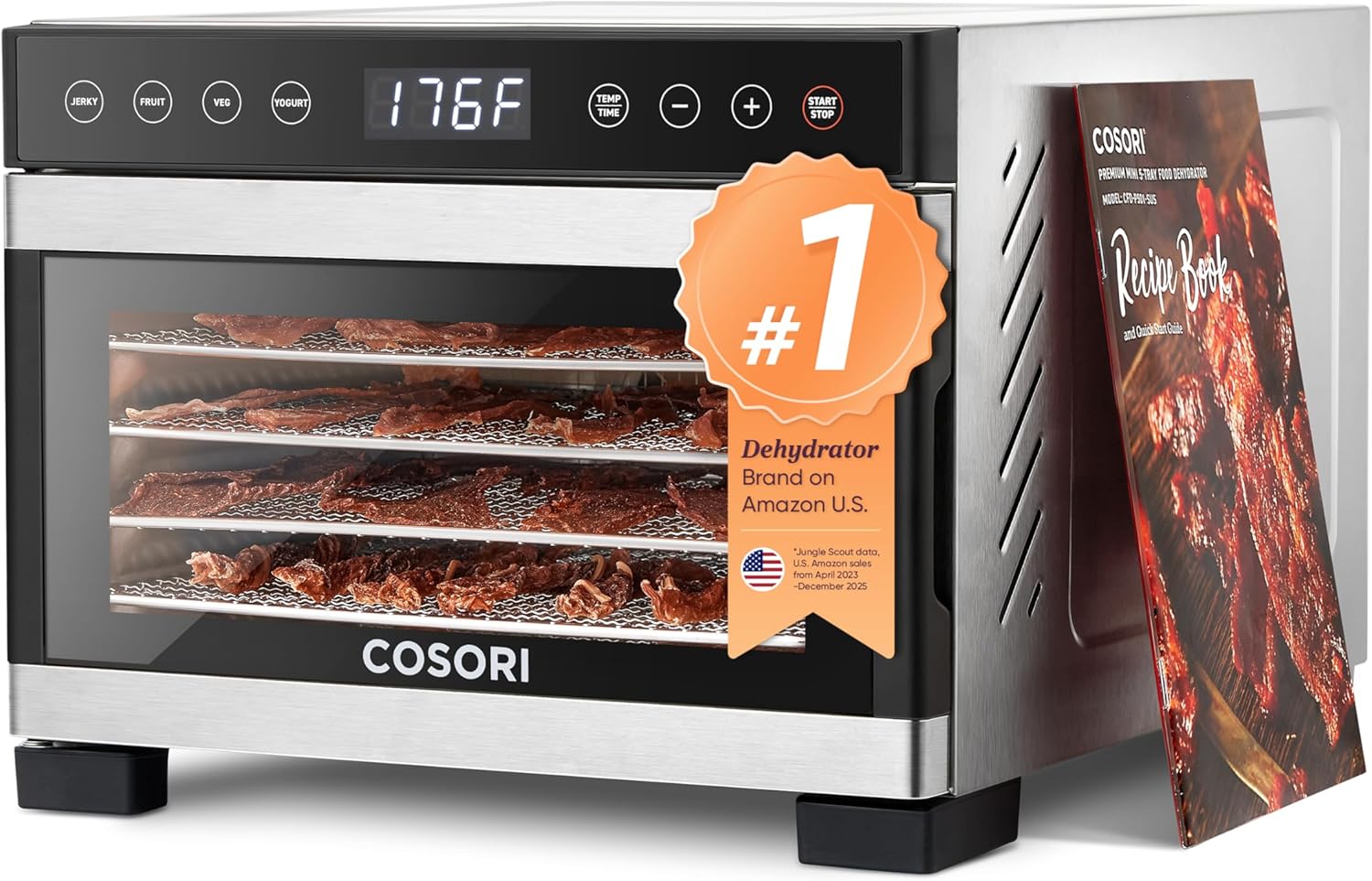
Cosori Food Dehydrator with 5 Stainless Steel Trays and Compact Design
Compact Countertop Design

Cosori Food Dehydrator with 5 Stainless Steel Trays and Compact Design

Best for Small kitchen countertop use

Designed for smaller kitchens, this Cosori unit features five stainless steel trays offering 3.1 square feet of drying space within a compact 13.9 by 11.3-inch footprint. It reaches a maximum temperature of 176°F, accommodating higher heat needs for safe jerky preparation. Four convenient presets for jerky, fruit, vegetables, and yogurt simplify operation, supported by a rear fan that promotes balanced airflow across all tiers.

What stands out

  • Reaches 176°F maximum temperature for specialized high-heat drying tasks
  • Compact footprint fits easily on standard kitchen counters without crowding
  • Four built-in presets simplify common drying tasks for everyday snacks

What to consider

  • The 3.1 square feet of drying space limits batch sizes compared to larger units, restricting large volume harvesting tasks.
  • Five trays provide less vertical flexibility when processing bulky food items simultaneously.
Key specifications
Number of Trays
5
Item Dimensions D x W x H
13.9"D x 11.3"W x 8.9"H
Wattage
480 watts
Material
Stainless Steel
Temperature Range
95-176 F °F
Material Features
Food Safe

The practical verdict

Best for individuals with limited kitchen space who want quick access to higher temperatures up to 176°F for jerky. Avoid if you frequently process large garden harvests or bulk batches that require extensive tray capacity. Its compact size and convenient presets make everyday snack preparation straightforward without dominating your kitchen workspace.

#3
Cosori Food Dehydrator with 10 Stainless Steel Trays and Precision Control
High-Capacity Family Drying

Cosori Food Dehydrator with 10 Stainless Steel Trays and Precision Control

Best for Large family batch processing

Offering an expansive 7.4 square feet of drying area across ten stainless steel trays, this high-capacity Cosori dehydrator handles up to 5.5 pounds of sliced beef at once. Horizontal airflow technology maintains consistent results without tray rotation. A top window and built-in light provide easy visibility into the drying chamber, while ten one-touch presets and a 46-recipe cookbook guide your snack-making process from start to finish.

What stands out

  • Generous ten-tray layout accommodates up to 5.5 pounds of food per batch
  • Transparent top window with interior light enables easy visual monitoring
  • Horizontal airflow technology eliminates the need for manual tray rotation

What to consider

  • The 14.8-inch depth and ten-tier height create a bulkier appliance profile that requires dedicated storage space.
  • Exterior surfaces can become warm during extended heating cycles in continuous operation.
Key specifications
Number of Trays
10
Item Dimensions D x W x H
14.8"D x 12.3"W x 13"H
Wattage
640 watts
Material
Stainless Steel
Temperature Range
95°F-167 °F
Material Features
Food Safe

The practical verdict

Best for large households, gardeners, and outdoor enthusiasts who need to process substantial quantities of food simultaneously. Avoid if you have minimal storage space or only require occasional snack preparation. The extensive ten-tray capacity, built-in viewing light, and horizontal airflow make large-batch drying efficient and straightforward.

#4
PSIIDAN Food Dehydrator with 8 Stainless Steel Trays and 650W
Fast Multi-Tray Processing

PSIIDAN Food Dehydrator with 8 Stainless Steel Trays and 650W

Best for Versatile multi-tray snack making

Powered by a 650-watt motor, this dehydrator uses an integrated circulation fan and upgraded exhaust system to generate forced hot air convection for uniform drying across eight full-size stainless steel trays. The unit features a transparent door window and interior light for progress checks, adjustable heat from 95°F to 167°F, and a timer reaching 48 hours. Dual-layer insulation and built-in overheat protection support safe everyday household use.

What stands out

  • Powerful 650W motor drives fast and uniform air circulation
  • Dual-layer insulation construction enhances heat retention during operation
  • Transparent door window allows clear visual progress checks without opening

What to consider

  • An eight-tier structure with a 13-inch depth requires adequate vertical and horizontal counter clearance during operation.
  • The fixed full-size tray layout lacks adjustable spacing heights for exceptionally bulky ingredients.
Key specifications
Number of Trays
8
Item Dimensions D x W x H
13"D x 13.2"W x 11.8"H
Wattage
650 watts
Material
Stainless Steel
Material Features
Dishwasher-safe Stainless Steel Trays
Color
Gray + Silver

The practical verdict

Best for home cooks seeking a robust 650-watt drying unit with dual-layer insulation for regular batch processing. Avoid if you prefer a low-profile appliance or require variable shelf spacing for exceptionally bulky ingredients. The combination of uniform air convection, an interior light, and precise digital controls delivers dependable results for diverse foods.

#5
Excalibur Select Series 8-Tray Stainless Steel Food Dehydrator
Classic Tray and Glass Design

Excalibur Select Series 8-Tray Stainless Steel Food Dehydrator

Best for Traditional horizontal airflow drying

Featuring eight chrome trays and clear glass French doors, this Excalibur dehydrator utilizes patented Hyperwave Pulse Technology and horizontal parallex air flow for even drying without tray rotation. The intuitive control panel provides an adjustable thermostat ranging from 85°F to 165°F with an extended 80-hour timer. Its design balances a compact footprint with substantial drying capacity, making it suitable for fruits, vegetables, jerky, and pet treats.

What stands out

  • Clear glass French doors offer straightforward visibility into the drying chamber
  • Horizontal parallex airflow promotes even drying without manual tray rotation
  • Extended timer supports precision drying tasks up to 80 hours

What to consider

  • The chrome tray material requires careful cleaning compared to solid stainless steel alternatives.
  • Measuring over 17 inches deep, the unit requires adequate counter space for safe placement.
Key specifications
Number of Trays
8
Item Dimensions D x W x H
17.32"D x 13.39"W x 14.08"H
Wattage
600 watts
Material
Glass, Stainless Steel
Material Features
Food Safe
Voltage
120

The practical verdict

Best for users who prefer glass French doors and specialized horizontal airflow technology for traditional batch drying. Avoid if you need temperatures exceeding 165°F or prefer dishwasher-safe stainless steel mesh surfaces. The extended 80-hour timer and clear viewing doors provide exceptional control for long dehydrating cycles across diverse recipes.

Buying guide

Evaluating Drying Capacity and Tray Count

Choosing the right tray count directly influences how much food you can process in a single operating cycle. Smaller models featuring five trays work well for occasional snack creation, while units with eight or ten trays accommodate larger harvests and bulk meat preparation. Consider your typical batch size and available counter space before deciding on a specific tier configuration.

Larger configurations provide ample square footage, allowing you to dry diverse ingredients simultaneously without mixing flavors. However, expanded tray counts often increase the physical footprint of the machine. Balancing your storage limitations with your daily processing goals ensures you select a dehydrator that matches your kitchen workflow efficiently.

Understanding Airflow Technology and Fan Placement

Airflow design plays a crucial role in how evenly your food dehydrates across multiple levels. Models featuring rear-mounted fans and horizontal airflow systems distribute heat uniformly across every tray, eliminating the need to manually rotate shelves during long cycles. This design prevents moisture pockets and ensures consistent textures throughout the batch.

Traditional vertical airflow units may require occasional tray swapping to achieve even results, depending on the ingredients used. Examining how a machine circulates air helps you determine how much hands-on attention the drying process requires. Prioritizing advanced airflow technology saves time and delivers more reliable outcomes for delicate fruits and dense meats.

Temperature Ranges and Heat Precision

Different food types require specific thermal thresholds to dry correctly and safely. Dehydrators offering adjustable temperature controls from 95 degrees Fahrenheit up to 175 degrees Fahrenheit or higher give you the flexibility needed for everything from delicate herbs to raw meat jerky. Precise increments allow you to dial in exact requirements for various recipes.

USDA guidelines recommend specific temperatures for preparing safe meat snacks, making a higher maximum heat setting an important factor for jerky enthusiasts. Conversely, lower settings protect the natural enzymes and vitamins in fruits and vegetables. Matching the appliance temperature range to your culinary goals ensures versatile performance year-round.

Motor Power and Energy Efficiency

The wattage rating of a dehydrator indicates the power behind its heating element and internal fan. Units ranging from 480 watts to 650 watts provide robust heating capabilities, speeding up moisture removal for dense ingredients and large batches. Higher wattage often translates to faster overall processing times.

While powerful motors enhance drying efficiency, they also require adequate electrical circuit capacity during extended operation. Evaluating the power draw helps you understand how the appliance fits into your household routine. Selecting an energy-efficient model with a reliable motor ensures consistent performance without unexpected utility concerns.

Noise Levels and Operational Sound

Because dehydrating cycles often run for many hours or overnight, operating noise is an important practical consideration. Advanced brushless motors and optimized fan designs keep noise levels below 48 decibels in certain models, ensuring minimal disruption in residential living spaces. Quiet performance lets you run the appliance overnight without disturbing household routines.

Standard cooling and exhaust fans can produce a steady hum throughout the drying cycle. If your kitchen opens into living areas, prioritizing a quiet motor specification significantly improves your daily user experience. Checking decibel ratings helps you select a machine that operates smoothly in the background.

Material Selection and Cleanup Convenience

The materials used in construction affect both durability and maintenance effort. Stainless steel trays and housing offer long-lasting resilience and food-safe performance, while removable components simplify the post-drying cleanup process. Dishwasher-safe parts reduce the effort required after processing sticky fruits or marinated meats.

Chrome or mesh inserts provide specialized surfaces for delicate herbs and fruit rolls, preventing small items from falling through tray grates. Reviewing the included accessories and material specifications ensures you choose a machine that is easy to maintain. Durable construction protects your investment over years of frequent snack preparation.

Frequently asked questions

Do I need to rotate trays during the dehydrating process?

Whether you need to rotate trays depends entirely on the airflow design of the specific dehydrator model you choose. Units equipped with rear-mounted fans and horizontal airflow technology circulate heat evenly across all levels, eliminating the need for manual tray rotation. Conversely, traditional vertical airflow systems may require you to swap tray positions periodically to ensure uniform moisture removal. Checking the manufacturer specifications for airflow type helps you determine how much hands-on attention your drying batches will require during operation.

What temperature should I use for making beef jerky?

Making safe and delicious beef jerky requires proper thermal processing to eliminate potential bacteria. The United States Department of Agriculture recommends heating meat to 165 degrees Fahrenheit during the preparation process. Many modern dehydrators feature adjustable temperature controls reaching up to 167 or 176 degrees Fahrenheit, allowing you to meet these safety guidelines easily. Always verify that your chosen model reaches the necessary heat threshold if your primary goal is preparing homemade meat snacks and pet treats safely.

How long do food dehydrator cycles typically take?

Dehydrating times vary widely based on the moisture content, thickness, and type of food you are processing. Delicate herbs and thin fruit slices may dry in just a few hours, while dense vegetables, thick meat strips, or large fruit batches can require anywhere from twelve to forty-eight hours. Machines equipped with digital timers up to 48 or 80 hours let you program the exact duration needed. Monitoring your ingredients during the final stages ensures you achieve your preferred texture and dryness level.

Are stainless steel trays better than plastic or chrome trays?

Stainless steel trays are widely favored for their durability, corrosion resistance, and food-safe qualities. They withstand high temperatures and frequent cleaning without degrading. Chrome trays offer a sturdy alternative, though they require careful maintenance to prevent moisture-related wear. Plastic components are lightweight and often BPA-free, but stainless steel remains a popular choice for long-term reliability and effortless cleanup in the dishwasher. Reviewing the included tray material helps you select an appliance that aligns with your kitchen preferences and maintenance habits.

Can I run my food dehydrator overnight?

Running a food dehydrator overnight is common practice because many drying cycles take several hours to complete. Models featuring quiet brushless motors operating below 48 decibels minimize noise disruption while you sleep. Additionally, units equipped with automatic shutoff timers provide peace of mind by turning off the heating element once the programmed cycle finishes. Ensuring the appliance is placed on a well-ventilated, heat-resistant surface away from flammable materials helps maintain safe operation during unattended overnight runs.

Final thoughts

Selecting the best food dehydrator involves balancing your available countertop space, desired batch capacity, and specific snack-making goals. Whether you choose a compact five-tier model for occasional use or an expansive ten-tier unit for high-volume preserving, modern appliances offer precise digital controls and efficient airflow technologies to simplify the process.

By carefully evaluating heating ranges, motor power, and tray materials, you can find a reliable dehydrator that integrates seamlessly into your kitchen routine. Investing in the right appliance ensures consistent, flavorful results for homemade jerky, dried fruits, and healthy snacks year-round.